






 Portuguese
  Spanish


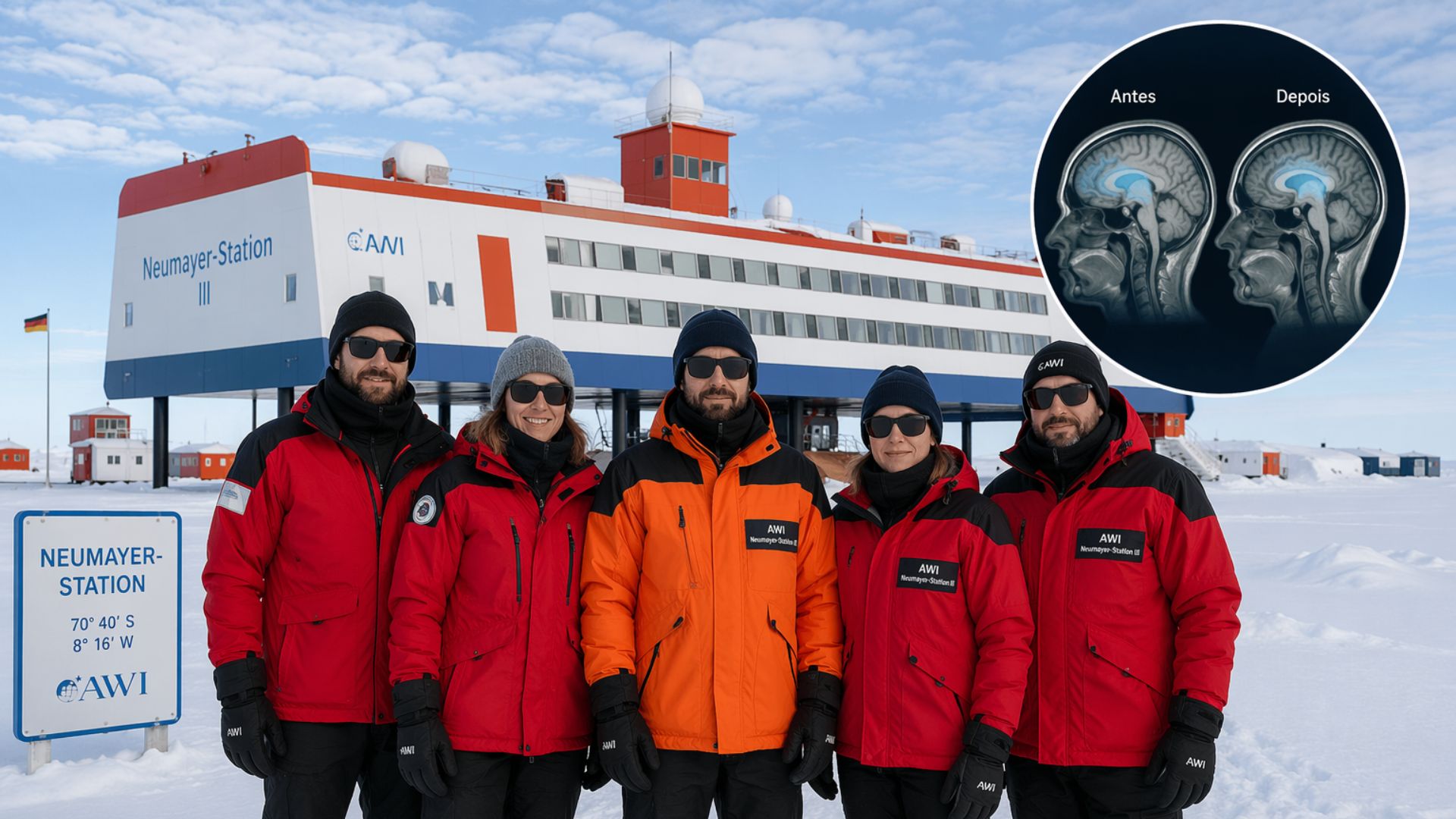


Stay in Antarctica reveals measurable impacts on the human brain and researchers’ attention after prolonged mission in hostile environment, with effects detected by imaging, blood tests, and cognitive tests.
A 14-month expedition to the German station Neumayer III in Antarctica was associated with measurable changes in the brain and cognitive performance of researchers subjected to prolonged stay, extreme cold, and months of darkness.
The follow-up, conducted by scientists from Charité and the Max Planck Institute for Human Development and published in The New England Journal of Medicine, identified a reduction in the dentate gyrus, a subregion of the hippocampus linked to memory and spatial orientation, as well as effects on spatial skills and selective attention.
Nine men and four women who stayed 14 months at the base participated in the study, of which nine had no contact with the outside world.
-
China Develops Custom 140-Ton Electric Mining Truck with 770 kWh Swappable Battery, Deploys 290 Units in Xinjiang’s Largest Zinc Mine

-
Meta to Launch Arena, a New Prediction App Targeting 3.56 Billion Users, Competing with Polymarket and Kalshi

-
Scientist Challenges Famous Human Evolution Theory, Argues Homo Sapiens Evolved Gradually Over Thousands of Years
-
15-Year-Old American Builds Ocean Generator with PVC Pipe and 3D-Printed Propeller for $12, Wins National Prize, Presents at White House, and Makes Forbes 30 Under 30 List




Before, during, and after the mission, the team underwent computerized cognitive tests, blood tests, and MRIs, while a group of nine people outside the expedition underwent the same evaluations for comparison.
The routine at Neumayer III helps explain why Antarctica has become a natural laboratory for this type of investigation.
According to the researchers, the environment features temperatures that can reach -50 °C, almost complete absence of light in winter, little privacy, and minimal contact with the outside, in addition to a decisive operational limitation: during the harshest months, there is no real margin to shorten the stay or to conduct quick evacuations.
Impact on the human brain

The main focus of the imaging tests was the hippocampus, a brain structure involved in memory formation and spatial processing.
Using high-resolution methodology, the scientists examined subregions of this area and observed, at the end of the mission, that the dentate gyrus was smaller in the expedition members compared to the control group, a finding that reinforced the hypothesis that extreme and unstimulating environments can produce physical effects on the brain.
What caught attention was the convergence between different measures.
The researchers did not rely solely on brain images but also monitored BDNF levels, a protein associated with the growth, maintenance, and plasticity of neurons and synapses.
According to the results, this substance had already decreased after three months in Antarctica and remained below the level recorded before the trip even a month and a half after returning, in line with the changes observed in the MRIs.
Cognitive changes and performance decline
The effects also appeared in cognitive tasks that simulate important demands for life in a hostile and restricted environment.
The tests showed changes in spatial skills, used to organize routes and references in space, and in selective attention, a necessary ability to filter distractions and concentrate mental resources on what matters.
Under normal conditions, the repetition of this type of test usually elevates performance over time, but this gain was smaller among participants who showed a reduction in the dentate gyrus.
This result is relevant because the dentate gyrus is not a peripheral region of brain function.
It is a subarea of the hippocampus with an important role in memory formation and spatial thinking, two functions particularly demanded in contexts of confinement, environmental monotony, and the need for continuous adaptation.
Thus, the anatomical alteration ceased to be just a detail of neuroimaging and began to correlate with concrete changes observed in cognitive performance.

Another decisive point of the work was the design of the follow-up.
Instead of comparing only the before and after of the expedition, the scientists monitored the volunteers at different moments of the mission, which allowed for observing the progression of changes throughout their stay on the continent.
This format strengthened the association between the extreme environment and the findings recorded in blood, brain, and attention and spatial processing tasks.
Antarctica as a laboratory for human adaptation
Antarctica offers a rare combination of factors that rarely appears so concentrated in other scenarios.
The rigid confinement, the almost unchanging landscape, the scarcity of external social contacts, and the prolonged darkness create a useful context for studying human adaptation under extreme conditions.
For this reason, this type of mission tends to interest not only polar medicine but also research on prolonged stays and operations in extreme environments.
In disclosing the results, the authors emphasized the need for caution in interpretation due to the small number of participants.
Nevertheless, they stated that the data provide an important indication that extreme environmental conditions can affect the human brain, especially in regions associated with the generation and maintenance of new neural connections.
The team itself pointed out at the time the intention to investigate whether physical activity could act as a protective strategy against these changes.
However, the sample size does not diminish the significance of the finding.
Studies in environments like Antarctica often face severe logistical limitations, making it rare to follow volunteers with repeated exams, biological collections, and cognitive tests over more than a year.


In this context, the research gained prominence precisely for bringing together different indicators around the same direction: that prolonged stays, combined with hostile environmental conditions, can leave objective marks on the body.
There is also a practical aspect that helps to contextualize these results.
The participants were not untrained individuals, but researchers on a structured mission, with training and technical support, inserted into a planned routine to operate in one of the most difficult environments on the planet.
Even so, the study found signs of impact on brain structure, biological markers, and cognitive functions related to spatial orientation and attention control.
This data places the discussion on a more objective ground.
Instead of limiting the effects of the Antarctic experience to poor sleep, emotional wear, or discomfort from confinement, the work showed that part of the body’s response can be measured with imaging tools, laboratory tests, and standardized assessments.
The more direct interpretation, with the caution required by a small sample, is that the brain reacts in a detectable way when daily life combines monotony, isolation, and environmental stress for many consecutive months.





