Portuguese
  Spanish


The federal government is betting on a new phase for Brazilian logistics, with auctions, strategic corridors, and long-term financing to expand the use of railways in freight transport and alleviate bottlenecks on important routes in the country.
Brazil is preparing one of the largest recent bets on railways to try to change an old distortion in national logistics. A continental country, a major producer of grains, minerals, and food, still heavily relies on trucks to transport cargo over long distances.
Now, the federal government is structuring a portfolio of R$ 160 billion in investments to expand railway transport and increase the share of railways in the transport matrix from 17.7% to 34.6% by 2035, according to data released by the Secretariat of Social Communication of the Presidency of the Republic and the Ministry of Transport.
The goal is noteworthy because it is not just about building tracks. It targets bottlenecks that affect freight, ports, highways, exports, and the competitiveness of producing regions.
-
Retired Railway Workers in Brazil Preserve Locomotive for 52 Years, Now See It Donated by the Government

-
Railway returns to prominence in Brazil after STF approval: a R$ 25.2 billion project promises to save R$ 9 billion in freight, transport 50 million tons per year, and transform Sinop into a logistics powerhouse for agribusiness.
-
Retired trains leave European tracks and become tons of steel, aluminum, and copper in dismantling yards where recycling exceeds 90%, but batteries, composites, and electronics create a new frontier of railway waste.

-
The strategic railway of Santa Catarina will receive R$ 608 million, will undergo historic modernization, and could transform logistics between Mafra and the Port of São Francisco do Sul.


A country too large to rely so much on highways
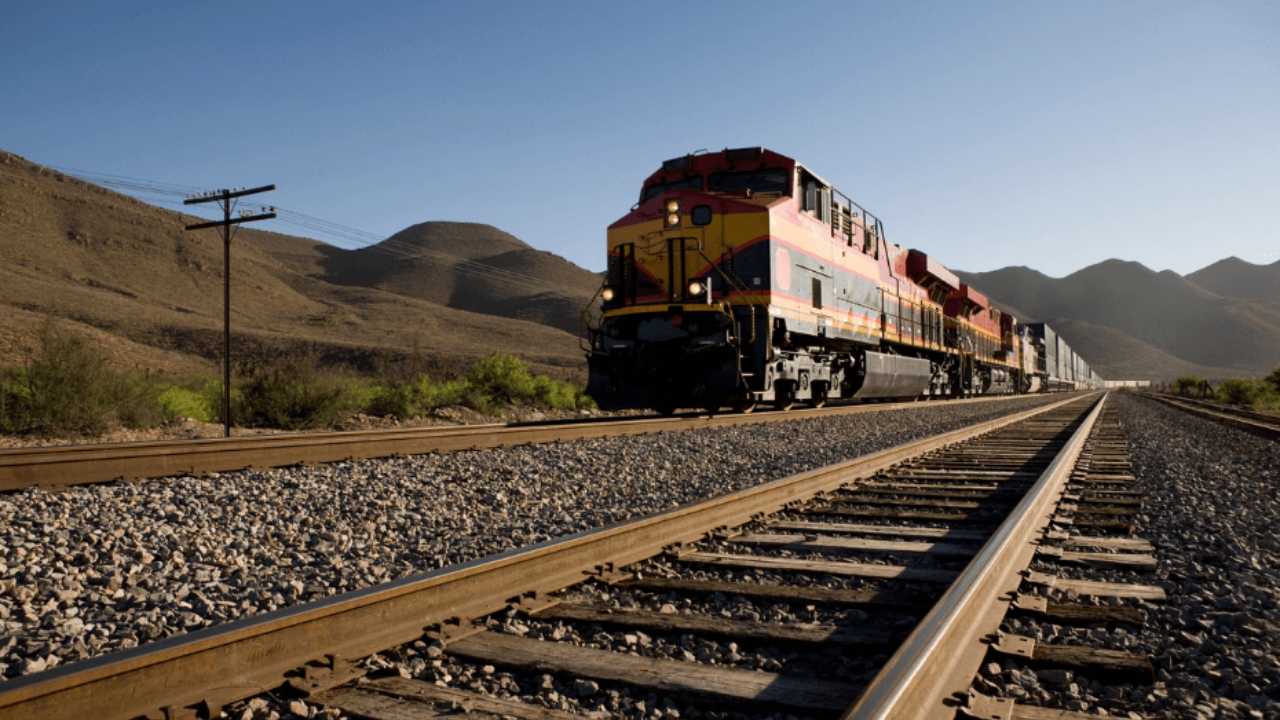
The strength of the agenda lies in the contrast. Brazil has about 30,000 km of railways, according to the Ministry of Transport, but less than 10,000 km are in operation.
This data helps explain why the debate has returned with weight. In a country of continental dimensions, transporting heavy cargo by truck on long routes increases costs, pressures highways, and creates bottlenecks in corridors that connect the productive interior to the ports.
The Minister of Transport, George Santoro, used the example of Mato Grosso to advocate for the change. The logic presented by the government is that the cost of transporting cargo from the Midwest to Santos should not weigh more than the international stretch between Santos and Shanghai.
The comparison sums up the problem. Brazilian production grows far from the ports, but much of the infrastructure still forces high-volume cargo to travel great distances on tires.
Plan foresees eight auctions and more than 9,000 km of tracks
According to the Ministry of Transport, the new railway portfolio includes eight auctions, more than 9,000 km of tracks, and a financing model with a term of up to 40 years by BNDES.
The agenda is part of the National Railway Grant Policy, presented as an attempt to organize concessions, public and private investments, sustainability, and logistical integration.
The government also mentions mechanisms to cover the so-called viability gap, used in projects considered important but that cannot be sustained solely with the expected private revenue.
In practice, the proposal attempts to make railway corridors viable that are of interest to the country, even when the initial economic calculation does not stand alone for the investor.
Ferrogrão, FICO, FIOL, and new corridors enter the map
Among the projects mentioned by ANTT, Ferrogrão appears as one of the strongest names. The corridor between Sinop, in Mato Grosso, and Miritituba or Itaituba, in Pará, has 933 km, a concession planned for 69 years, and an estimated CAPEX of R$ 25.2 billion.
Another strategic axis is the East-West Corridor, formed by FICO and FIOL. ANTT reports 1,708 km, CAPEX of R$ 28.5 billion, and long-term demand close to 40 million tons.
The portfolio also includes EF-118, called the Southeast Railway Ring, with 575 km and CAPEX of R$ 4.2 billion. The proposal is to improve connections between Espírito Santo and Rio de Janeiro, as well as to expand railway access to ports.
In the West Network, the plan involves 1,973 km and CAPEX of R$ 18.95 billion, connecting São Paulo and Mato Grosso do Sul. Meanwhile, the South Network comprises 4,250 km in corridors that pass through Paraná, Santa Catarina, and Rio Grande do Sul.
Ongoing works show that the plan has already started
Although much of the portfolio still depends on concessions, modeling, and schedules, some projects already appear as showcases of expansion.
FICO has 364 km under construction in Goiás, according to the Ministry of Transport. The work is carried out by Vale as a cross-investment linked to the early renewal of the Vitória a Minas Railway.
In Mato Grosso, the extension of the Northern Network foresees 160 km in the first phase, a terminal in Dom Aquino, and a composition of 130 wagons to transport grains from the Midwest to the Port of Santos. The project is by Rumo, within the New PAC, with more than R$ 5 billion in private investment.
The Transnordestina was also included in the official discourse. According to Secom, the project connects the Port of Pecém in Ceará, the Port of Suape in Pernambuco, and the cerrado of Piauí. The government cited a record of 1,700 meters of tracks in one day and a goal to install more than 200 km of tracks by 2026.
Cargo on tracks is growing, but the challenge is still enormous
The railway sector is already showing progress in volume. The CNT reported that Brazilian railways transported 554.48 million useful tons in 2025, the highest volume in the recent series.
Even so, the leap intended by the government requires more than isolated projects. It is necessary to connect railways to ports, terminals, productive areas, waterways, and highways, preventing the tracks from ending far from where the cargo really needs to reach.
The ANTF, an entity in the freight railway sector, states that rail transport can emit 85% less CO₂, be 10 times safer, and up to 30% cheaper than road transport. These data reinforce the sector’s argument but need to be viewed within each route and type of cargo.


The delicate point is in the timing and execution
The amount of R$ 160 billion does not mean that all the money is already applied to projects. The more accurate reading is that the government is structuring a portfolio with this investment potential.
Part of the projects depends on auctions, technical analysis, licensing, financial modeling, and evaluation by control bodies. Therefore, the real impact will be measured less by the announcement and more by the ability to bring corridors to fruition.
Even so, the ambition reveals an important change in the Brazilian logistics debate. The country is not just discussing new railways. It is trying to correct a historical dependency that increases transport costs, overloads roads, and limits the competitiveness of those producing far from the coast.
If the portfolio advances, the railway leap could go far beyond the tracks. It could reshape how Brazil exports its production, competes in external markets, and organizes its own economic territory in the coming decades.