






 Portuguese
  Spanish


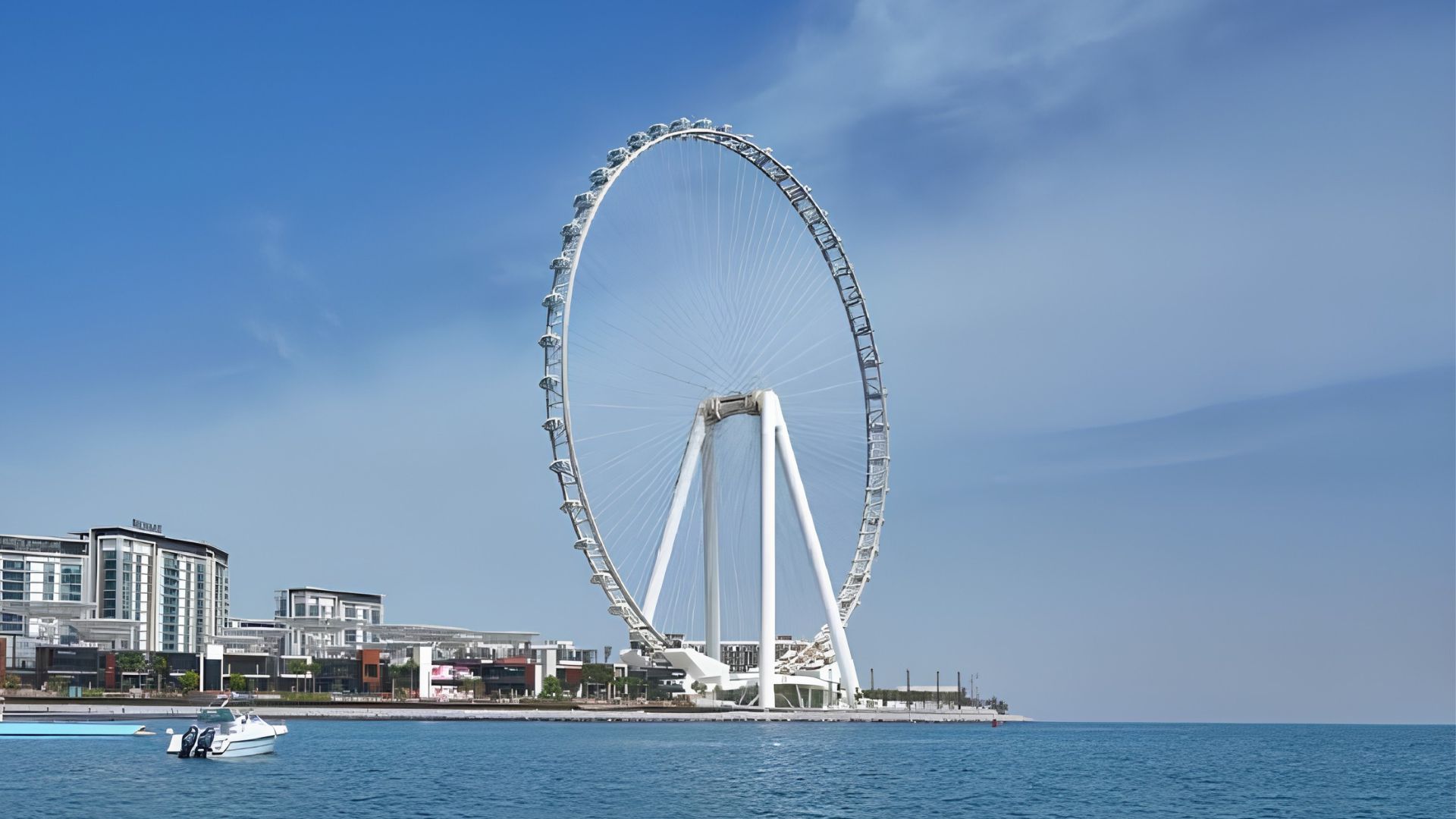

Ain Dubai gathers 250 meters in height, 11,200 tons of steel, and 48 cabins in the world’s largest observation wheel.
With 250 meters in height, Ain Dubai has transformed the scale of modern Ferris wheels and has come to occupy a level closer to the engineering of large structures than conventional entertainment. Installed on Bluewaters Island in Dubai, the attraction is described by its developers as the largest and tallest observation wheel in the world.
What makes the project so extraordinary is not just the height. The structure combines 48 cabins, capacity for 1,750 people, large-scale operation, and a metallic mass worthy of industrial works, bringing together numbers that helped transform Ain Dubai into one of the most ambitious projects ever executed in the urban leisure sector.
Ain Dubai is 250 meters high and nearly doubles the scale of the London Eye
The engineering company Mace, which was involved in the project management, states that Ain Dubai reaches 250 meters in height and is almost twice the size of the London Eye. This proportion helps explain why the structure quickly became a new visual landmark of Dubai.
-
Northern Lights May Be Visible in 19 U.S. States Tonight as Solar Ejection Approaches Earth, Potentially Triggering Geomagnetic Storm

-
Energy-Efficient Upgrade: Brazilian Utility Offers Discounts to Replace Old Fridges and Bulbs with New Models in Paraná Homes
-
World’s Fastest Tractor, the JCB Fastrac Two, Hits Nearly 247.5 km/h with Over 1,000 Horsepower

-
At 86, mountaineer Carlos Soria becomes the oldest person ever to summit an 8,000-meter peak, reaching the top of Manaslu in Nepal.



Mace itself defines the work as the construction of the largest observation wheel on the planet. The official website of the attraction reinforces the same positioning and presents the project as an experience elevated to 250 meters in the sky, with a panoramic view over the city.
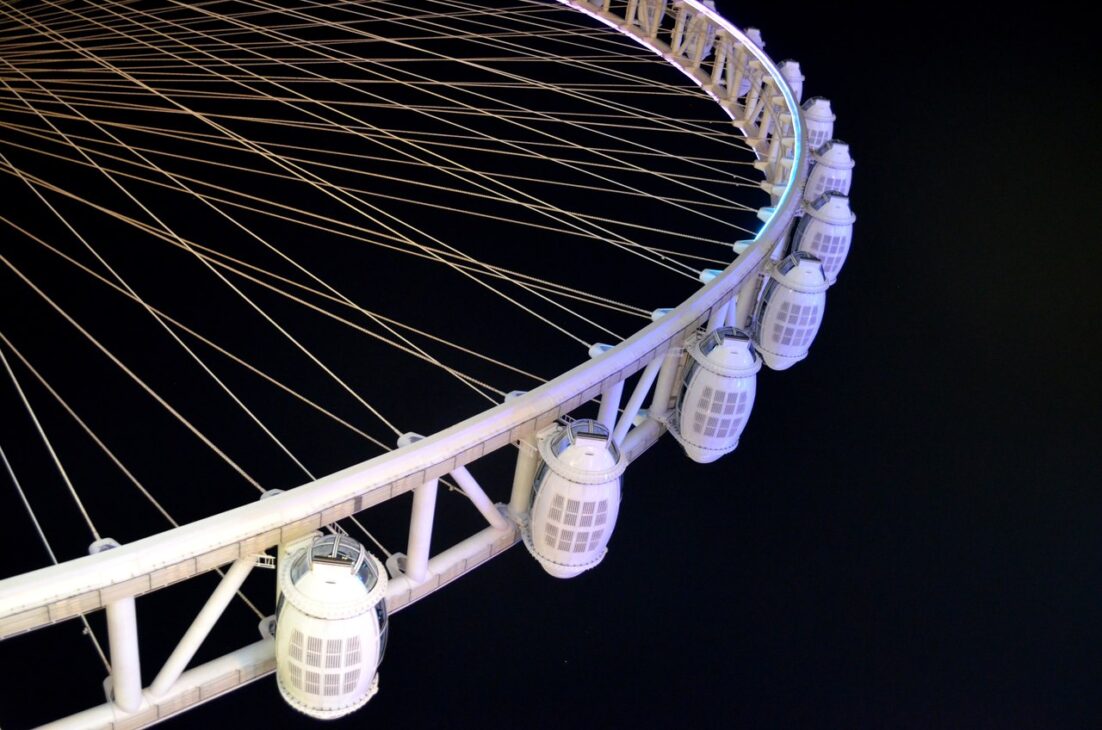
More than just expanding an existing record, Ain Dubai redefined the concept of this type of attraction. The project was designed to combine tourism, panoramic view, events, and entertainment in an urban equipment of monumental scale.
Ain Dubai’s structure used 11,200 tons of steel and surpassed the Eiffel Tower
The scale of the work becomes even more evident when observing the amount of material used. Mace states that Ain Dubai consumed 11,200 tons of steel, a volume about 33% greater than the material used in the Eiffel Tower in Paris.

At the center of the wheel, the assembly formed by the hub and main axle weighs 1,805 tons. According to the same source, this monumental piece is equivalent to the approximate weight of four Airbus A380 aircraft, a fact that helps to gauge the real size of the structure.
To position this assembly, the construction used two of the largest cranes in the world, lifting the piece to about 130 meters high. This type of operation is precisely what makes Ain Dubai more akin to a heavy infrastructure project than a traditional amusement ride.
Ain Dubai cabins carry 1,750 people and complete a rotation in 38 minutes
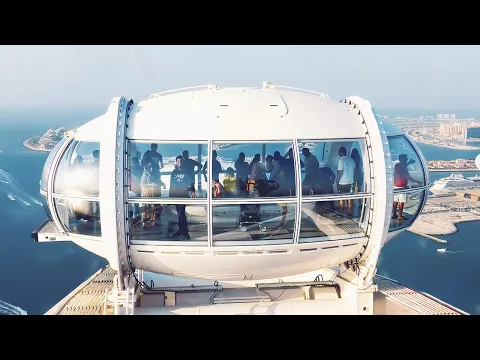
On the official website, Ain Dubai states that the wheel has 48 high-tech cabins with a total capacity for 1,750 people. Mace adds that each cabin is larger than two double-decker buses side by side, emphasizing the unusual size of the assembly.
According to Dubai Holding, a full rotation takes about 38 minutes. This time was designed to turn the ride into a prolonged panoramic experience, rather than a quick spin typical of an amusement park.
The proposal also goes beyond simple observation. Dubai Holding stated at the launch that the attraction was divided into different experience categories, including observation cabins, social cabins, and private cabins, expanding the role of the wheel as a premium event and leisure space.
Engineering of Ain Dubai required colossal operation and millions of work hours
Mace reports that the execution of Ain Dubai totaled more than 14 million work hours, considering activities inside and outside the site. Of this total, there were more than nine million hours on-site and about five million off-site, a clear portrait of the technical complexity of the project.

The same source highlights that the project’s strategy incorporated specialists with previous experience in large engineering works, including professionals who have worked on projects like the London Eye and The Shard. This background was used to tackle planning, assembly, and safety challenges in an unconventional project.
Beyond the physical scale, Ain Dubai required coordination of structural, logistical, and operational disciplines at a level rare for the entertainment sector. This combination explains why the project is often treated as an engineering showcase, not just a tourist attraction.
The inauguration of Ain Dubai in 2021 consolidated Dubai in the race for tourist megaprojects
Dubai Holding officially announced on August 24, 2021, that Ain Dubai would open to the public on October 21, 2021. In the launch communication, the company positioned the wheel as a strategic piece to reinforce Dubai’s image as a global hub for tourism and entertainment.
The same announcement highlighted that the attraction was designed to offer climate-controlled internal views and panoramas of the sea and city, with daytime and nighttime experiences. The proposal was not just to erect a record-breaking Ferris wheel but to create a high-impact urban and international tourist asset.
This helps to understand why Ain Dubai fits into a larger trend in the Emirates: transforming leisure attractions into national-scale symbols, capable of attracting visitors both for the experience and the grandeur of the work.
Ain Dubai shows when entertainment reaches the scale of heavy infrastructure
For decades, the world’s largest machines were primarily associated with mining, shipbuilding, energy, or space exploration.
Ain Dubai shows that entertainment has also entered this race for extreme dimensions and has begun to employ structural solutions typically seen in bridges, megatowers, and industrial platforms.
In Dubai’s case, this is clearly reflected in the numbers: 250 meters in height, 11,200 tons of steel, 1,805 tons in the central axis, 48 cabins, 1,750 passengers, and a 38-minute rotation in a piece of equipment designed to dominate the urban landscape and become a destination in itself.
In the end, Ain Dubai is more than just a gigantic Ferris wheel. It represents the transformation of leisure into a megaproject, a technological showcase, and an urban monument, uniting tourism, architecture, and engineering in a single record-breaking structure.


