






 Portuguese
  Spanish




A New Solar-Powered Desalination Technology Can Turn Seawater Into Drinking Water With Five Times Higher Efficiency Than Current Methods. Discover This Revolutionary Innovation
The scarcity of drinking water is one of the largest global crises currently faced. It is estimated that 2.2 billion people lack adequate access to this essential resource, according to the UN World Water Development Report 2024. Population growth and increasing freshwater consumption have severely pressured coastal and island nations, where desalination of seawater is a vital necessity. However, traditional methods of desalination are expensive, energy-intensive, and require frequent maintenance.
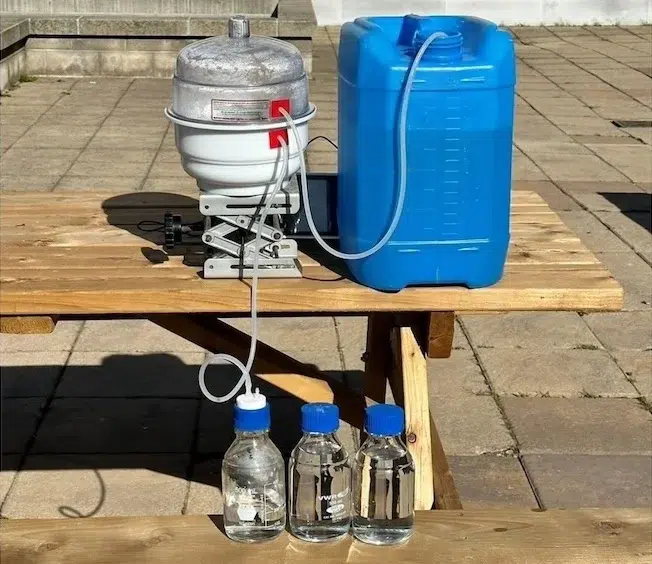
Researchers at the University of Waterloo in Canada have developed an innovative and efficient solution: a solar-powered desalination device capable of producing 20 liters of drinking water per day with 93% energy efficiency.
This advancement could transform the desalination landscape, offering an ecological and economical alternative to meet the growing demand for drinking water.
-
Brazilian Engineer Who Grew Up Without Electricity Develops Software, Expands AltoQi to 67,000 Clients, Aiming for $21 Million by Digitizing Brazil’s Construction Industry

-
Spain Launches World’s Largest Floating Dry Dock: 56-Meter Giant Produces Massive Concrete Structures in A Coruña Using Technology Proven in Brazil

-
AI-powered toys that talk, recognize faces, and collect data face scrutiny from Brazilian government over children’s privacy concerns

-
4,000-Year-Old Child’s Skull Unveils Ancient Burial in 7,500-Year-Old Norwegian Rock Shelter, Impressing Archaeologists






Nature As Inspiration
The key differentiator of this device is that it mimics the natural water cycle, which evaporates and condenses repeatedly in nature. According to Dr. Michael Tam, a professor in the Department of Chemical Engineering at Waterloo, the team was inspired by how trees transport water from roots to leaves and how water moves through the environment.
By replicating this process, the device allows seawater to be desalinated continuously and efficiently, without the salt buildup that often disrupts traditional systems.
In conventional desalination systems, accumulated salt blocks the membranes used to separate freshwater from salt, requiring frequent cleaning and often causing interruptions in the process.
The new technology, on the other hand, operates in a closed cycle, where water evaporates, condenses, and salt is continuously separated. This eliminates the need for constant cleaning and increases the system’s durability.
Solar Energy: The Secret to High Efficiency
One of the most impressive aspects of the device is its efficient use of solar energy. By harnessing 93% of the received sunlight, the system converts this energy into heat, which is used to evaporate seawater and thus produce drinking water.
With this energy efficiency, the device can generate 20 liters of drinking water per square meter daily, a quantity sufficient to meet the World Health Organization’s daily water consumption recommendation.
The secret to the device’s efficiency lies in the innovative materials used. Researchers Eva Wang and Weinan Zhao, PhD candidates at the University of Waterloo, developed the system with a nickel foam coated with a conductive polymer and thermoresponsive pollen particles.
These materials absorb sunlight extremely effectively, converting it into heat to warm and evaporate seawater.
Saltwater is heated and then transported to an upper layer where it evaporates, while the salt remains in the lower layer, preventing blockages and ensuring continuous operation.
A Desalination Solution for Remote Areas
In addition to its high efficiency, the device also offers another crucial advantage: portability. This makes it a viable option for communities in remote areas with limited access to drinking water.
Dr. Yuning Li, a professor in the Department of Chemical Engineering at Waterloo and co-author of the project, emphasizes that the device is ideal for isolated regions where freshwater scarcity is a serious problem.
The ability to operate anywhere with access to sunlight makes the device a practical and accessible solution for many coastal and island communities.
In these locations, desalination is already an essential process, and the introduction of a cheaper, efficient, and portable technology could be revolutionary.
The team at the University of Waterloo is confident that this innovation could have a significant impact in addressing the global water crisis.
The next step in the development of the technology is to build larger prototypes and test them in real-world environments, such as at sea, to assess their scalability potential.
If these tests are successful, the device could be produced on a large scale, offering a viable and sustainable solution for communities around the world.
This technology also aligns with several of the UN Sustainable Development Goals, including the goal of ensuring universal and equitable access to drinking water (SDG 6), promoting climate action (SDG 13), and fostering innovation in infrastructure (SDG 9).
The adoption of solar-powered desalination technologies could be a game-changer, literally, in the fight against water scarcity and the impact of climate change in coastal and island regions.









Como obter este dispositivo ? Aqui em Moçambique seria uma alternativa muito viável para as zonas áridas que tem água salobre…eu gostaria de obter este convite para aprender a fabricar este dispositivo …
Teremos de se preocupar tbm com o crescimento da população mundial pq do jeito que está crescendo essa população mundial, vai chegar um dia que não teremos mais recursos naturais para alimentar todos. Eu acho que a ONU já deveria se preocupar e já fazendo algo para resolver esse problema desse crescimento populacional.
Isso é o que plantaram nas nossas mentes através de filmes etc. se jjuntar toda a população do planeta ocupa somente aproximadamente RJ e SP. o restante do mundo fica a disposição para produzir e que precisamos.
Maravilhoso. Vamos ver se chegará aos mais necessitados.