Portuguese
  Spanish


Ambitious Plan Forecasts Construction of 1,600 Civilian Vessels, Modernization of Shipyards, and a 15% Increase in the Workforce by 2036
With one foot in the future and the other firmly anchored in its maritime tradition, Russia has just announced the largest naval revitalization plan in its history. According to the government, over 500 billion rubles, approximately US$ 6.2 billion, will be injected into the shipbuilding sector over the next six years. The information was officially released on May 12, 2025, during a meeting led by Prime Minister Mikhail Mishustin in Moscow, as reported by Offshore Energy.
National Strategy Aims for a Modern and Independent Fleet
The heart of the new policy lies in the update of the Strategy for the Development of the Shipbuilding Industry. The plan projects the construction of more than 1,600 civilian vessels by 2036, focusing on oil tankers, gas carriers, container ships, and bulk carriers. Does it seem exaggerated? But it makes sense: a significant part of the current Russian fleet was built in the 1970s and 1980s, and natural wear and tear demands urgent replacement.
The Russian government also emphasized that it will prioritize ships aimed at the Northern Sea Route (NSR) and the North-South corridor, routes that connect the country to nations considered “friendly” amid the international sanctions scenario. The goal is ambitious: by 2036, there will be 51 ships in the NSR, reaching 135 by 2050.
-
North Korean Fiasco: Launch of the Largest Warship Ends in Sinking

-
While giant ships still burn heavy fuel and the maritime sector races against climate targets, Maersk and Vale are starting to bet on ethanol as a new route to reduce emissions at sea.

-
China begins construction of the world’s largest LNG ship, a 344-meter giant capable of supplying 4.7 million homes for a month, carrying 271,000 m³ of gas, and placing QatarEnergy in the largest naval order ever recorded in world history.
-
China is designing a container ship with a thorium nuclear reactor that will operate for 40 years without refueling, and the 25,000-container giant from Jiangnan Shipyard will cross oceans without emitting carbon in an industry that burns 300 million tons of fuel per year.


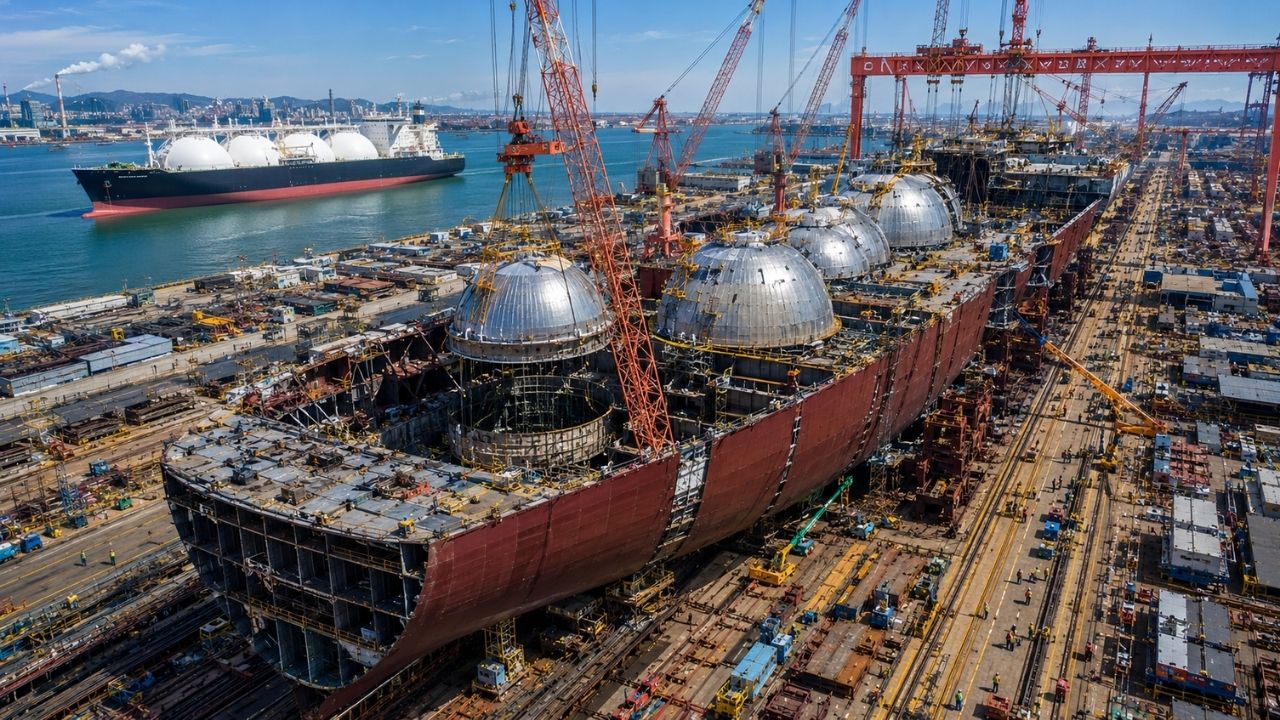

Modernization of Shipyards and Increase in Production in Russia
To handle this massive production, Russia will also modernize its shipyards and expand its installed capacity. The plan is to raise the utilization rate of shipyards from current levels to 61% by 2036, reaching 73% by 2050. With this, a significant increase in the serial production of vessels is expected, making the process more efficient and cost-competitive.
Additionally, there will be the construction of new shipyards and the modernization of old facilities. It’s like giving a complete upgrade to a classic car factory to enable it to produce spacecraft. Literally, a generational leap.
Reduction of Dependence on Foreign Technology
In a context where industrial autonomy is increasingly strategic, Russia seeks to reduce its dependence on imported equipment. The goal is bold: by 2036, half of the components used in the shipbuilding industry should be domestically manufactured. By 2050, this figure should reach 80%.
With this, the country aims not only to ensure a stable supply of parts but also to stimulate its base industry and research centers, in line with the desire for technological self-sufficiency.
Russia Bets on Workforce and Innovation as Drivers of Transformation
But it’s not enough to have infrastructure: skilled people are needed to drive the transformation. The plan provides for a 15% increase in the workforce by 2036, reaching around 190,000 people. Furthermore, the government aims to invest heavily in applied scientific research, automation, and the digitalization of shipyards.
This is a smart move. The more modern the industry, the more it attracts young talents, researchers, and engineers willing to innovate, and this is precisely what the country is seeking.
Geopolitics and Response to Sanctions Drive the Plan
In the background, there is geopolitical pressure. Russia wants to reinforce its position in global maritime trade without relying on partners that have imposed sanctions. The Northern Sea Route thus becomes a vital artery for the flow of goods. And it is no coincidence that the United States has also recently launched a similar strategy to strengthen its shipbuilding industry in the face of China’s advance.
Related: US Wants a Fleet of 250 Ships to Contain China’s Advance in the Seas
It’s as if the global maritime chessboard has been reshuffled. Each country is now trying to secure its fleet, its technology, and its routes, and Russia, with this billion-dollar investment, seeks to regain its status as one of the major players in the naval game of the 21st century.