Portuguese
  Spanish


Scientists discovered in Russia the rare mineral Petrovite, whose unique crystalline structure may inspire new technologies for more efficient batteries, thanks to the unusual copper coordination naturally observed.
According to Phys.org, Professor Stanislav Filatov, from the Department of Crystallography at St. Petersburg University, spent more than 40 years studying the mineralogy of slag cones and lava flows from the fumaroles of Kamchatka — formations created after two major eruptions of the Tolbachik Volcano in 1975-1976 and in 2012-2013. This territory is unique in mineralogical diversity: dozens of new minerals have been found there in recent years, many of which are unique in the world. Petrovite was one of them.
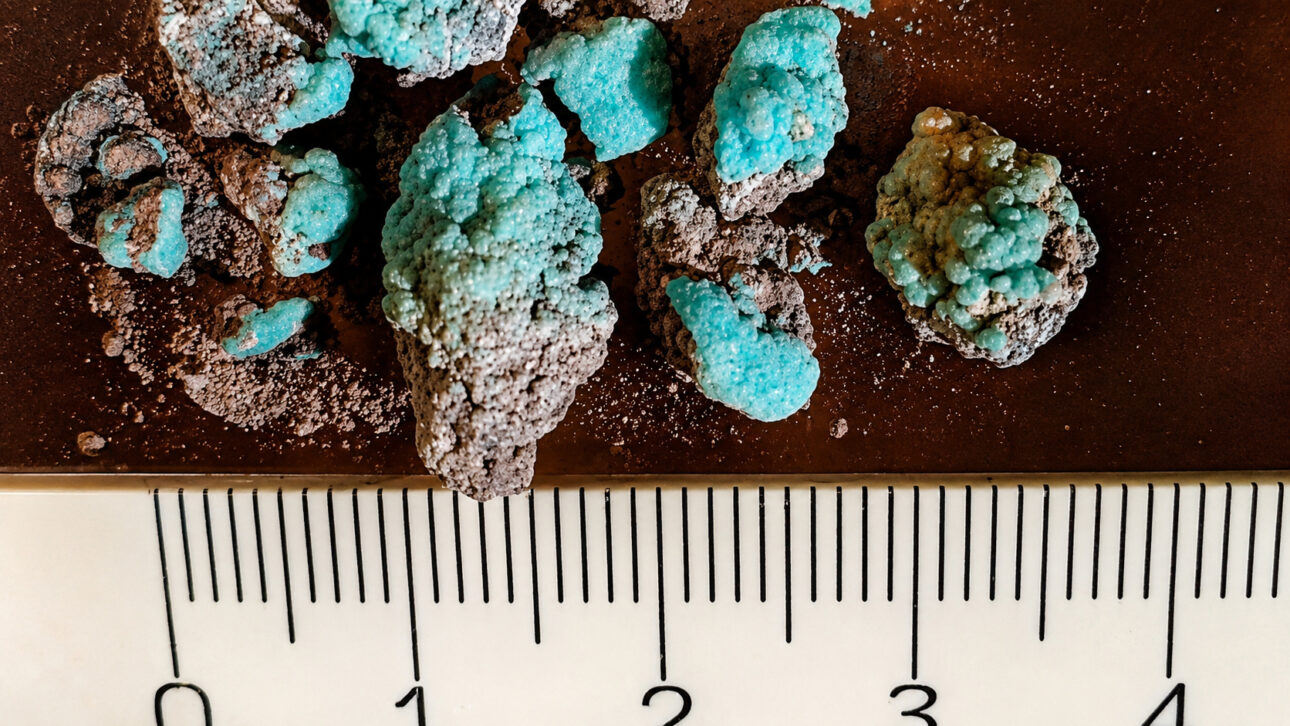
The mineral has the chemical formula Na10CaCu2(SO4)8 and appears as blue globular aggregates of tabular crystals with gas inclusions. Its composition was determined by Svetlana Moskaleva, a researcher at the Institute of Volcanology and Seismology of the Far Eastern Branch of the Russian Academy of Sciences. The crystalline structure was studied by Andrey Shablinskii, from the Grebenshchikov Institute of Silicate Chemistry and a graduate of St. Petersburg University.
What made Petrovite immediately interesting beyond mineralogy was a specific structural feature: the copper atom in its crystalline structure has an unusual and very rare coordination of seven oxygen atoms. “Such coordination is characteristic of only a few compounds,” Filatov told Phys.org. The mineral was named in honor of Professor Tomas Petrov, a crystallographer at St. Petersburg University who was the first in the world to create a technology to grow jewelry malachite. Petrovite was published in the Mineralogical Magazine with the complete study of its composition and structure.
-
Ancient Stone City in the Desert, Once Home to 30,000, Puzzles Scientists with Nabateans’ Water Mastery 2,000 Years Ago

-
Ancient Creature Thought Extinct Since Dinosaur Era Reappears, Baffling Scientists

-
India Deploys Giant Fabric Tubes Filled with Sand to Combat Coastal Erosion and Rebuild Disappearing Beaches

-
China Unveils Most Human-Like Humanoid Robot for Public Sale, Featuring Silicone Skin and 88 Joints, Priced from $17,600




What happens inside a mineral that never existed before
To understand why Petrovite immediately interested battery researchers, it is necessary to understand what its crystalline structure does differently from any known mineral. According to Phys.org, Petrovite is formed by oxygen, sodium, sulfur, and copper atoms that build a three-dimensional porous framework.
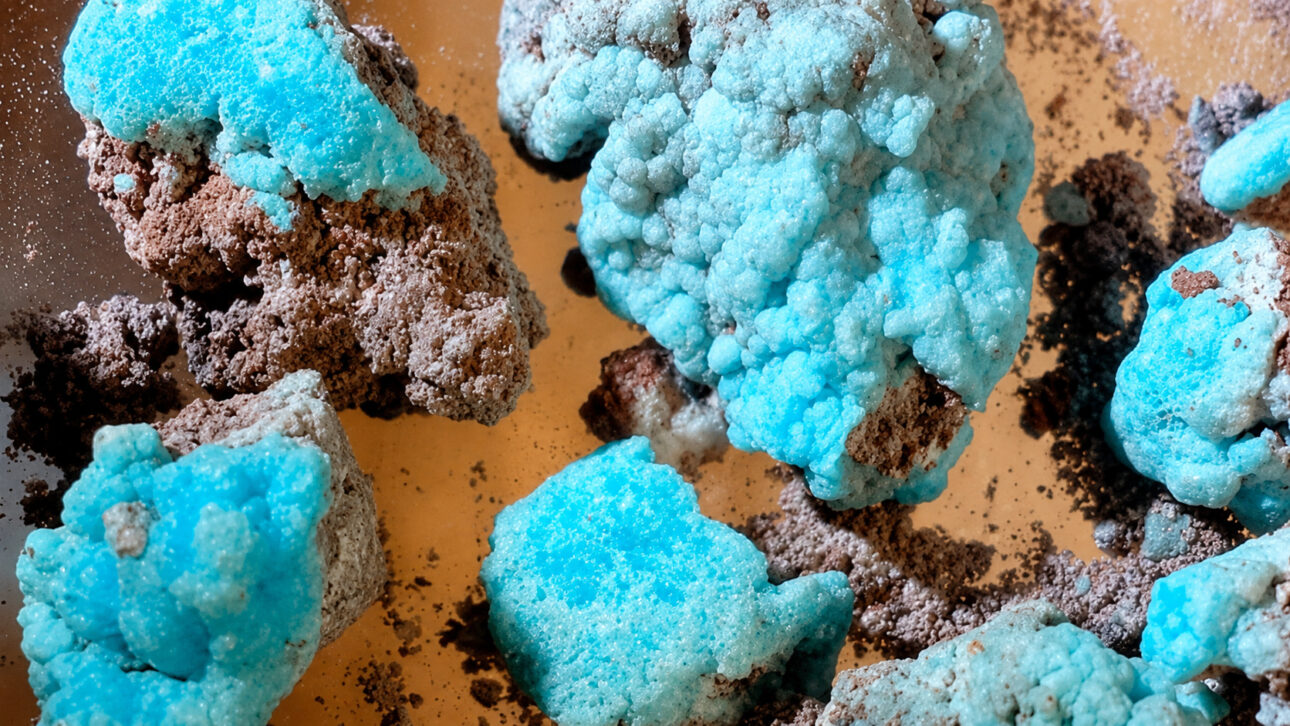
The voids in this framework are connected by channels through which the relatively small sodium atoms can move. It is this ionic mobility — the ability of sodium atoms to circulate through the crystal’s channels — that scientists have identified as potentially valuable for battery technology. A battery operates by the movement of ions between electrodes. The more easily the ions move through the electrode material, the more efficient the battery is.
The structure of Petrovite creates exactly the conditions that battery engineers try to replicate artificially in the laboratory: well-defined channels, appropriately sized for the sodium ion, and a stable framework that does not collapse when the ions move. “Scientists have established that the structural type of Petrovite is promising for ionic conductivity and can be used as a cathode material for sodium-ion batteries,” said Filatov.
The problem that prevents direct use and why synthesis is the solution
The discovery of Petrovite as a natural mineral does not mean it can simply be extracted and placed in a battery. The path from a mineral found in a volcanic fumarole to a commercial electrode component encounters a specific obstacle that the researchers themselves identified.
According to Phys.org, the central problem is the amount of copper in the crystalline structure of Petrovite. Copper is the transition metal in the formula — the component that participates in the electrochemical reactions that allow energy storage and release in a battery. In natural Petrovite, the proportion of copper in the structure is small.
For the material to function efficiently as a battery cathode, this proportion needs to be higher. “The biggest problem for this use is the small amount of the transition metal — copper — in the mineral’s crystalline structure,” said Filatov. “This can be solved by synthesizing in the laboratory a compound with the same structure as Petrovite.”
What the researchers propose is not to mine Petrovite in Kamchatka and use it directly. It is to use the crystalline structure of Petrovite as a model — an architectural blueprint that nature created and that chemists can reproduce in the laboratory with optimized proportions of each element. Nature solved the design problem. Chemistry solves the composition problem.
Why sodium-ion batteries — and what makes them relevant now
The context in which Petrovite emerged is important to understand why its specific crystalline structure for sodium has strategic relevance beyond mineralogical curiosity. Lithium-ion batteries dominate the current energy storage market — they are in cell phones, laptops, electric cars, and renewable energy storage systems.
But lithium is a geographically concentrated resource, with much of the reserves in South America and processing dominated by China. Sodium is the sixth most abundant element in the Earth’s crust — it is virtually everywhere, is cheap, and does not have the geopolitical concentration of lithium. If sodium-ion batteries achieve performance comparable to lithium ones, the dependence on a single strategic metal for the entire energy storage chain could be significantly reduced.
The obstacle for sodium-ion batteries is finding efficient cathode materials — structures that accommodate the movement of sodium ions with low resistance and high stability over many charge and discharge cycles. The sodium ion is larger than the lithium ion, which means it needs larger channels in the electrode material. Petrovite, with its channels precisely sized for sodium, is a natural model of how to build this structure.
Kamchatka as a natural laboratory for new minerals
Petrovite is not the only new mineral found in the Tolbachik region — it is part of a pattern of discoveries that transforms Kamchatka into one of the most mineralogically rich and least explored regions on the planet. Filatov’s team also found Saranchinaite in the same volcanic complex — a mineral with a structure related to Petrovite and which may be a product of reactions between saranchinaite, calcium sulfate, and sodium sulfate.
The hypothesis that Petrovite forms when previous minerals containing nickel are gradually replaced by new material brought by hot, metal-rich fluids — like those circulating in volcanic fumaroles — is relevant because it describes a formation mechanism that occurs at temperature and pressure scales that laboratories can replicate. Each new discovery in Kamchatka adds a mineral to the catalog and simultaneously a piece of data on how specific crystalline structures form under extreme natural conditions.
For materials science, this data is equivalent to finding architectural designs that nature has tested for millions of years — long before any engineer attempted to build something similar. Petrovite is blue, small, formed in one of the most extreme environments on the Earth’s surface, and has an internal structure that nature took volcanic eruptions to create and that laboratories now attempt to reproduce on a scale that can power the next generation of batteries.