Portuguese
  Spanish


Learn How Dependent Your State Is on the USA for Its Exports! Also Learn About the Products That Will Have Significant Impact.
An in-depth analysis by the National Confederation of Industry (CNI), released this Tuesday, July 29, 2025, sheds light on the intricate trade web that connects Brazil to the United States.
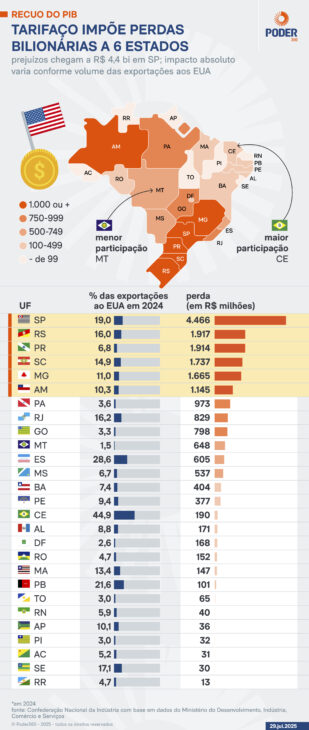
The data, revealing the States with the Highest Dependence on the USA for their exports in 2024, highlights the importance of this economic partner for various Brazilian regions.
However, a new factor urgently imposes itself: the impending new tariffs that will come into effect on August 1, which will have a significant impact on key products such as unroasted coffee, frozen meats, sugar, soy, and steel products.
-
Brazil’s 2026 Tax Refund: Record 9.58 Million Filers in Largest Payout Ever, But a Key Detail on Priority Recipients Draws Nationwide Attention

-
Itaú Alters Hybrid Work Model, Increasing Office Days from 2028, Prompting Employees to Adjust to New Routine
-
Facing Labor Shortage, Japan Plans to Invest $34 Million to Attract Foreign Workers in Construction, Healthcare, Industry, and Commerce

-
Brazilian City Makes Remarkable Leap, Becomes 4th Wealthiest in the Country with GDP of R$ 134.1 Billion




This measure adds a layer of complexity and uncertainty to this vital relationship.
The CNI study, therefore, gains even more relevance, detailing not only the intensity of this connection but also the products that drive these exchanges, providing a crucial overview for the strategic planning of companies and governments.
The Heart of Commercial Dependence: Ceará in the Lead and the Power of Technology
The CNI research draws a clear map of state dependence. Ceará stands out as the state with the largest share of its exports destined for the North American market.
In 2024, an impressive 44.9% of everything it sold abroad went to the USA.
The main engine of this relationship is telecommunication equipment, highlighting optical fibers and cables, showcasing the robustness of its high-tech industry and its role in the global supply chain.
Diversity of Products and Regions: From the Southeast to the Northeast of the Country
Following the order of dependence, Espírito Santo ranks second, with 28.6% of its exports going to the USA in 2024.
This state is notable for its variety of products, ranging from coffee and granite to manufactured goods, reflecting its vocation for foreign trade.
Next, Paraíba directs 21.6% of its external sales to the USA.
Although the specifics of the products are not as prominent as the leaders, the representation highlights the importance of the North American market for the Paraíba economy.
Closing the list of states with the highest dependence in this context, Sergipe recorded 17.1% of its exports to the United States in 2024.
The presence of this northeastern state reinforces the breadth of the economic influence of the USA in different regions of Brazil.
See All States:
The Impact of New Tariffs Starting on August 1: Key Products on Alert
The CNI data for 2024 reflects the maturity of the commercial relationship between Brazil and the USA, which goes far beyond commodities and extends to manufactured and high-tech products.
However, the current scenario updates with the news of the imposition of new tariffs that will take effect on August 1.
This measure is particularly concerning, as some of the main products on Brazil’s export agenda will be the most affected by this tariff.
The items that are expected to feel the most significant impact are: unroasted coffee, frozen meats, sugar, soy, and steel products.
This measure may directly impact the competitiveness of these products in the North American market, making them more expensive for the end consumer in the USA and consequently discouraging demand. This will especially affect those states with strong production and export of these goods.
The rise in import costs for the USA may discourage buyers and force Brazilian producers to seek alternative markets or absorb part of these costs, which would affect their profit margins.
For the states that lead this dependence and for the producing sectors of these goods, the challenge is threefold: while deepening ties with a reliable partner, they need to explore new markets and adapt their strategies to mitigate the effects of these new tariff barriers, ensuring greater economic resilience in the face of geopolitical or economic fluctuations.
This strong connection with the United States, the largest consumer market in the world, represents a valuable gateway for Brazilian companies and a seal of quality for exported products.
However, the lesson that the CNI data and the new tariff scenario bring is clear: strengthening and diversifying commercial partnerships, in addition to closely monitoring international trade policies, is essential for the economic health of each state and, by extension, for all of Brazil.
What will be the real impact of these tariffs in the coming months? We will closely monitor the developments.