Portuguese
  Spanish


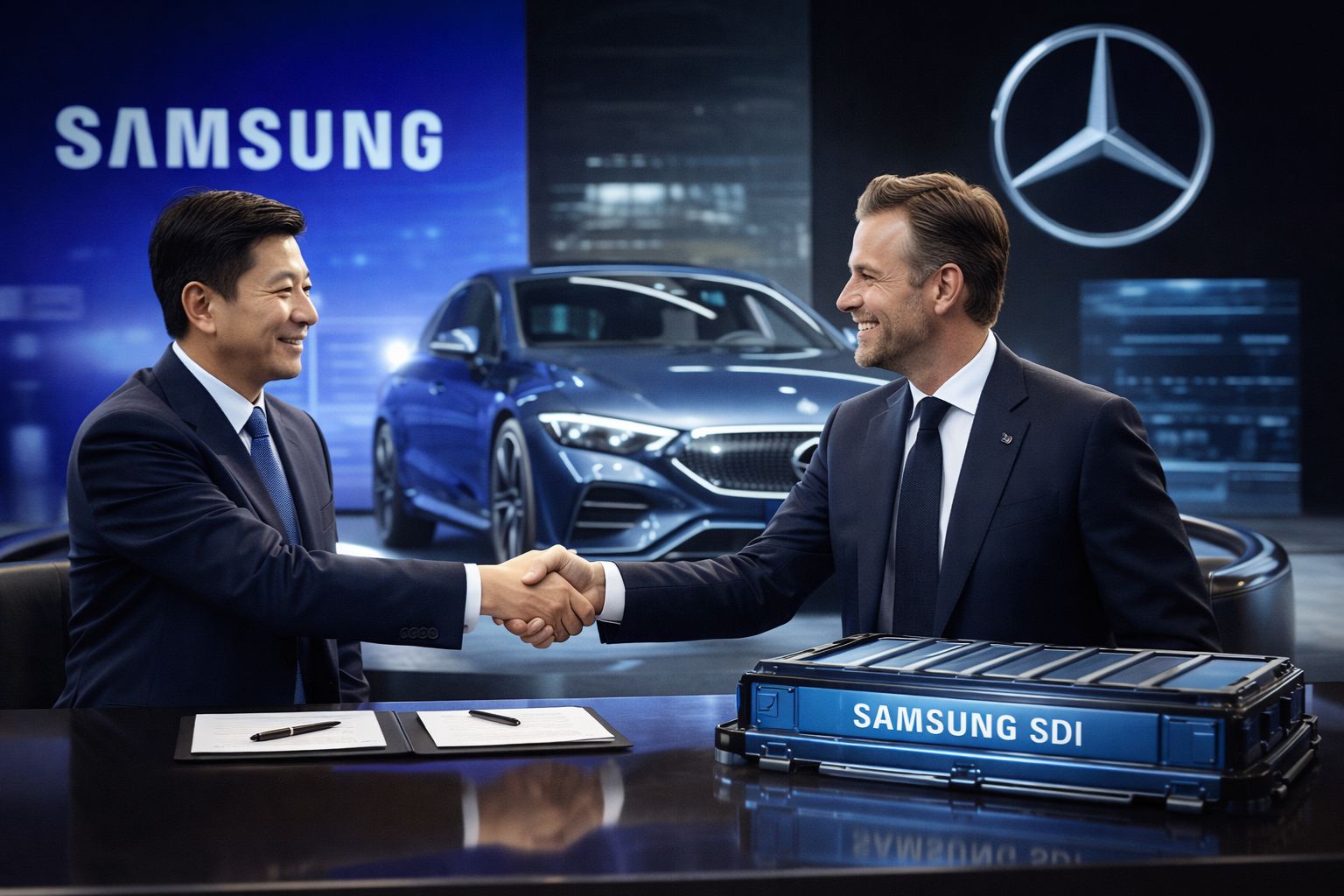


Samsung and Mercedes-Benz are close to finalizing an unprecedented agreement for the supply of prismatic batteries for the German automaker’s electric cars starting in 2028. The Samsung SDI division would be responsible for the supply, and the partnership could lead to the construction of new factories in Europe, in countries such as Austria, Slovakia, and the Czech Republic.
Samsung and Mercedes-Benz are on the verge of sealing a partnership that could redefine the global production chain of electric cars. The discussions between the two giants gained momentum after meetings between executives and signal a strategic move that goes far beyond a simple supply contract. If the agreement is confirmed, the Samsung SDI division will supply prismatic batteries for the electric cars from Mercedes-Benz planned for 2028, a milestone that represents the first time Samsung’s battery technology would be used in vehicles produced by the German automaker. The partnership changes the power dynamics in the global automotive industry by bridging what was treated as two separate poles: European engineering and Asian battery technology.
The rapprochement is not accidental. Mercedes-Benz initially relied on Automotive Cells Company (ACC) to supply its electric car production, but issues such as high costs and delays led to a revision of this strategy, opening the door for new partners to enter the game. Samsung emerged as a viable alternative and, according to information circulating in the industry, may even expand its industrial presence in Europe to meet demand. Factories in countries like Austria, Slovakia, or the Czech Republic are among the possibilities being studied, which would strengthen local production and reduce the logistical costs that weigh on the final price of electric cars.
What the agreement between Samsung and Mercedes-Benz changes in electric cars
According to information from the portal sammyguru & Tudo Celular, batteries are the most expensive and strategic component of electric cars, accounting for about one-third of the total vehicle cost in many models. When an automaker like Mercedes-Benz chooses a battery supplier, it is defining not only a business partner but also the technology that will differentiate its electric cars in the market for the coming years. The choice of Samsung SDI, which uses the prismatic format, signals that Mercedes-Benz is betting on a specific architecture that balances energy density, safety, and ease of large-scale production.
-
Polar Air Mass to Hit Brazil: Temperatures to Plummet in Nine States, Near Freezing in the South with Frost Risk Until Monday

-
Chinese “dark factories” produce electric cars 24/7 with minimal human intervention, as Zeekr assembles 800 units daily, raising concerns in Brazil.

-
Spectacular Green Aurora Seen from Space Illuminates International Space Station, Captivates French Astronaut

-
In Tasmania, a Beach Features a Natural Stone Mosaic Formed by Earth’s Cracks Millions of Years Ago


The prismatic format of Samsung batteries stands out from the cylindrical cells used by competitors like Tesla and the pouch cells adopted by other manufacturers. Prismatic cells offer advantages in packaging within battery modules, allowing for greater volumetric density and, consequently, more range in a smaller space within the electric vehicle. For a brand like Mercedes-Benz, which needs to offer premium vehicles with competitive range, this feature is decisive. The agreement with Samsung is not just a transaction; it is a technological bet.
Why Mercedes-Benz Switched from ACC to Samsung in Electric Cars
Mercedes-Benz’s decision to reassess its partnership with Automotive Cells Company and open negotiations with Samsung reveals the difficulties that European automakers are facing in producing batteries at scale. The ACC, a European consortium with participation from Stellantis, TotalEnergies, and Mercedes-Benz, faced higher-than-expected costs and delays in delivering cells for the German automaker’s electric cars, issues that jeopardized the launch schedules of models planned for the coming years.
In light of this scenario, Mercedes-Benz needed to act. Samsung, with decades of experience in battery production for consumer electronics and a consolidated automotive division, offers the reliability of a company that already produces at massive volumes, something that ACC is still building. For Mercedes-Benz, ensuring a stable supply of batteries is a matter of survival in the electric vehicle market, where delays can cost billions of euros in lost sales and brand positioning. Samsung represents operational security that ACC has failed to deliver.
How Europe Can Gain New Battery Factories for Electric Cars
One of the most interesting aspects of the possible agreement is the prospect of new Samsung factories on European soil. Countries like Austria, Slovakia, and the Czech Republic are emerging as candidates to host these units, leveraging their strategic location in the center of Europe, skilled labor, and proximity to Mercedes-Benz factories in Germany. Samsung’s arrival on the European continent would have implications that go beyond the contract with Mercedes-Benz: it would consolidate Europe as a real hub for electric vehicle battery production, reducing dependence on Asian imports.
For the candidate countries, the prospect of receiving billion-dollar investments in battery factories is a rare opportunity. Each large-scale cell factory generates thousands of direct jobs, attracts secondary suppliers, and positions the country in the global electric vehicle production chain for decades. Austria, Slovakia, and the Czech Republic already have automotive traditions and compatible industrial infrastructure, which explains why they are favored. The final decision will depend on factors such as tax incentives, availability of clean energy, and labor agreements.
The Existing Relationship Between Samsung and Mercedes-Benz Outside Electric Cars
What many people do not know is that Samsung and Mercedes-Benz have been technology partners for years, although in a different domain. Mercedes-Benz uses technologies from Harman, a subsidiary of Samsung, in its infotainment systems, including premium audio, screen interfaces, and integration with smartphone applications. This existing relationship makes the battery agreement a natural evolution, not a blind bet. The two companies already know each other and operate together in environments that require precision and automotive quality.
The expansion of the partnership to electric car batteries fits into Samsung’s broader strategy to position itself as a comprehensive supplier for the automotive sector. While Apple abandoned plans to build its own car, Samsung is betting on being the technological backbone of established brands like Mercedes-Benz, providing everything from digital panel chips to the batteries that power the vehicles. For Mercedes-Benz, working with a company that already understands automotive quality standards reduces integration risks and accelerates the development of new models.
What the agreement means for the global future of electric cars
If the contract between Samsung and Mercedes-Benz is confirmed, it will be yet another sign that the electric car industry is consolidating around a small number of large battery suppliers. Samsung SDI, LG Energy Solution, CATL, and Panasonic dominate the global automotive cell market, and each agreement that one of these companies makes with a major automaker redefines the balance of the sector for the next ten to fifteen years.
For consumers, the impact may be felt in prices, range, and availability of electric cars. If Samsung can deliver prismatic batteries at a competitive cost and industrial scale, the Mercedes-Benz models expected for 2028 could hit the market with more affordable prices and superior range compared to competitors that still rely on less established suppliers. Details such as contract values and official timelines have not yet been disclosed, but the agreement could have a direct impact on the global electric car market and accelerate the transition that all traditional automakers now face.
Samsung and Mercedes-Benz may finalize an agreement that places Korean batteries in German electric cars starting in 2028. Would you buy a Mercedes with a Samsung battery? Does this type of partnership improve or worsen electric cars? Share your opinion in the comments.