






 Portuguese
  Spanish
  5 min of reading
  0 comments


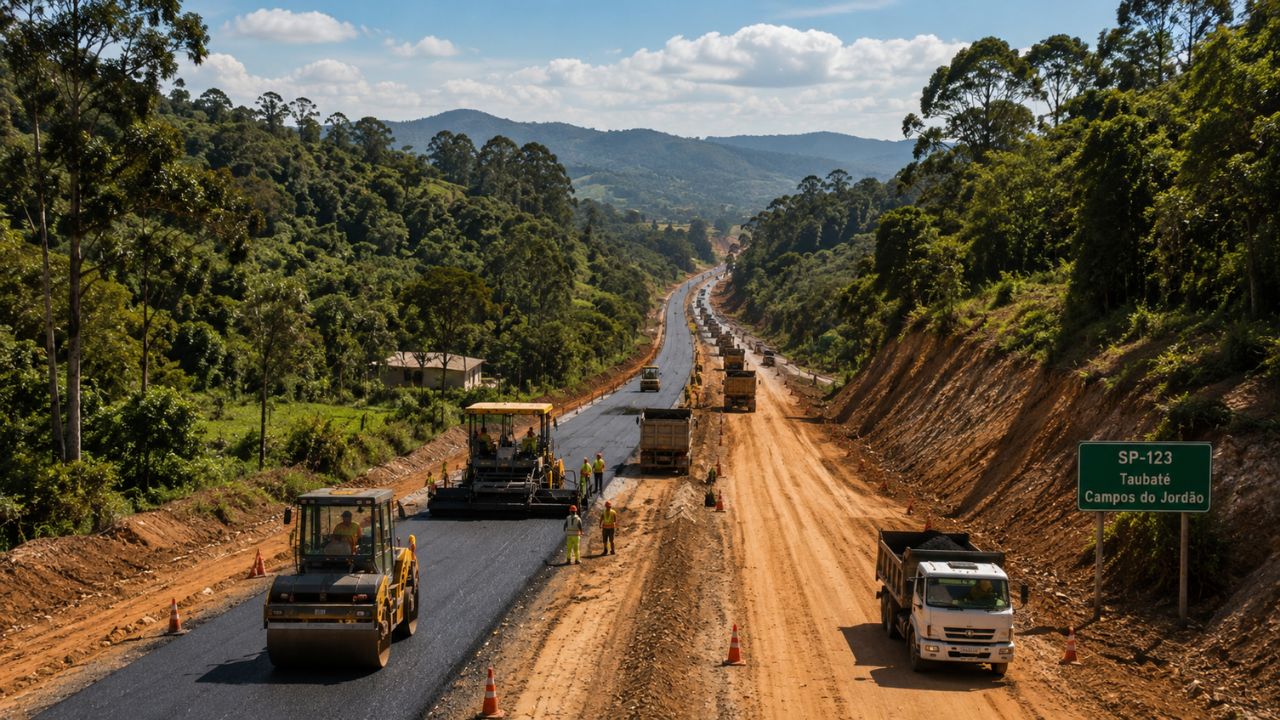
The SP-123, between Taubaté and Campos do Jordão, will be transformed into a smart highway with 45 km of extension, infrastructure for autonomous vehicles, electric charging points, and asphalt made from recycled tires.
São Paulo has just taken the first concrete step towards a new era in Brazilian road infrastructure. On Thursday, April 2, the São Paulo government signed the service order authorizing the start of modernization works on the Floriano Rodrigues Pinheiro highway (SP-123), the stretch connecting Taubaté to Campos do Jordão.
With an investment of R$ 192 million in partnership with the Inter-American Development Bank (IDB), the 45-kilometer road will be transformed into the state’s first ‘smart highway’ — equipped with infrastructure for autonomous vehicles, charging points for electric cars, Wi-Fi and 4G connectivity along the entire route, in addition to pavement made with ecological asphalt produced from recycled tire rubber. The works are expected to be completed in 18 months.
What will change in the 45 km of SP’s first ‘smart highway’?
The interventions cover the stretch between km 1.2 and km 46 of the SP-123 and will directly benefit over 600,000 residents of the municipalities of Taubaté, Pindamonhangaba, Tremembé, Campos do Jordão, and Santo Antônio do Pinhal.
-
Bolivian Female Construction Workers Form Association to Combat Discrimination and 38% Pay Gap in the Industry

-
Near Amsterdam, residents buy land and discover they must also build streets, manage drainage, handle waste, and grow food on half their plot.
-
Brazil’s WEG to Open New Factory in China by 2027, Expanding Production of Large Rotating Electric Machines and Low to Medium Voltage Motors in Rugao

-
Chinese Shipyard Secures $1 Billion in Orders for Low-Carbon Container Ships Amid Global Fleet Renewal Efforts


The set of works addresses a pent-up demand of almost a decade in the region. Among the main transformations foreseen are:
- Infrastructure dedicated to the operation of autonomous vehicles
- Charging points for electric cars along the road
- Wi-Fi and 4G signal coverage throughout the route
- Pavement with ecological asphalt made from recycled tire rubber
- Implementation of additional lanes to improve traffic flow
- 11.8 kilometers of bike path between km 1.2 and km 13, with passages for pedestrians and cyclists
- Construction of an interchange viaduct between SP-123 and Dr. Caio Gomes Figueiredo highway (SP-132), in Pindamonhangaba
- Widening of bridges along the highway
Technology for autonomous vehicles: what this means in practice
The inclusion of infrastructure for autonomous cars is one of the elements that distinguishes SP-123 from any other highway in the state.
Autonomous vehicles are those capable of moving without direct human driver intervention — and to operate safely, they rely on sensors, real-time data, and specific road signage.
By transforming SP-123 into a technological corridor prepared for this type of vehicle, the São Paulo government anticipates a trend that is already a reality in countries like the United States, China, and Germany, but which is still in its early stages in Brazil.

Governor Tarcísio de Freitas highlighted the scope of the work:
“We will have one of the most modern roads in Brazil. Everything here is being designed to offer the best for drivers. This is a road that will accommodate autonomous vehicles, which will be able to operate here without difficulty.”
Ecological asphalt and reforestation: the environmental agenda of the project
The modernization of SP-123 also carries a relevant environmental dimension. The asphalt used in the paving will have a differentiated composition — including rubber from recycled tires as raw material, which reduces the irregular disposal of this waste and decreases carbon emissions associated with the conventional production of the material.
In addition, the São Paulo Road Department (DER-SP) intends to reforest 30 hectares along the project’s route, with the aim of containing erosion and offsetting emissions generated during construction.
The president of DER-SP, Sérgio Codello, reinforced the combined benefits of the initiative:
“We will reduce operational costs with the work on SP-123, decreasing travel time, integrating new technologies, offering more safety, comfort, and new solutions with a positive environmental impact by using recyclable materials on the road.”
The Secretary of Environment, Infrastructure, and Logistics, Natália Resende, also commented on the strategic scope of the project:
“This is an investment that goes beyond road modernization: we are implementing a new road standard on SP-123, which incorporates connectivity, support for autonomous mobility, and low-impact environmental solutions.”
Local road SBS-371 also undergoes works in the region
During the same visit of Caravana 3D to Vale do Paraíba, the governor monitored the progress of recovery works on local road SBS-371, which connects SP-123 to the municipality of São Bento do Sapucaí, in the Serra da Mantiqueira.
The 15.5-kilometer stretch is undergoing intervention, with completion expected by October. The total investment is R$ 37.6 million, with funds from the Government of São Paulo itself. The work is expected to generate approximately 360 direct jobs and benefit over 11,000 people.


The region is a consolidated tourist hub, recognized for Pedra do Baú, the Wine Route, and the São Bento do Sapucaí Winter Festival — events that attract visitors especially on weekends, holidays, and vacation seasons.
Tarcísio de Freitas highlighted that the paving is “super important for those who visit the region and for those who live from local agribusiness.”
Caravana 3D and investments in inland São Paulo
The signing of the service order for SP-123 marked the conclusion of the Vale do Paraíba stage of Caravana 3D — Development, Dignity, and Dialogue, an initiative of the Government of São Paulo that travels through the state’s regions to announce investments and strengthen dialogue with municipalities.
The caravan has already passed through São José do Rio Preto, Araçatuba, Marília, Sorocaba, Presidente Prudente, and Itapeva before arriving in Vale do Paraíba.
In each stage, visits are made to cities in the region and concrete announcements are made in the areas of health, education, housing, infrastructure, and public safety.
Source: Government of SP





Be the first to react!