Portuguese
  Spanish


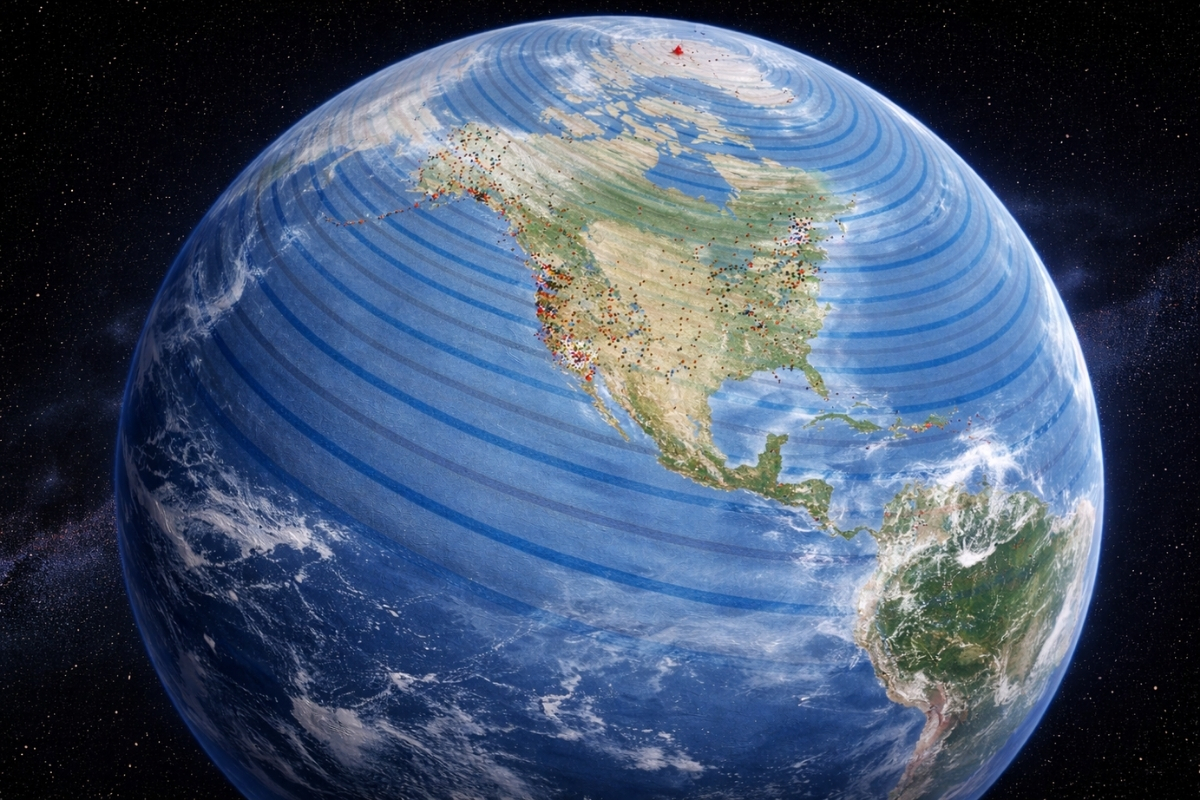


The Event Generated Pulses Every 90 Seconds, Lasted 9 Days and Was Only Confirmed When the SWOT Satellite Managed to See the Movement of Water Inside the Fjord
The Earth recorded rare behavior in September 2023: seismic sensors picked up a repetitive pulse every 90 seconds, without interruption, for 9 days. The pattern was too regular to seem like a common tremor and too long to be ignored.
What seemed like a geological mystery turned out to have its origin in water. A megatsunami formed in Dickson Fjord, Greenland, and was trapped within the fjord, oscillating back and forth for days.
The region is remote, almost devoid of human presence, which explains why the episode did not trigger an immediate alert to the world. Nevertheless, the energy was great enough to leave a global signature and attract the attention of scientists in various countries.
-
Almost 1 billion euros, two gigafactories, and a million-dollar public investment, Chinese company aims to turn Spanish city into Europe’s new battery hub.

-
Advancement in the industry: Brazilian company creates ultralight material comparable to steel and paves the way for hydrogen cylinders up to 70% lighter, with a direct impact on logistics, the energy industry, and national competitiveness – learn about Forza Composites

-
In Brazil’s backyard: Tesla, by Elon Musk, announces official operations in Uruguay, where electric vehicles already make up 20% of new cars but still leaves out the largest market in the region.

-
This Mars rover may finally reveal if life ever existed on Mars.



The Planet Shook for 9 Days and No One Understood Why
The signal detected across the planet did not resemble a classic earthquake. Instead of a short, strong peak, it appeared as a continuous pulse, with a steady rhythm, repeating the same interval for days.
This type of behavior is unusual in seismic records. Hence, the phenomenon became a puzzle, as there was no direct explanation that fit the observed duration and repetition.
The detail that caught the most attention was the persistence. There were 9 days with the same pattern, as if the Earth was being pushed regularly, always in the same rhythm.
Dickson Fjord Became the Stage for a Silent Megatsunami

The origin point of the event was Dickson Fjord, in northeastern Greenland. On September 16, 2023, a major landslide occurred involving rock, ice, and debris, directly impacting the water in the fjord.
The impact displaced a massive volume of water in a short time. This created a megatsunami within the narrow channel, behaving differently from the tsunami that usually crosses oceans and reaches urban areas.
The location is surrounded by rock walls and acts as a natural corridor. This geography helped keep the energy concentrated, rather than allowing the wave to spread out and lose strength quickly.
The Wave Reached 200 M and Transformed the Fjord into a Resonance Chamber
The event is described with a tsunami height of up to 200 m, along with subsequent waves reaching 110 m. These numbers illustrate the magnitude of the energy released at the time of the landslide.
What makes this case even rarer is that the phenomenon was trapped within the fjord itself. Instead of advancing to the open ocean, the water began to oscillate within the channel, as if it were stuck in a closed system.
This transformed the fjord into a kind of natural resonance chamber. The energy continued circulating inside, repeating the movement and keeping the event active for days.
The Seiche Kept the Water Oscillating Like a Natural Engine
The movement that sustained the event has a name: seiche. It is a large-scale oscillation that occurs when water is trapped in a closed or semi-closed space and begins to go back and forth in a repetitive cycle.
In the case of a long, narrow fjord, the seiche can gain strength and persistence. The water hits one end, returns, hits the other, and continues repeating, maintaining a constant sway.
This back and forth helps explain why the planet registered such regular pulses. The water became a natural mechanical “engine,” pushing and pulling the system for too long to be confused with a common seismic event.
The SWOT Satellite Captured What Did Not Appear in Traditional Monitoring
The confirmation of the phenomenon gained momentum with the Surface Water Ocean Topography satellite, known as SWOT. It was launched in December 2022 and has the ability to measure water surface height with high precision.
The differential of SWOT is its ability to map water areas in more detail, including in complex regions like fjords. This broadens the observation range in places where there are no installed instruments and where human presence is minimal.
With this reading, it was possible to identify clear signs of movement within Dickson Fjord, showing that the water was not just agitated; it was oscillating in an organized and persistent manner.
Differences of Up to 2 M in the Surface Confirmed the Back and Forth of the Wave
The satellite data showed that the surface of the water within the fjord exhibited well-defined slopes, with height differences of up to 2 m at different moments.
The most important thing is that these slopes changed direction. At one moment, the water appeared higher on one side, then the pattern inverted, indicating the continuous balance from one extreme to the other.
This behavior aligns with seiche dynamics and helps explain the repetitive seismic signature. Even without a tsunami advancing into the open ocean, the energy within the fjord was sufficient to generate a signal felt on a global scale.
The Hidden Alert: Extreme Events Can Happen Off the Human Radar
The Case of Dickson Fjord shows that extreme events can occur in isolated areas and still produce detectable impacts on the planet. When the scenario is remote, the world may take time to understand what happened, even with signals appearing in instruments.
It is also clear that space technology has taken on a central role in this type of discovery. Satellites like SWOT expand the capacity to observe changes in water in regions where there is no constant monitoring.
The megatsunami in Greenland lasted 9 days, had pulses every 90 seconds, and left a global mark. Now, this type of event enters a new phase, with a greater chance of being detected, measured, and understood quickly.