Portuguese
  Spanish


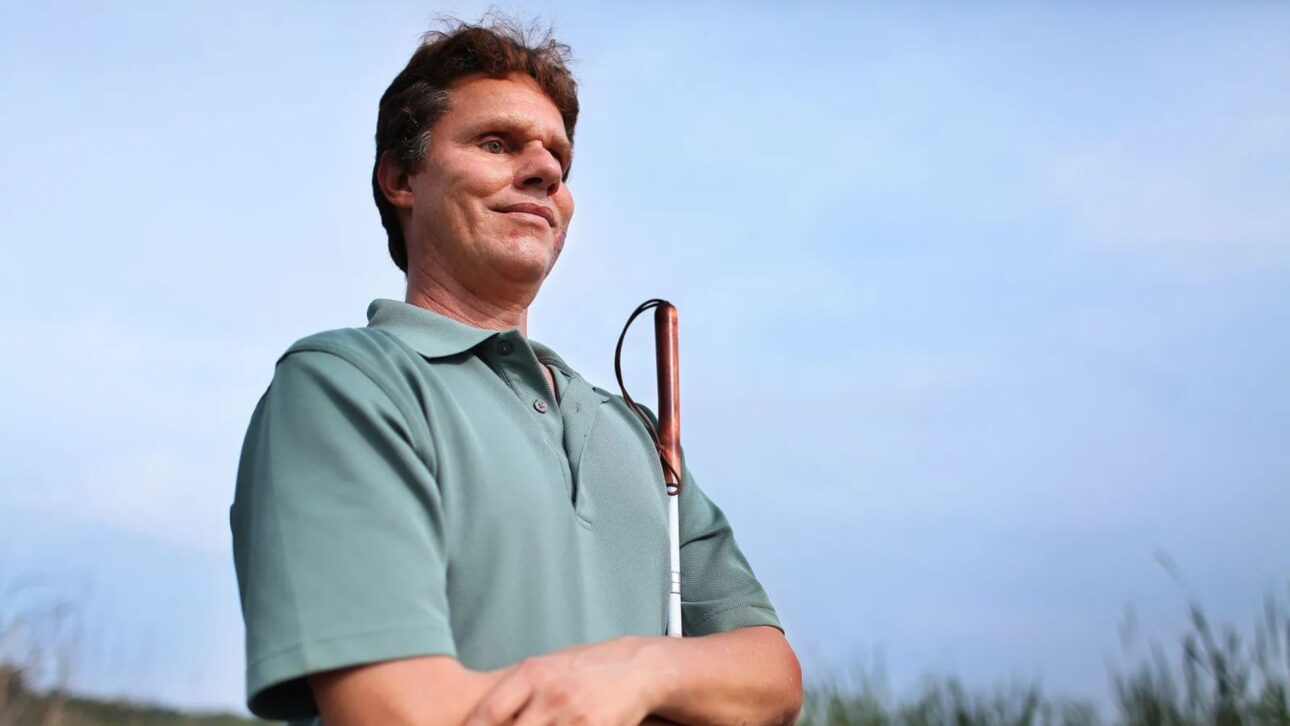
Daniel Kish lost both eyes to retinal cancer as a child and learned on his own to navigate using tongue clicks that echo off surrounding objects. The blind man whom science calls the real-life Batman founded an organization that has trained over a thousand blind people in nearly 40 countries.
Daniel Kish lost both eyes to retinal cancer in childhood. His mother says this hardly slowed him down. While other blind children depended on adults to move around, Daniel developed his own system to perceive the world around him: he made tongue clicks on the roof of his mouth and listened to the echoes returning from nearby objects. No one ever taught him. This blind man learned to echolocate just like bats, and he did it on his own, even before he understood what he was doing.
At six years old, Daniel was riding a bicycle. He explains that to pedal at speed, you need to click a lot. Over time, he began climbing trees, navigating unknown spaces, and identifying obstacles at distances of six or seven meters, like parked cars, poles, and fences. Science was fascinated. Researchers confirmed that, by producing these clicks, the brain of an experienced echolocator activates the visual processing area, the same used by those who see with their eyes.
The first day of school told by someone who heard everything
Daniel described the first day of the first school year with a richness of detail that no conventional account of visual impairment could reproduce. When the bell rang and the children ran out, he went along, clicking with his tongue, hearing the wall to his left, dodging chairs out of place, crossing the door by perceiving its edges through the echo. Outside, the environment was chaotic: voices everywhere, balls bouncing, shoes shuffling. The noise acted like a dense and almost impenetrable wall.
-
Ice Cream Shop Grows from 39 Square Meters to $19 Million Revenue with Popsicles Sold at 20 Cents in Brazil

-
Rural Worker Spotted “Flying” on a Drone in Brazil

-
Turkish Cave Suggests Neanderthals and Homo Sapiens Shared Cultural Traditions for Millennia; Discovery Unveils Similar Tools, Hunting Techniques, and Shells at a Major Prehistoric Site
-
Burkina Faso Bans NGOs from Photographing Vulnerable People Without Consent and Outlaws Fundraising Campaigns Exploiting Suffering


But curiosity overcame fear. Daniel advanced cautiously, following the free spaces between groups of people. When the building began to disappear behind him in the confusion of sounds, he clapped his hands to hear the echo from the wall and orient himself back. He found a post with a soft click, then another, then seven more lined up. Later he discovered it was an obstacle course. That day, a six-year-old blind man had mapped the schoolyard by sound, without a cane, without a guide, without any instruction.
How Flash Sonar works in practice
The technique that Daniel uses and teaches is called Flash Sonar, and it works like an active sonar. Unlike passive sonar, which relies on environmental sounds like footsteps or cane taps and produces vague images, active sonar is generated by the user in a controlled manner. The tongue click goes out, encounters objects, returns altered by the environment, and the brain extracts precise information about the location, dimension, and texture of surfaces from these alterations.
With Flash Sonar, a trained blind man can distinguish the front of a car from the rear by the height and inclination of the echo. He can differentiate a van from a pickup truck by the hollow sound the body projects. A tree is identified by the narrow, solid echo at the base that opens towards the top and becomes more sparse. An open door is detected by the absence of response to the click, the silence of the empty space revealing the passage. The precision possible with Flash Sonar, according to Daniel, allows perceiving scenes hundreds of meters away when the objects are sufficiently large.
The method that teaches blind babies to use a cane before walking
Daniel founded the organization World Access for the Blind, known by the acronym WAFTB, to bring his philosophy and techniques to blind people of all ages worldwide. To date, he and his instructors have worked with over a thousand blind students in nearly 40 countries. A significant portion of these students were children, including more than 73 in the UK, with at least twenty under six years old and more than a dozen under four years old.
The organization advocates that the long cane be introduced as early as possible, even before the child learns to walk. The justification is straightforward: sighted children begin to learn to see at birth. A blind man who only receives the cane at seven years old has already missed crucial years of perceptual development. The cane, in WAFTB’s philosophy, is not a probe or a shield. It is an extension of the perceptual system, as integrated into movement as the eyes are for those who can see.
The girl forbidden to use a cane at school and the debate about rights


In November 2015, a case in the United Kingdom gained international attention. Lily-Grace Hooper, seven years old, practically blind after a stroke at four days old, was prohibited by her school from using the long cane. The justification from the sensory support service’s risk assessment was that the cane would pose a “high risk” to others around her. The girl was supposed to have adult support one hundred percent of the time.
Daniel Kish publicly responded to the case. He described the decision as presumptuous, because there is no scientific data or anecdotal records showing blind children’s canes causing recurring accidents. He called it discriminatory, because any child can trip over another’s backpack or be hit by a ball, without anyone banning backpacks or balls. And he called it disrespectful, because taking away a blind child’s autonomy to perceive their own environment is denying a right that sighted people never have to defend. According to lawyers consulted by Daniel, British human rights legislation classifies the prohibition as illegal.
The science that confirms what Daniel learned on his own
Researchers studying human echolocation confirmed what Daniel discovered in practice: when an experienced echolocator hears the returning echo of a click, the brain’s visual processing area is activated. It is not a metaphor. It is measurable neurological activation of the same region responsible for vision in sighted people. The brain, deprived of visual input through the eyes, recruits the visual system to process sound echoes.
This adaptation, according to Daniel, is not a rare talent. It is a capability that can be taught and developed, especially when training starts early. The central lesson of this blind man’s story is not about disability. It’s about what the human brain does when it finds the right environment to adapt. And the right environment, in the case of Daniel Kish, was a mother who let her son explore, a school that couldn’t contain his curiosity, and years of clicks in the dark that, one by one, built a sound map of the world.
The source is the book Inclusion and Rehabilitation of the Visually Impaired Person, published by the Visual Impairment Portal (deficienciavisual.com.br), which includes the article by Daniel Kish prepared for the I International Online Congress on Inclusion and Rehabilitation of Visually Impaired People, held in December 2015. Made available by the Read to See project.
Have you ever heard of human echolocation or Daniel Kish’s work? What surprised you most about this story? Leave it in the comments.