Portuguese
  Spanish


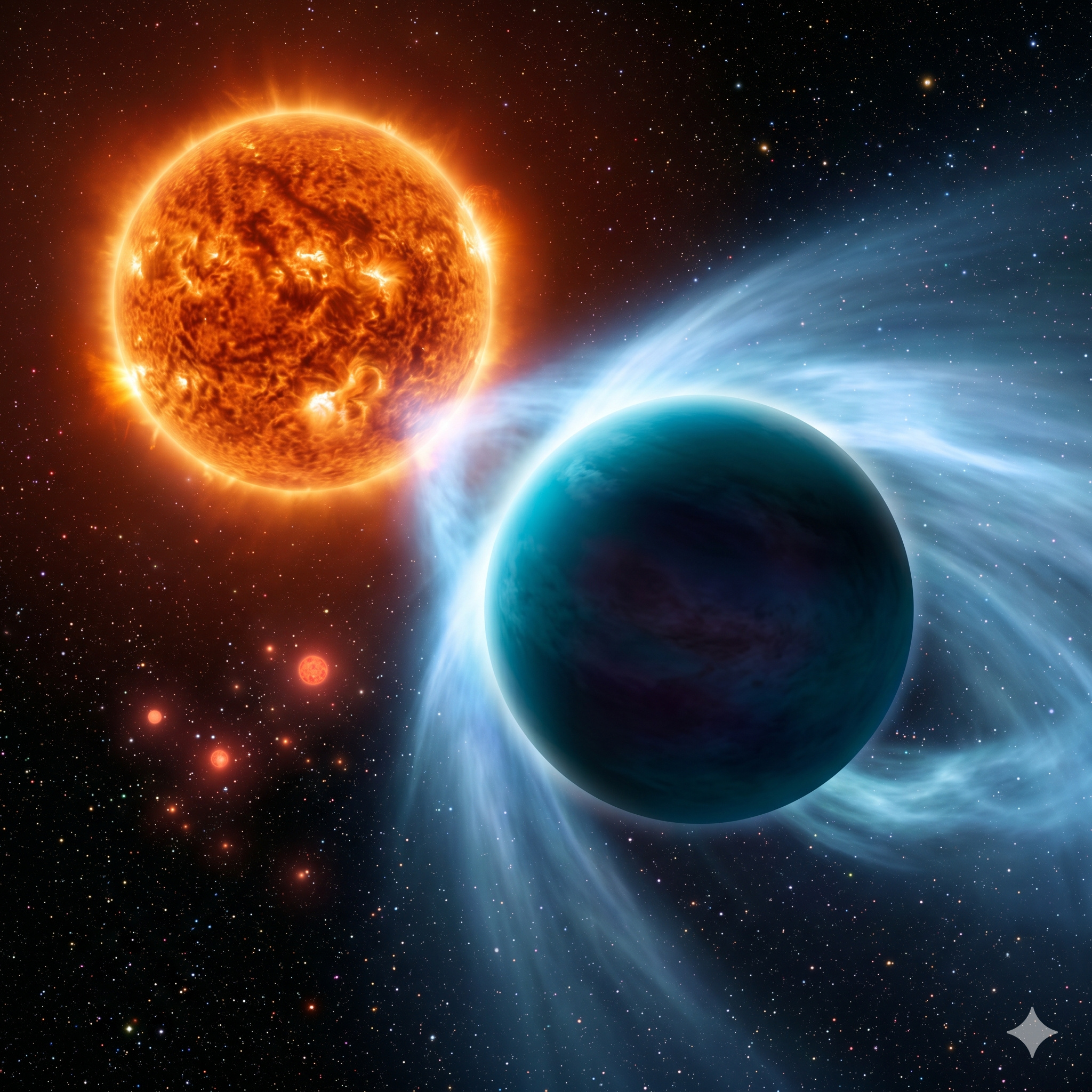

GJ 1214 b may be a water-rich planet on a much larger scale than Earth and helps scientists understand how this resource behaves under extreme conditions.
Discovered in 2009, exoplanet GJ 1214 b has become one of the most investigated worlds in modern astronomy for combining intermediate size, thick atmosphere, and a composition still difficult to decipher. Located about 48 light-years from Earth, in the direction of the constellation Ophiuchus, it orbits an M-type dwarf star and appears in the NASA catalog as a mini-Neptune type planet, although it was treated for years as a “super-Earth” for being between the rocky planets and the ice giants of the Solar System.
With approximately 2.73 times the radius of Earth and a mass estimated by NASA at about 8.4 Earth masses, GJ 1214 b does not fit the profile of a predominantly rocky planet. Its low relative density and extremely short orbit, of only 1.6 days, have made it a priority target for understanding worlds rich in volatiles, dense atmospheres, and possible reservoirs of water in the form of vapor, ice, or material incorporated into the internal structure.
On May 10, 2023, NASA reported that observations from the James Webb Space Telescope provided the most detailed view ever obtained of GJ 1214 b and indicated a highly reflective planet, covered by haze or clouds, with an atmosphere possibly rich in heavier molecules, such as water or methane.
-
Engineers Develop Fridge-Sized Machine to Produce 95-Octane Synthetic Fuel from Air and Water, Aiming to Sustain Combustion Engines Without Oil

-
Two-Armed Robot Uses AI to Reassemble Destroyed Pompeii Frescoes, Solving an “Impossible” Puzzle
-
New Law in Brazil Requires Breaks for Type 1 Diabetes Management at Work, School, and Public Exams

-
Scientists Confirm “Greening” of Antarctica: Ice on the World’s Coldest Continent Turns Green as Mosses Multiply Over Tenfold in Four Decades


Structure indicates the possibility of a deep global ocean beneath a thick atmosphere
Scientific models indicate that GJ 1214 b may be a so-called “ocean world”, where an extensive layer of water covers much of the planet.


However, this ocean would not be similar to Earth’s oceans. It is believed to be beneath a thick atmosphere and possibly enveloped by layers of water in different physical states, including high-pressure ice.
This type of structure may include:
- atmosphere rich in vapor and light gases
- deep liquid water layer
- regions with compressed ice under high pressure
Water, in this case, is not only on the surface but distributed in a complex three-dimensional system throughout the planetary structure.
Dense atmosphere hinders direct observation but reinforces the hypothesis of water abundance
Observations made with the Hubble Space Telescope and other instruments indicate that GJ 1214 b has a thick atmosphere, likely composed of water vapor or gases such as hydrogen and helium mixed with particles.
This atmosphere acts as a barrier that prevents direct observation of the surface, but at the same time reinforces the hypothesis of a planet rich in volatiles, including water.
The difficulty in seeing through the atmosphere is, paradoxically, one of the pieces of evidence that the planet may have an unusual composition.
High temperatures transform water into an extreme environment
Despite the possible abundance of water, conditions on GJ 1214 b are extremely different from those found on Earth.
The planet is very close to its star and completes an orbit in about 1.6 Earth days, which results in high temperatures.
This means that:
- water can exist in vapor form
- the ocean can be under intense pressure
- there are no conditions equivalent to those on Earth’s surface
The presence of water does not imply habitability, but rather an extreme environment where this resource behaves differently.
Study of the planet helps to understand how water behaves outside Earth
Even in hostile conditions, GJ 1214 b offers a natural laboratory to study water in scenarios that do not exist on our planet. Scientists use this type of exoplanet to investigate:
- how water is distributed on massive planets
- how it interacts with dense atmospheres
- how pressure and temperature alter its properties

These studies help broaden the understanding of the water cycle on a planetary scale, going beyond Earth’s limitations.
Ocean world may reveal ways to understand water retention on planets
One of the most relevant points is the water retention capacity. On Earth, water is maintained by a delicate balance between gravity, temperature, and atmosphere. On GJ 1214 b, this balance occurs in a completely different way.
The planet can demonstrate:
- how thick atmospheres help retain water
- how gravity influences the distribution of liquids
- how water can persist in extreme environments
This knowledge can be applied to understanding the evolution of planets and the availability of water in other star systems.
Comparison with Earth highlights difference in scale and complexity
Earth’s oceans represent a relatively small fraction of the planet’s total mass. On GJ 1214 b, water may represent a significant part of the global composition, creating a scenario where the resource dominates the planetary structure.
This difference in scale shows that Earth may not be the most common standard when it comes to water distribution in the universe.

With the advancement of instruments like the James Webb Space Telescope, the analysis of planetary atmospheres and compositions has become more precise.
GJ 1214 b continues to be one of the main targets for this type of investigation, due to its relative proximity and unique characteristics. Each new observation helps refine models and bring scientists closer to more concrete answers about its composition.
Scientific interest goes beyond water and involves planetary formation
Beyond water, GJ 1214 b helps answer fundamental questions about how planets form. It represents an intermediate class between rocky planets and gas giants, offering clues about structural transitions and chemical composition.
This type of planet helps fill gaps in the understanding of planetary diversity in the universe. The possibility of a water-dominated world on a planetary scale broadens the debate about resource distribution in the universe.
While Earth faces challenges related to water management, other worlds may concentrate this resource in much larger quantities, albeit under inaccessible conditions.
The question that arises is direct: can understanding how water exists on planets like GJ 1214 b help redefine the role of this resource in science and in the search for new habitable worlds?