Portuguese
  Spanish


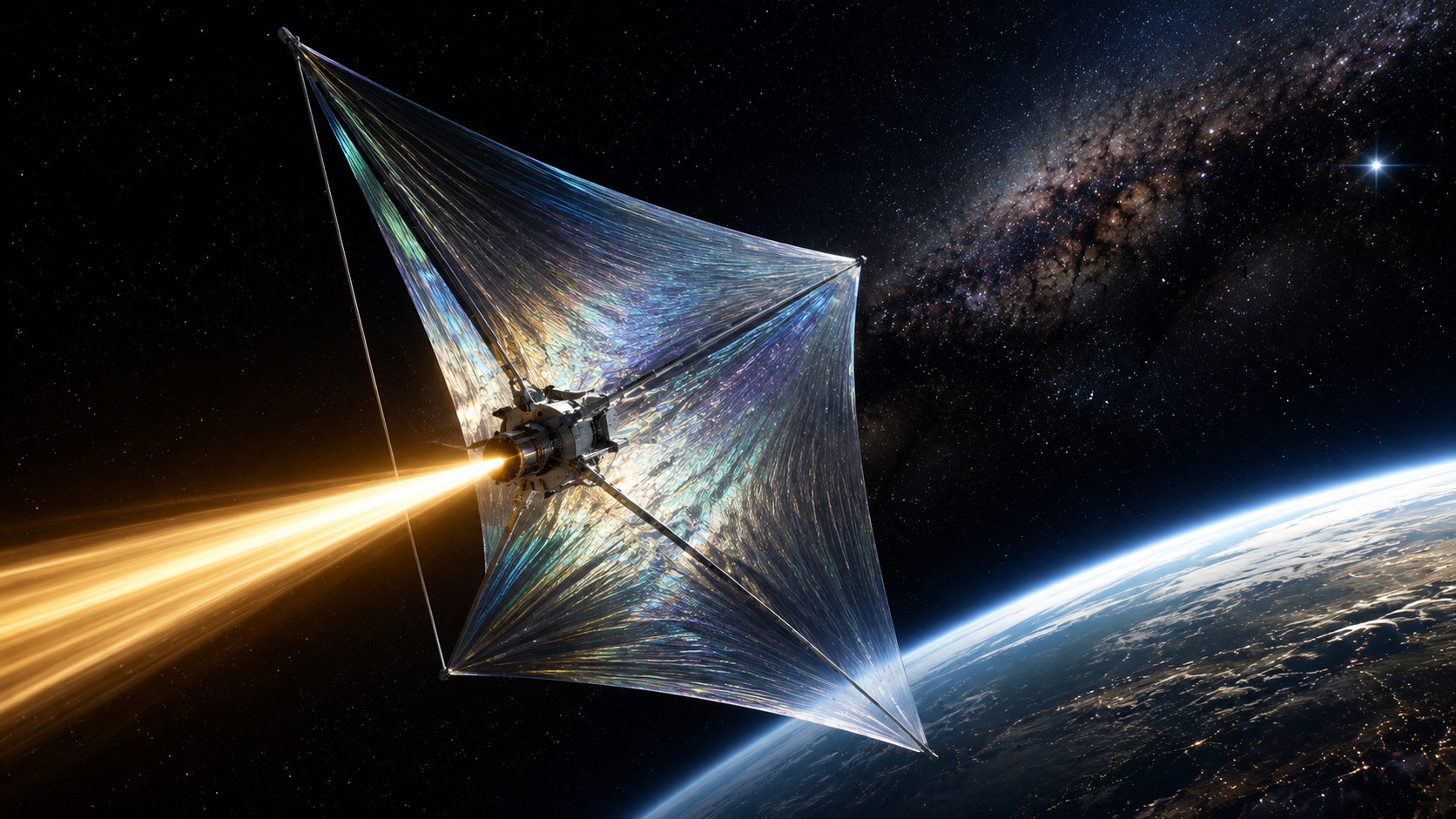

Scientists test light-driven metapropulsion with metamaterials capable of accelerating spacecraft and reducing space travel to 20 years.
Traveling to Alpha Centauri, the star system closest to the Solar System, would take hundreds of thousands of years using current rockets. Now, scientists at Texas A&M University in the United States believe that this scenario could change drastically with a new light-driven metapropulsion technology.
The study led by Kaushik Kudtarkar and published in ScienceDirect on March 30, presents an ultra-light structure based on metamaterials capable of using lasers to propel and steer spacecraft without physical contact. According to the researchers, interstellar travel could drop to approximately 20 years.
The proposal attracted attention because it combines advanced photonics, nanotechnology, and extremely precise optical systems. In addition to accelerating spacecraft, the technology also allows for complete three-dimensional maneuvers using only light.
-
China Tests Giant 582-Ton Magnets to Contain Plasma Hotter Than the Sun’s Core, Aiming to Cut Superconductor Costs and Generate First Electricity from “Artificial Sun” by 2030

-
Seventh Grader Builds Nuclear Fusion Machine at Home, Aiming for Guinness World Record

-
Ancient Ritual Circle, Hidden for 5,000 Years, Discovered in Scotland’s Machrie Moor Using Sensors, Revealing a “Phantom Stonehenge”

-
Engineers Develop Fridge-Sized Machine to Produce 95-Octane Synthetic Fuel from Air and Water, Aiming to Sustain Combustion Engines Without Oil



How light-driven metapropulsion works in practice
The so-called directed energy propulsion uses gigantic lasers to push spacecraft from a distance. Instead of traditional engines, the spacecraft receives thrust through the pressure exerted by photons.
The research’s differential lies precisely in the metamaterials used on the surface of the structure. These artificial materials can control the interaction with light on an extremely small and precise scale.
In practice, the scientists developed microscopic patterns capable of altering the behavior of photons when they hit the spacecraft’s surface. This creates the so-called “metapropulsion jets,” responsible for generating controlled movement.
Among the main advances presented by the team are:
- Complete three-dimensional control of the spacecraft;
- Direction without mechanical contact;
- Ultra-thin and extremely lightweight structure;
- Use of lasers as the main source of acceleration;
- Greater precision in trajectory control.
According to the researchers, the structure managed to demonstrate a level of maneuverability never achieved in previous optical propulsion systems.

Metamaterials allow precise control of light in spacecraft
Metamaterials are considered the technological foundation of this new generation of light-driven metapropulsion. Unlike conventional materials, they are artificially created to manipulate electromagnetic waves.
These ultra-thin structures, also called metasurfaces and metalenses, have nanometric patterns capable of controlling the direction, intensity, and dispersion of light with extreme precision.
This makes the energy transfer to spacecraft much more efficient. Moreover, metamaterials help reduce weight, which is essential for long-duration interstellar missions.
Another important detail highlighted by scientists is that the force generated mainly depends on the power of the light emitted by the lasers, and not necessarily on the size of the spacecraft. This opens up possibilities for larger projects in the future.

Scientists believe the technology can surpass the limits of current rockets
Modern space exploration still heavily relies on chemical fuels. Although efficient for nearby missions, these systems have limitations when it comes to interstellar travel.
Voyager 1, for example, launched in 1977 by NASA, is currently traveling at about 61,000 kilometers per hour. Even at this impressive speed, it would take more than 70,000 years to reach Alpha Centauri.
With the new light-driven metapropulsion, the scenario changes completely. Researchers believe that small ultra-light spacecraft could reach significant fractions of the speed of light, reducing the journey to something close to two decades.
This concept already appears in initiatives like the Breakthrough Starshot project, which aims to send space nanosondes propelled by lasers towards neighboring star systems.
Light replaces fuel and reduces the weight of future spacecraft
One of the biggest advantages of light-driven metapropulsion is the reduction in dependence on conventional fuel. Instead of carrying tons of chemical propellant, spacecraft would use the pressure of light itself as a source of acceleration.
Although photons have no mass, they carry linear momentum. When they hit surfaces carefully designed with metamaterials, they can transfer enough energy to propel lightweight structures in space.
This model offers important advantages:
- Significant reduction in spacecraft weight;
- Less need for fuel storage;
- Potential for much higher speeds;
- Less mechanical wear during long journeys;
- Possibility of miniaturizing spacecraft.
Scientists point out that this change could completely redefine aerospace designs in the coming decades.
Microgravity tests will be the next step in research
The experiments carried out so far have taken place in the laboratory. Now, the team is seeking funding to take the tests to microgravity environments, where light-driven metapropulsion can be analyzed under more realistic conditions.
According to Kaushik Kudtarkar and his colleagues, the absence of gravitational interference will allow for more precise observation of how metamaterials react to intense light beams.
The next tests may involve:
- Orbital platforms;
- Controlled microgravity environments;
- Advanced space simulations;
- Larger optical structures;
- More powerful and stable lasers.
If the results are positive, the technology could pave the way for a new generation of ultra-light interstellar spacecraft.

Metapropulsion and metamaterials could open a new space era
In recent years, scientists have heavily invested in technologies related to photonics, nanotechnology, and advanced manipulation of light. The new light-driven metapropulsion emerges precisely within this scenario of accelerated innovation.
In addition to space exploration, metamaterials are also being studied for applications in telecommunications, optical sensors, radars, medicine, and advanced computing.
Experts believe that the combination of lasers, optical intelligence, and ultrathin structures could reduce operational costs, increase energy efficiency, and enhance the capacity of future space missions.
There are still significant challenges involving laser power, structural stability, and optical precision. Even so, initial results show that the idea of reaching other stars in just 20 years no longer seems purely theoretical.
The research reinforces how light can become one of the most important tools of modern space engineering, bringing humanity closer to a goal pursued for decades: traveling beyond the Solar System in timeframes viable for a single generation.
With information from Science Direct.