






 Portuguese
  Spanish


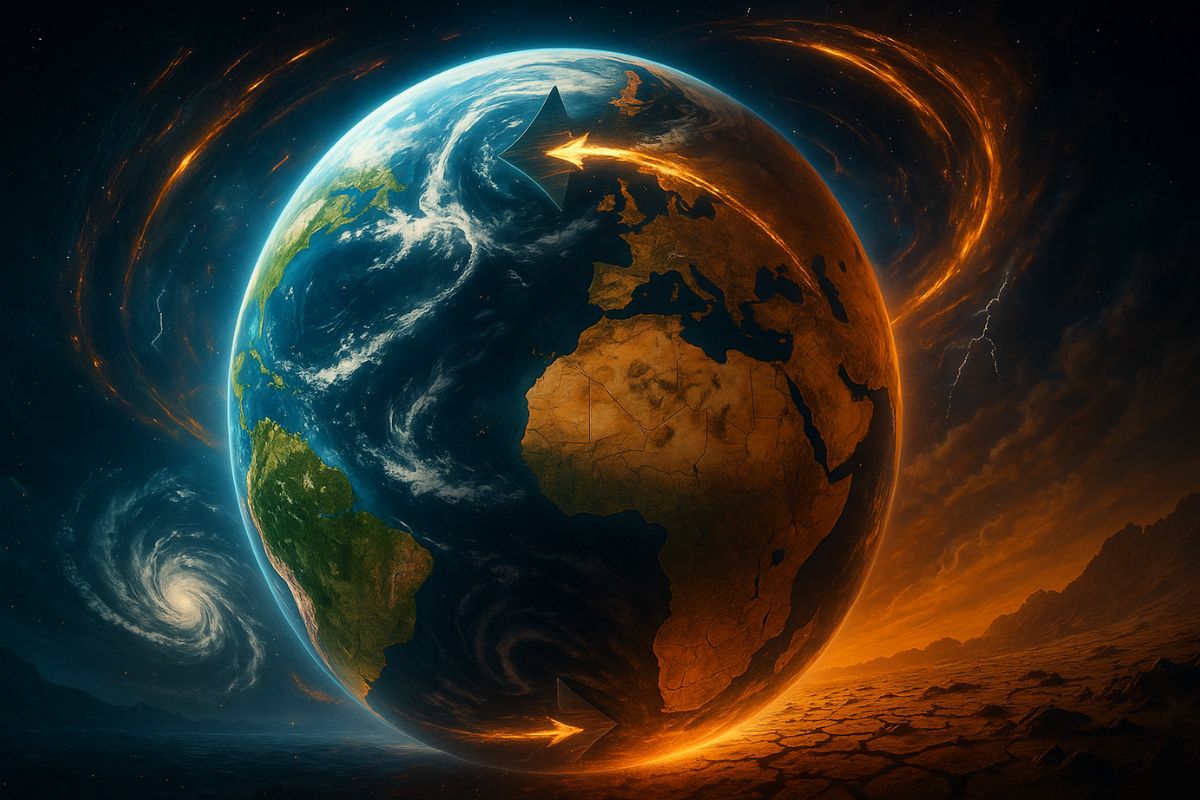


Max Planck Institute Study Reveals That Earth Rotating Backwards Would Completely Change Climate, Altering Agriculture, Biodiversity, and Storm Patterns on the Planet
The hypothesis of the Earth rotating backwards intrigues scientists because it reveals how a seemingly simple change could provoke gigantic transformations on a global scale. According to the Olhar Digital portal, studies show that the reversed rotational movement would directly affect winds, ocean currents, and rainfall, redesigning deserts, fertile areas, and even the survival of species.
Researchers point out that deserts like the Sahara could disappear, giving way to vegetation, while regions currently fertile including southern Brazil would face drought and aridity.
The planet would remain habitable, but completely different from how we know it today.
-
$75 Million Bridge in Brazil Opens to Connect Cities, Create Jobs, and Cut Travel Time from 30 to 2 Minutes; Spanning 1.24 km, It’s Among the Country’s Largest and Ends Decades of Ferry Queues.

-
Brazilian Farmer Builds 8-Ton Tractor from Army Truck Engine, Plants Over 100 Hectares of Soybeans
-
11-Year-Old Entrepreneur Turns Fear of Bees into Honey Lemonade, Wins $60,000 on Shark Tank, Secures Whole Foods Deal, and Expands Brand Across U.S. Stores

-
9-Year-Old in Brazil Sells Homemade Sweets to Support Grandfather with Parkinson’s, Family Dreams of Buying Candy-Making Machine




How Earth’s Rotation Influences Climate
The Earth’s rotation is responsible for defining patterns of winds, ocean currents, and rainfall distribution. If this movement were reversed, the Sun would rise in the west and set in the east, and the entire climatic logic would be redesigned.
According to scientist Florian Ziemen from the Max Planck Institute for Meteorology, the topography of the continents would remain the same, but the climatic and ecological systems would be completely different.
Hurricanes and cyclones would emerge in areas where they have never occurred, and entire agricultural zones could cease to exist.
Deserts Disappear, But New Arid Areas Emerge
The simulation released by Ziemen shows that the total area of deserts would shrink by about 11 million km², making room for the expansion of grasses and dense vegetation. This new plant cover would increase carbon absorption, altering the global climate balance.
On the other hand, new arid areas would emerge in regions that are currently productive, such as southern Brazil, Argentina, the southeastern United States, and northern China.
This would displace agricultural poles, transforming economies and changing food production logic worldwide.
Direct Impacts on Brazil
For Brazil, the consequences would be drastic. While the south could become desert, areas currently underutilized could become fertile.
This redistribution of rainfall and water resources would affect livestock, agriculture, and entire production chains, requiring quick adaptation from society.
Moreover, animal and plant species would lose their current habitats and would need to adapt or disappear, while new species could emerge in transformed ecosystems.
Global and Scientific Consequences
The changes would not be limited to agriculture. The Olhar Digital portal highlights that winds and storm systems would change radically, bringing hurricanes and extreme events to areas that have never experienced such phenomena.
In addition, the change in the carbon cycle caused by the new vegetation would alter the climatic balance, creating unpredictable long-term effects.
The planet would remain habitable, but unrecognizable in its natural dynamics.
Real Possibility of Happening?
In practice, the chance of the Earth rotating backwards becoming a reality is virtually zero. For this to happen, a collision with a celestial body the size of the Moon would be required, an event that would likely destroy life on the planet.
Still, scientists consider these simulations valuable. They show how life depends on a delicate balance between physics, climate, and biology and help better understand the fragility of our Earth system.
The simulation of the Earth rotating backwards serves as a scientific warning about how small physical changes can cause global transformations.
Deserts could disappear, new arid areas would emerge, and humanity would have to adapt to a completely new reality.
And you? Do you think these simulations help to better understand the fragility of Earth or are they just curiosities without practical application?
Leave your opinion in the comments; we want to hear from those closely following climate changes and the advances of science.





Quanta estultice