






 Portuguese
  Spanish



Global Report of 2025 Reveals That Vital Ecosystems Are Under Extreme Pressure, While Only Ozone and Aerosols Remain Within the Safe Zone
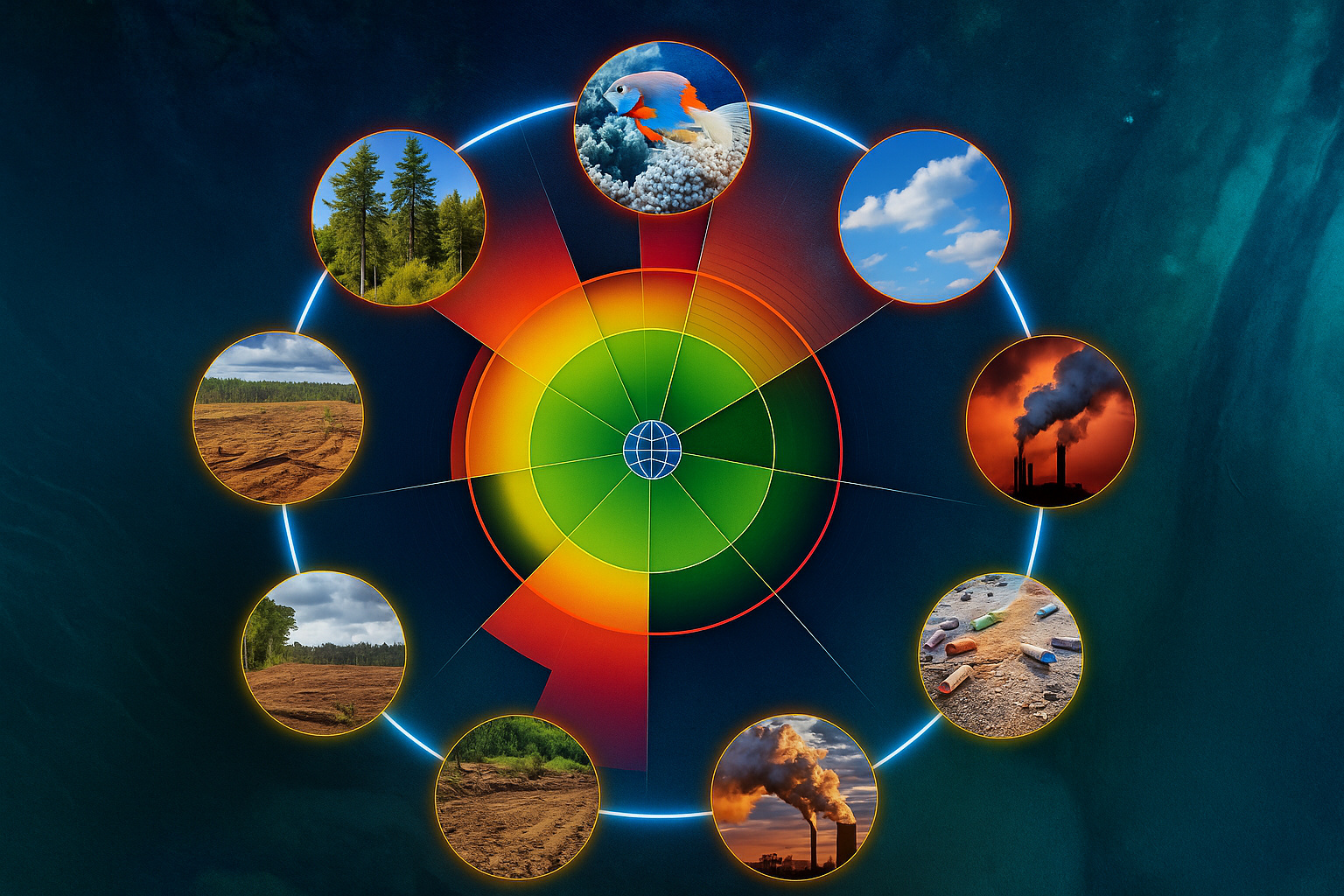
An international survey released in September 2025 by the Potsdam Institute for Climate Impact Research (PIK) confirmed that the Earth has already surpassed seven of its nine planetary boundaries. These boundaries function as scientific indicators that measure the extent to which the planet can still sustain life in balance.
The main novelty of the report was the confirmation that ocean acidification has moved from the alert zone to the risk zone. Thus, it has become yet another process operating outside environmental safety. According to researchers, this condition poses a direct threat to coral reefs, shellfish, and marine species essential for the global food chain.
Meanwhile, only the ozone layer, having recovered after multilateral efforts since the 1990s, and atmospheric aerosols remain within considered stable limits. Thus, the report shows that advances made in some sectors contrast with severe setbacks in others.
-
China Develops Custom 140-Ton Electric Mining Truck with 770 kWh Swappable Battery, Deploys 290 Units in Xinjiang’s Largest Zinc Mine

-
Meta to Launch Arena, a New Prediction App Targeting 3.56 Billion Users, Competing with Polymarket and Kalshi

-
Scientist Challenges Famous Human Evolution Theory, Argues Homo Sapiens Evolved Gradually Over Thousands of Years
-
15-Year-Old American Builds Ocean Generator with PVC Pipe and 3D-Printed Propeller for $12, Wins National Prize, Presents at White House, and Makes Forbes 30 Under 30 List




Seven Boundaries Have Been Breached
According to the study, published with support from international councils and updated annually since 2009, the seven processes operating outside safety are:
- Land Use Changes: between 2000 and 2018, nearly 90% of deforestation was caused by agricultural expansion. Thus, global forest cover has fallen to 59%, below the 75% considered safe by Copernicus.
- Climate Change: in 2024, CO₂ reached 422 ppm, while the safe limit was 350 ppm. Furthermore, radiative forcing reached 2.79 W/m², above the safe value of +1.0 W/m².
- Biodiversity: at least 73 vertebrate groups have disappeared in the last 500 years. Therefore, accelerated losses in intensive agricultural areas reinforce the warning made by PIK reports.
- Nitrogen and Phosphorus Cycles: in 2024, phosphorus discharge reached 22.6 Tg per year, above the limit of 11 Tg. Furthermore, industrial nitrogen fixation reached 190 Tg, exceeding the limit of 62 Tg annually.
- Freshwater Use: 18% of the land surface is already experiencing critical changes in river, lake, and aquifer flows. Meanwhile, 16% faces inadequate moisture levels, placing entire ecosystems at risk.
- Chemical Pollution: between 2000 and 2017, the production of synthetic substances continuously grew. Moreover, a recent Brazilian study found microplastics even in the human brain, raising alarm signals for health impacts.
- Ocean Acidification: in 2025, the aragonite level fell to near 2.75, below the ideal of 2.80. Thus, there was official confirmation of the breach of the safety barrier.
Confirmed Global Impacts
The report highlights that breaching these boundaries is already presenting consequences in different parts of the world. The increase in the global average temperature in 2024 made August the hottest month on record.
According to Renata Piazzon, director of the Arapyaú Institute, “the data shows that the planet is under enormous pressure. If we do not take immediate action, we will be further accelerating the climate crisis and the loss of biodiversity.”
Furthermore, PIK points out that the oceans are becoming increasingly acidic and less oxygenated. Thus, entire food chains are at risk. Co-author Levke Caesar stated that “marine heatwaves are increasing, and this pressures a vital system to stabilize the planet.”
Historical and Scientific Context
The concept of planetary boundaries was proposed in 2009 by scientist Johan Rockström, also from PIK. Since then, researchers have refined data and updates to alert governments and society to the climate emergency.
A report from the Global Coral Reef Monitoring Network (GCRMN), published in 2020, already indicated that the world lost 14% of its coral reefs between 2009 and 2019. Moreover, more than 73 countries were analyzed. This data now gains relevance in light of the confirmation that the oceans have definitively crossed the safety threshold.

What Is at Stake for the Future?
Experts assess that the breach of seven planetary boundaries not only jeopardizes ecosystems but also food security, the availability of freshwater, and global climate stability.
The persistence of this scenario may exacerbate environmental disasters, increase prolonged droughts, lead to more severe flooding, and accelerate the loss of species fundamental to the balance of the biosphere.
Therefore, in light of this situation, scientists emphasize the need for coordinated actions among countries. It is necessary to reduce greenhouse gas emissions, limit deforestation, and control chemical pollution.
What do you believe should be a priority for the world: accelerate stringent measures against the climate crisis or bet on gradual solutions to reconcile economy and environmental preservation?






