Portuguese
  Spanish


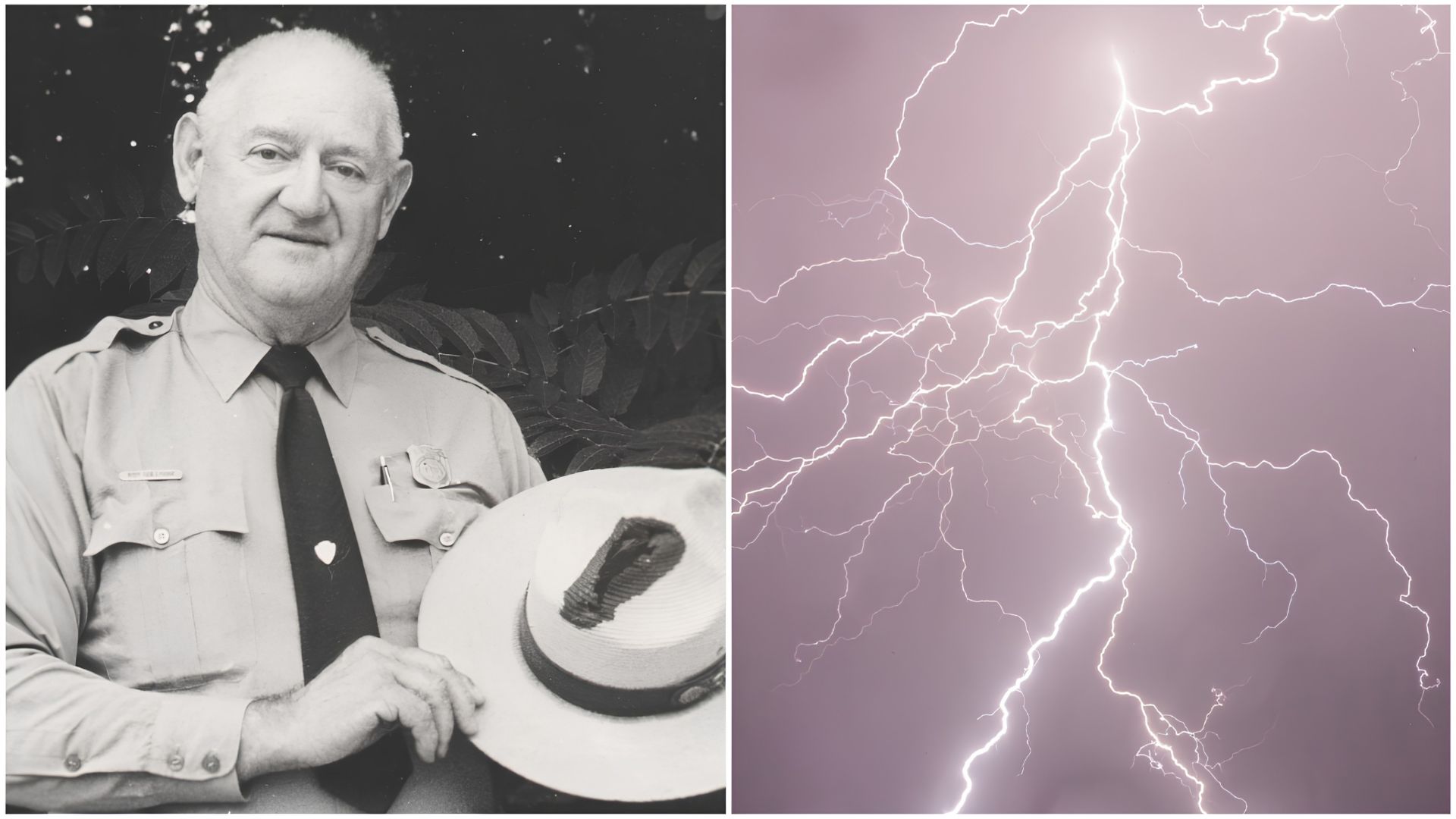

Roy Sullivan survived 7 lightning strikes and became the “human lightning rod”; understand the real case and what science says about electrical discharges.
In 1977, American park ranger Roy Sullivan entered the Guinness World Records after surviving a feat that defies statistics and logic: being struck by lightning seven times throughout his life and remaining alive. The case occurred in the United States, mainly within Shenandoah National Park, where he worked as a park ranger. Records indicate that the incidents happened between 1942 and 1977, a period during which Sullivan suffered different types of injuries, including burns, hair loss, hearing damage, and even his clothes catching fire. Nevertheless, he survived all events, something considered extremely rare by meteorology and atmospheric electricity specialists.
Roy Sullivan was struck by lightning seven times between 1942 and 1977 in one of the most storm-exposed parks in the United States
Roy Sullivan worked for decades as a park ranger in Shenandoah National Park, a mountainous area of Virginia known for the frequency of electrical storms. This geographical factor is considered one of the main explanations for the repetition of the incidents.
The first recorded incident occurred in 1942, when he was in an observation tower and was struck after lightning hit the structure. The impact resulted in his foot being burned, marking the beginning of a sequence of unusual events.
-
Orphaned Youth Turns Dismissed Idea into Global Prestige with Innovative Wristwatch

-
English Skills Boost Career Opportunities in the Oil and Gas Industry

-
Brazil Secures Second Place at WorldSkills 2024 in Lyon, with 64 Young Professionals and 8 Medals, Including Gold from a Rio de Janeiro Hairdresser

-
3,000 Military Personnel from 10 Countries, Including US and Chinese Marines, Train Together in Brazil’s Savanna: Operation Formosa Becomes Largest Naval Ground Exercise Before First Cancellation Since 1988



Other episodes happened over the years, often during routine activities in the park. In one of the most well-known cases, lightning struck his hat, setting it on fire and burning his hair. In another, he lost his eyebrow and suffered burns on his shoulder.
Each episode had different characteristics, but all involved direct or indirect electrical discharges, which makes the case even rarer from a scientific point of view.
The probability of a person being struck by lightning is already low, and for it to happen seven times is extremely unlikely
According to National Weather Service data, the probability of a person being struck by lightning in their lifetime is relatively low. Estimates indicate that the annual risk is less than 1 in 1 million.
When considering the possibility of multiple occurrences, the numbers become even more extreme. The chance of the same person being struck seven times is considered statistically improbable to the point of being treated as an exceptional case.
This scenario does not mean that there is some human “magnetic factor”, but rather a combination of frequent exposure to risky environments and specific circumstances over time.
In Sullivan’s case, working outdoors in a mountainous region significantly increased his exposure to electrical storms.
Lightning can reach temperatures higher than the Sun’s surface and carry enough energy to cause severe damage
An atmospheric electrical discharge can reach temperatures of up to 30 thousand degrees Celsius, a value higher than the temperature of the Sun’s surface. This intense energy is released in fractions of a second, but is sufficient to cause severe burns, cardiac arrest, and neurological damage.
In addition to temperature, the electrical current involved in a lightning strike can exceed tens of thousands of amperes. When this current passes through the human body, it can affect vital organs and essential systems.

Despite this, not all lightning strikes directly hit the person, which can explain cases of survival. In many episodes, the discharge occurs indirectly, by conduction through objects or through the ground.
This detail is important to understand how Roy Sullivan managed to survive multiple events.
Survival depends on the type of discharge and the path of the electrical current through the body
Experts explain that surviving a lightning strike depends on several factors, including the type of discharge, the intensity of the current, and the path the electricity takes through the body.
There are different forms of impact, such as:
- direct strike
- ground current
- conduction through nearby objects
- side flash from structures
When the current travels over the surface of the body instead of passing through vital organs, the chances of survival increase. This phenomenon is known as the “flashover” effect.
This type of electrical behavior can reduce internal damage, although it still causes external burns and other physical effects. In Sullivan’s case, it is believed that many of the impacts occurred in this way, which contributed to his survival.
Case became a global reference and entered historical records of extreme events
Official recognition came with inclusion in the Guinness World Records, solidifying Roy Sullivan as the person with the most documented lightning strike survivals.
The case began to be cited in studies, reports, and educational materials on storm safety, serving as an extreme example of risk exposure.
The story also helped raise awareness about the dangers of electrical storms, especially for people who work outdoors.
Furthermore, the case reinforces the importance of protective measures, such as avoiding open areas, isolated structures, and contact with metallic objects during storms.
Working outdoors in mountainous regions significantly increases the risk of electrical discharges
Environments such as national parks, rural areas, and mountainous regions are more prone to the formation of electrical storms, increasing the risk for workers in these areas.
In Shenandoah National Park, the combination of elevated terrain and climatic conditions favors the frequent occurrence of lightning. This context helps explain Sullivan’s prolonged exposure to risk.
Professions that require constant outdoor presence, such as park rangers, farmers, and construction workers, are among the most vulnerable during storms. This factor reinforces that Sullivan’s case, although extreme, did not occur in a random context.
Science explains the phenomenon, but does not eliminate the rare nature of the case
Even with explanations based on probability and physics, Roy Sullivan’s case continues to be considered exceptional. The repetition of events of this nature in a single person is not common and cannot be generalized.
Researchers point out that most people struck by lightning experience only one event in their lifetime, if it occurs.

The case does not indicate special resistance of the human body to electricity, but rather a rare combination of exposure, circumstances, and type of discharge. This distinction is fundamental to avoid mistaken interpretations of the phenomenon.
Story raises debate about limits of probability and extreme events in nature
Cases like Roy Sullivan’s challenge common perceptions of risk and probability, showing that extremely rare events can happen under certain conditions. At the same time, they reinforce the importance of understanding natural phenomena based on science and data, avoiding supernatural or unfounded interpretations.
The episode remains one of the most extreme examples ever recorded of interaction between human beings and intense natural forces, such as atmospheric electrical discharges.
Given a case like this, do you believe we are prepared to fully understand extreme natural events, or do we still underestimate the real impact of these phenomena on daily life?