Portuguese
  Spanish


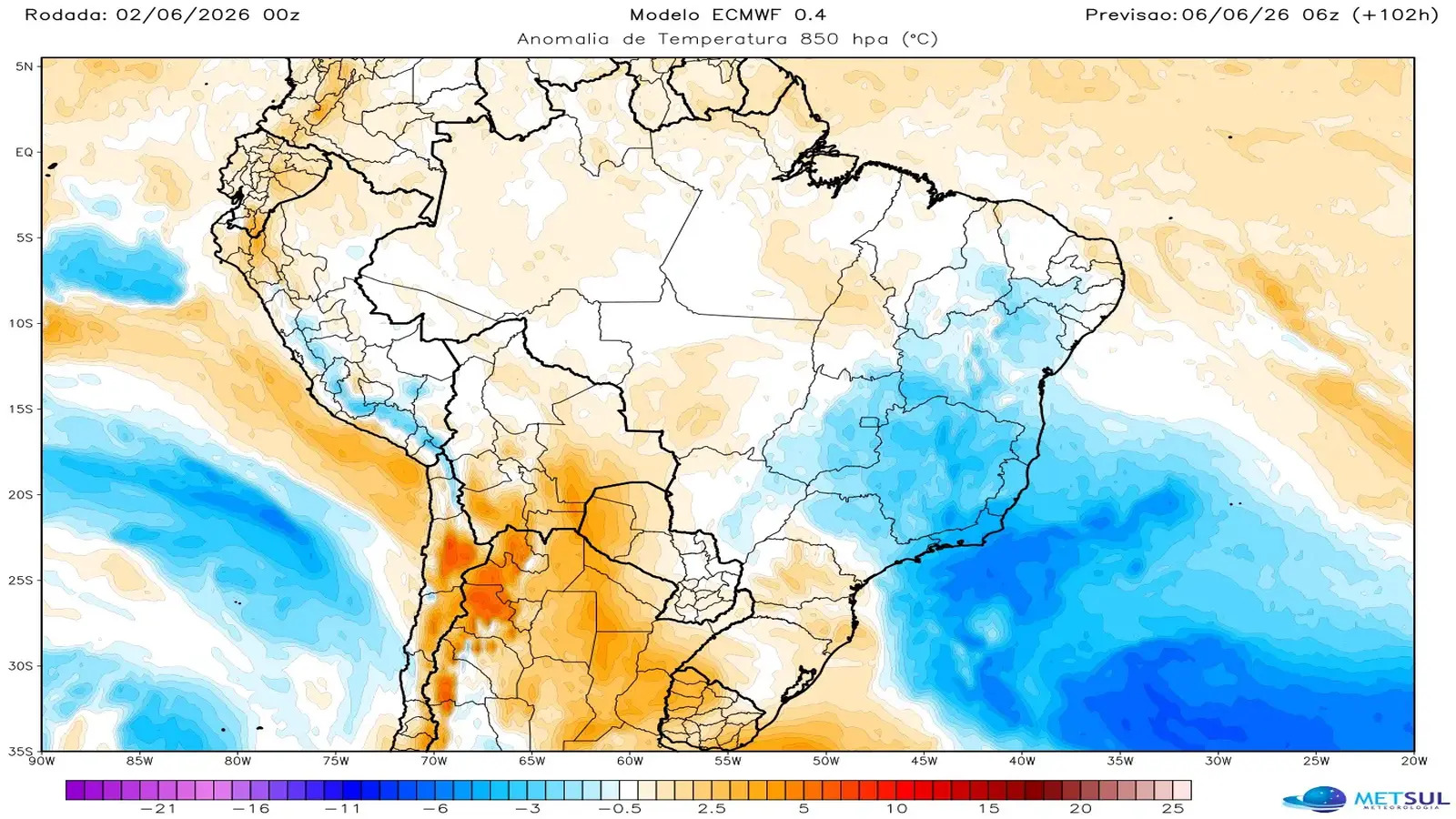

According to a forecast by Metsul released yesterday (READ HERE), a cold air mass with a maritime trajectory is advancing through the Atlantic Ocean, expected to cause a temperature drop in the Southeast and also influence the Northeast in the coming days. The system, associated with a high pressure of 1035 hPa in the South Atlantic, is expected to cause cold in Minas Gerais, São Paulo, and the interior of Bahia, as well as heavy rain on the Bahian coast.
Cold air mass arrived laterally in Rio Grande do Sul
The incursion of cold air only grazed Rio Grande do Sul, but it was already enough to cause a Tuesday morning with winter-like temperatures in several cities of Rio Grande do Sul.
The lowest temperatures reached 3.8ºC in Getúlio Vargas, 4.8ºC in Bagé, 5.0ºC in São José dos Ausentes and São Francisco de Paula, as well as 5.4ºC in Capão Bonito do Sul.
-
Scientists Convert Food Waste into Aviation Fuel, Successfully Test 50% Blend with Conventional Kerosene to Cut Emissions and Promote Sustainable Flights

-
OnePlus N6 Smartphone to Launch in India with 8,000mAh Battery and 45W SuperVOOC Charging, Lasting Up to Three Days
-
Scientists Plan to Release Air Bubbles Underwater to Protect Antarctica’s “Doomsday Glacier” from Melting

-
Chinese R6000 Drone Combines Airplane and Helicopter Features, Carries Up to 12 People for Multiple Missions




Minimum temperatures of 5.9ºC were also recorded in Viamão, 6.1ºC in Ijuí and Chuí, 6.2ºC in Pontão, 6.7ºC in Sarandi, Gravataí, and Tapera, and 6.8ºC in Porto Alegre, Lami, and Espumoso.
As the cold air does not advance more directly over the territory of Rio Grande do Sul, the forecast indicates a rise in temperature starting this Wednesday (3).
The afternoons should be pleasant and even a bit warm in the second half of the week, while the nights remain cold, especially in higher areas.

Southeast will have cold dawns and possibility of frost
The most intense cooling is expected to occur in the Southeast of Brazil. São Paulo and Minas Gerais will have cold dawns at the end of the week, with the possibility of frost in the southern part of Minas and in mountainous areas of São Paulo.
Minas Gerais is expected to feel the effects for a longer period, with a long sequence of cold nights and frost formation in several cities. The condition may even reach points in the center of the state.
The cold air will also reach Espírito Santo. In Rio de Janeiro, the circulation of high pressure should favor humid winds from the ocean, increased cloudiness, rain, and lower temperatures.
Bahia should have heavy rain on the coast and cold in the interior
The maritime trajectory of the cold air mass allows the system to advance along the coast of Brazil until it influences the Northeast Region, where low temperatures are not the norm.
Bahia is expected to be one of the most affected states, but with different effects between the coast and the interior. On the coastal strip, the cold front at the forefront of the cold air mass and the moisture flow from the ocean should cause a lot of rain.
The Salvador region deserves attention, with expected accumulations above 100 mm. Some models indicate that the volumes may even exceed 150 mm.
In the interior of Bahia, the drier air should favor a drop in temperature. Municipalities further west and near the border with Minas Gerais may record single-digit lows, below 10ºC.
Cold in the Northeast may surpass marks of cities in Rio Grande do Sul
Many municipalities in Bahia far from the coast may record lows between 10ºC and 13ºC, especially between the end of the week and the beginning of the next.
This condition draws attention because it is not common in the Northeast of Brazil. In some parts of Bahia, the weekend lows may be below those recorded in many cities in Rio Grande do Sul.
This article was prepared based on information from the provided source material, with data, numbers, and forecasts preserved as per the consulted content.