






 Portuguese
  Spanish



41,000 Years Ago, Earth’s Magnetic Field Underwent a Major Change. Now, For the First Time, It’s Possible to Hear How It Sounded. See How This Event Is Revealing New Secrets About Our Planet!
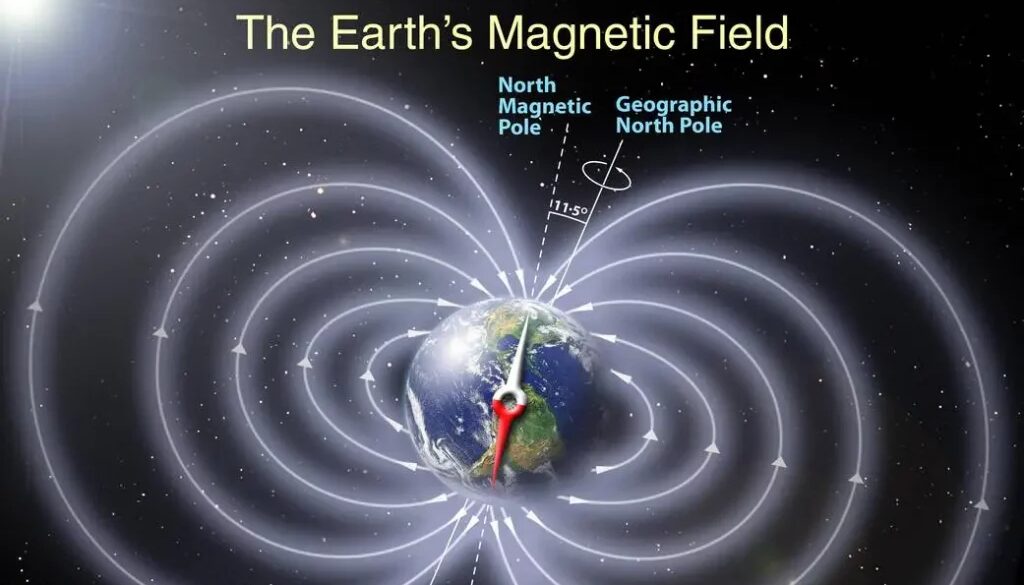
The Earth’s magnetic field plays a fundamental role in protecting our planet from cosmic and solar radiation, something that often goes unnoticed in everyday life. However, around 41,000 years ago, this protective shield faltered and underwent a reversal.
This dramatic event, known as the Laschamp event, brought with it a series of geological and climatic changes that still intrigue scientists today.
What Is the Laschamp Event?
The Laschamp event was a period of reversal of the Earth’s magnetic field, when the magnetic poles temporarily inverted. During this event, which lasted approximately 250 years, the magnetic field weakened drastically, exposing the Earth to elevated levels of cosmic radiation.
-
James Webb Telescope Uncovers Unexpected Clues on Mysterious Moon, Potentially Redefining Planetary Origins

-
$1.5 Billion Sleipnir Vessel Transforms Ocean into Floating Construction Site with 12 Hybrid Engines and Capacity to Lift 20,000 Tons

-
23 Years After Tragedy, Brazil’s Alcântara Space Center to Launch New Suborbital Rocket in 2026 with South Korean SEBIT Project Targeting Near-Space Tests
-
Entrepreneur Turns Neighbor’s Coffee Grounds Waste into Eco-Friendly Pellets, Earning Up to $40,000 Monthly in Brazil


The consequence of this inversion was a greater penetration of solar radiation into our atmosphere, leaving evidence in ice layers and ocean sediments.
The discovery of this phenomenon occurred through paleomagnetic studies, which analyze rocks and sediments to understand the Earth’s magnetic history.
During the Laschamp event, the magnetic field dropped to only 10% of its usual strength, which would have considerable impacts on various forms of life, as well as possible influences on human behaviors, such as the more frequent use of caves as shelters.
The Impact on the Planet and Living Beings
One of the main consequences of the weakening of the magnetic field during the Laschamp event was the increased exposure to cosmic radiation. Evidence indicates that this event may have contributed to the extinction of some species, such as Australian megafauna.
Although this hypothesis is still a matter of debate among scientists, it is undeniable that the extra radiation would have caused significant environmental stresses.
Additionally, there are theories suggesting that the changes in environmental conditions during this period may have impacted human behavior.
With greater exposure to harmful radiation, it is possible that our ancestors sought refuge in caves to protect themselves from the effects of these changes in the magnetic field.
Earth’s Magnetic Field: The Sound of Magnetic Inversion
Although the Laschamp event occurred tens of thousands of years ago, scientists from the Technical University of Denmark and the German Research Centre for Geosciences have managed to bring this ancient disturbance to life in an innovative way: by transforming it into sound.
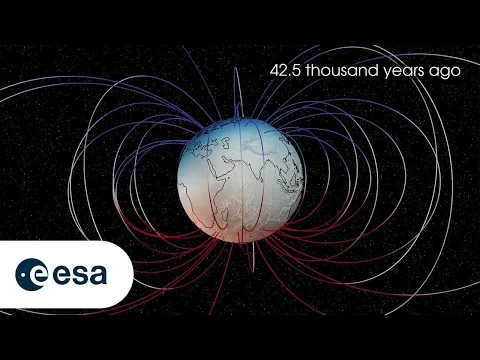

Using data from the Swarm mission of the European Space Agency (ESA), researchers created a soundscape based on the movements of the magnetic field lines during the Laschamp event.
The result is an unsettling and mysterious sound that evokes the sense of a moment of great disturbance in the planet’s history.
This innovative approach helps make an abstract scientific event more accessible to the public, allowing people to “hear” what happened thousands of years ago.
The combination of scientific data with natural sounds, such as creaking wood and breaking stones, results in an immersive auditory experience that transports listeners to the past.
The Implications for the Future
Today, scientists continue to monitor the Earth’s magnetic field, especially in areas where it appears to be weakening. A notable example is the South Atlantic Anomaly, a region where the magnetic field is particularly weak.
Some experts speculate that this anomaly could be a precursor to a new pole reversal, although there is no concrete evidence that a reversal is imminent.
Since 2013, the satellites of the ESA’s Swarm mission have been collecting detailed data on the Earth’s magnetic field, helping scientists to better understand its complex dynamics.
This data is also essential for predicting possible future changes in the magnetic field, which could have significant implications for our modern technology.
What Could a New Inversion Mean?
While a new magnetic pole inversion is unlikely to happen in the near future, the effects of a continued weakening of the magnetic field could be significant, especially regarding our technological dependence.
A weaker magnetic field would offer less protection against solar wind and cosmic radiation, which could cause problems for telecommunications satellites, GPS systems, and even electric grids.
According to Monika Korte, a geomagnetism expert at GFZ Potsdam, a new inversion could increase the occurrence of geomagnetic storms, which already cause damage to satellites and communication disruptions.
However, she emphasizes that the Earth’s atmosphere would continue to provide enough protection for humans and other living beings against most radiation.


