






 Portuguese
  Spanish




SpaceX, Elon Musk’s Company, Will Be Responsible for Launching Dragonfly, NASA’s First Mission to Titan with Nuclear Energy.
This Monday (26), SpaceX signed a groundbreaking contract with NASA worth US$ 256.6 million (approximately R$ 1.49 billion). The agreement includes the costs and services necessary for launching the Dragonfly mission, which will explore Titan, Saturn’s largest moon. This partnership marks a historic milestone, as it will be the first time SpaceX transports nuclear materials into space.
Dragonfly Mission: Nuclear Energy to Explore Titan
Dragonfly will be powered by a radioisotope thermoelectric generator (RTG), which utilizes the decay of plutonium-238 to produce energy. This is a significant change for SpaceX, which has so far used solar energy in its missions. However, on Titan, which is nearly ten times the distance from Earth to the Sun and has a thick atmosphere of nitrogen and methane, solar power is not viable.
The SpaceX Falcon Heavy rocket, which is already certified for high-cost robotic missions by NASA, will undergo an additional certification process. This includes a rigorous analysis of the self-destruct system to ensure the safety of the nuclear material on board.
-
World’s First Lithium-Sulfur Battery Factory Launches, Promising to Double Range Without Relying on China

-
AI Data Centers Now Feature Built-In Nuclear Power Plants and Have Ordered Non-Existent Reactors
-
In India, thousands earn about $2.50 an hour cooking and cleaning with a phone strapped to their heads, as every move is recorded to train humanoid robots for jobs they might one day replace.

-
Nuclear Fusion Study Proposes Transforming Mercury into Gold Using Tokamak Neutrons, but Real-World Application Remains Uncertain




The Journey and Future of Dragonfly
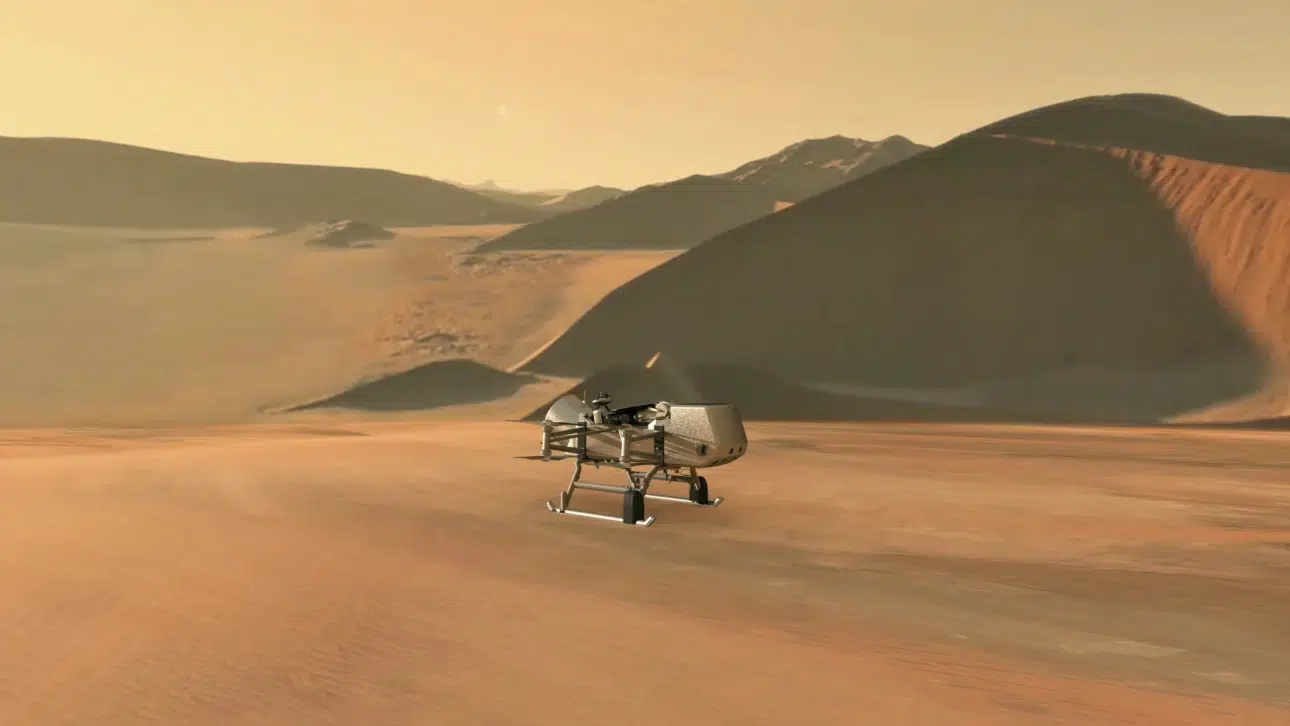
Scheduled to launch in July 2028, Dragonfly will take six years to reach Titan, arriving only in 2034. The spacecraft will be encapsulated and descend into the moon’s atmosphere using parachutes, later activating its eight rotors to explore the surface.
The main goal of the mission is to investigate locations rich in organic molecules – the so-called “building blocks of life.” Dragonfly will “hop” from one point to another in short flights, taking advantage of Titan’s dense atmosphere and low gravity for scientific analysis.
Delays and Financial Challenges
Originally scheduled for 2026, the mission faced successive delays due to the Covid-19 pandemic, which increased its costs and complicated the timeline. Today, the project has already exceeded double its initial budget, reaching US$ 3.35 billion (R$ 19.46 billion).
Despite the challenges, the partnership between SpaceX and NASA demonstrates the potential for collaboration between the public and private sectors in space exploration. Dragonfly not only opens new scientific possibilities but also reinforces NASA’s confidence in SpaceX rockets for large-scale and complex missions.
A Historic Milestone for SpaceX and NASA
This contract is a watershed moment for SpaceX, consolidating its role as an essential partner for NASA in innovative missions. Dragonfly promises to be more than a trip to Titan – it will be a journey to expand our understanding of life in the universe and a step forward in the exploration of the solar system.





Será que titã possuí vida ?