






 Portuguese
  Spanish


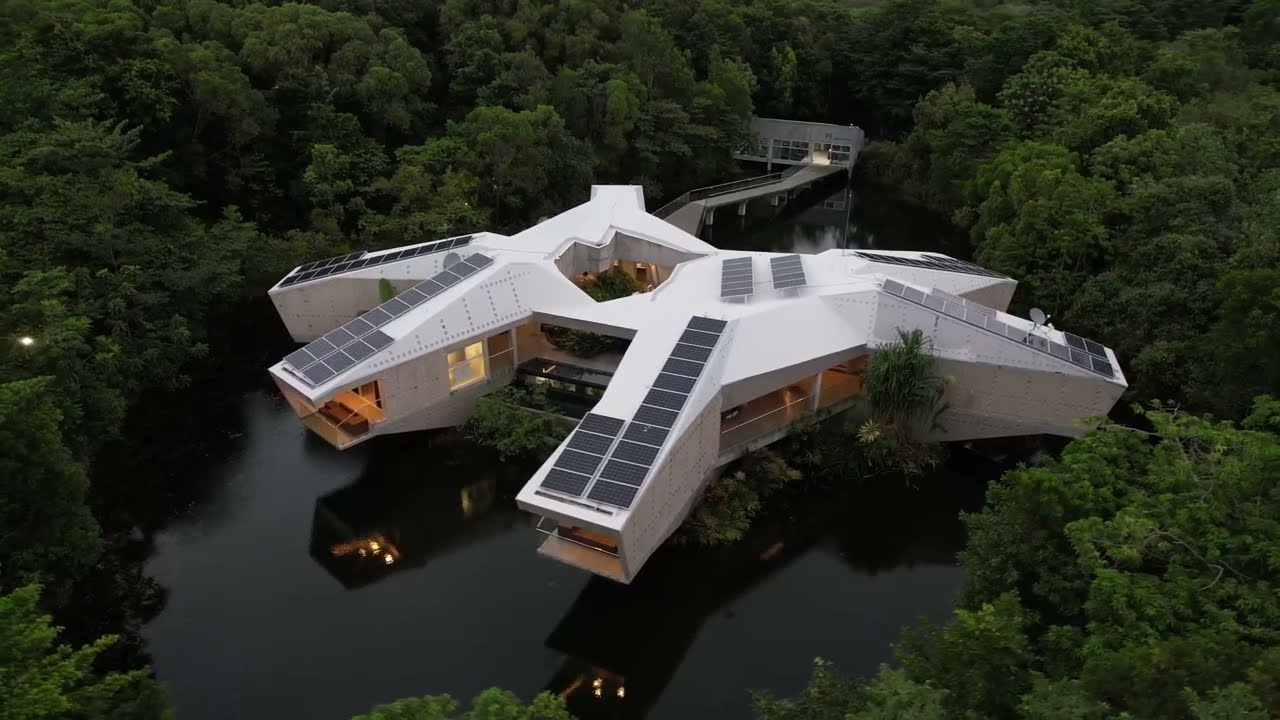

Stamp House is an off-grid mansion in Australia made to withstand category 5 cyclones, floods, and operate on solar energy.
The Stamp House, also known as Alkira, is a residence built in Cape Tribulation, in the far north of Queensland, Australia, in a region marked by rainforest, wetlands, high tides, and the risk of severe cyclones. Designed by the firm Charles Wright Architects, the house was conceived as an off-grid structure, resistant to extreme weather and capable of operating independently in a sensitive coastal environment.
What makes the construction surprising is the combination of luxury, engineering, and climate survival. The house was designed to withstand category 5 cyclones, function as a shelter, operate on solar energy, collect up to 250,000 liters of water, and use its own treatment and reuse systems, all over an artificial lake integrated into the landscape.
Stamp House was created as an off-grid mansion to face extreme weather in tropical Australia
The Stamp House was not conceived as a conventional luxury house. The project was born from a much more complex requirement: to create a residence capable of functioning in a remote location, without relying on the traditional power grid and without destroying the fragile ecology of a coastal tropical area.
-
Couple Transforms Suffolk’s Last 1891 Windmill into Luxurious Four-Story Home with Zinc Observation Room in England

-
Father and Son Build 97 cm Thick Circular Stone House in Brazil, Inspired by Scottish Architecture, Creating a New Agrotourism Hub
-
Sweden Removes 200-Ton Concrete Gallery to Restore Pjältån River’s Natural Flow in Europe’s Largest Aquatic Restoration Project

-
Key Infrastructure Projects for Brazil’s Next President: Expanding Railways to Cut Transport Costs, Reduce Truck Traffic, Create Jobs, and Boost Industries Nationwide


According to Charles Wright Architects, the house operates as a carbon-neutral residence in operation, with its own energy generation, elevated structure, integrated environmental systems, and design focused on climate resilience. The proposal is to combine residential comfort with architecture prepared for floods, extreme tides, and cyclonic events.
Concrete structure uses large cantilevers to reduce the risk of flooding and storm surge
The shape of the Stamp House draws attention because the house seems to float over the water. In practice, it was positioned over an artificial wetland ecosystem and uses large structural cantilevers to keep the environments elevated, reducing the impact of possible floods and tides associated with cyclones.
The building envelope opens into six “arms” or extensions, a solution that increases the visual presence of the house over the lake and helps distribute the spaces. The structure combines cast-in-place concrete and precast pieces, with the material chosen for its durability, thermal mass, and resistance in a corrosive tropical environment.
The house is classified as a category 5 cyclone shelter
One of the strongest features of the Stamp House is its climate resistance. Specialized sources and project materials state that the residence was designed to withstand category 5 cyclones, the most extreme level on the scale used for these events in the South Pacific.
This classification changes the meaning of the house. It is not just a beautiful mansion in a tropical landscape, but a construction designed to function as a shelter in one of the most vulnerable regions of Australia to extreme winds, floods, and storm surges.
Solar panels cover a large part of the roof and allow off-grid operation
The Stamp House was designed to operate without a traditional grid connection. The energy system uses solar panels distributed over a large part of the roof, with battery storage to keep lighting, cooling, and internal systems running without relying on fossil fuels.
This point is essential to understand the proposal of the residence. Instead of installing sustainable technology only as a complement, the house transforms solar energy, natural ventilation, thermal mass, and operational autonomy into central parts of the architectural project.

The water system is another technical differential. According to New Atlas, the Stamp House has a structure capable of capturing up to 250,000 liters of water for domestic use and irrigation, in addition to recycling the water used by the occupants within the property’s own environmental system.
The house also features on-site tertiary sewage treatment. This reinforces the logic of independent operation, especially important in a remote, environmentally sensitive region subject to intense variations in rainfall and tide.
Central pool was inspired by an Australian stamp and aids in natural cooling
The internal design also has an unusual curiosity. The main space revolves around a central pool inspired by the Australian seal “One Pound Jimmy”, a reference that appears in the project’s own case study.
The water areas, patios, and internal falls help create an evaporative cooling effect during the drier months. With this, the house uses its own landscaping design as part of the climate strategy, reducing dependency on intensive mechanical systems.
Spaces were designed for natural ventilation instead of closed insulation
The Stamp House also deviates from the logic of fully sealed tropical houses dependent on air conditioning. The project prioritizes open areas, natural ventilation, wide doors, windows, and direct connection with the external environment.
According to Charles Wright Architects, the main living, dining, leisure, and recreation spaces were planned as open, safe, and flexible areas. This solution attempts to balance protection against extreme weather with a more integrated tropical life with the exterior.
Mansion became an international reference in resilient tropical architecture
The Stamp House gained international recognition for combining high-standard residence, energy autonomy, and climate resistance. The project was a finalist at the World Architecture Festival 2014 in the international houses category and received the Robin Dods Award for residential architecture in Queensland.

This recognition helps explain why the house appears in global publications about extreme architecture and sustainability. It is not just an exotic construction but a prototype of coastal housing prepared for a future of more intense climate events.
The Stamp House impresses because it transforms a luxury house into a kind of climate machine. It combines resistant concrete, elevated structure, solar panels, water capture, its own sewage treatment, natural ventilation, and protection against category 5 cyclones.
In the end, the curiosity is not just in the appearance of the house over the lake. The strongest point is that the mansion was designed to respond to a real problem: how to live comfortably in a remote tropical area, vulnerable to floods, extreme tides, and violent cyclones, without relying on traditional infrastructure.


