






 Portuguese
  Spanish


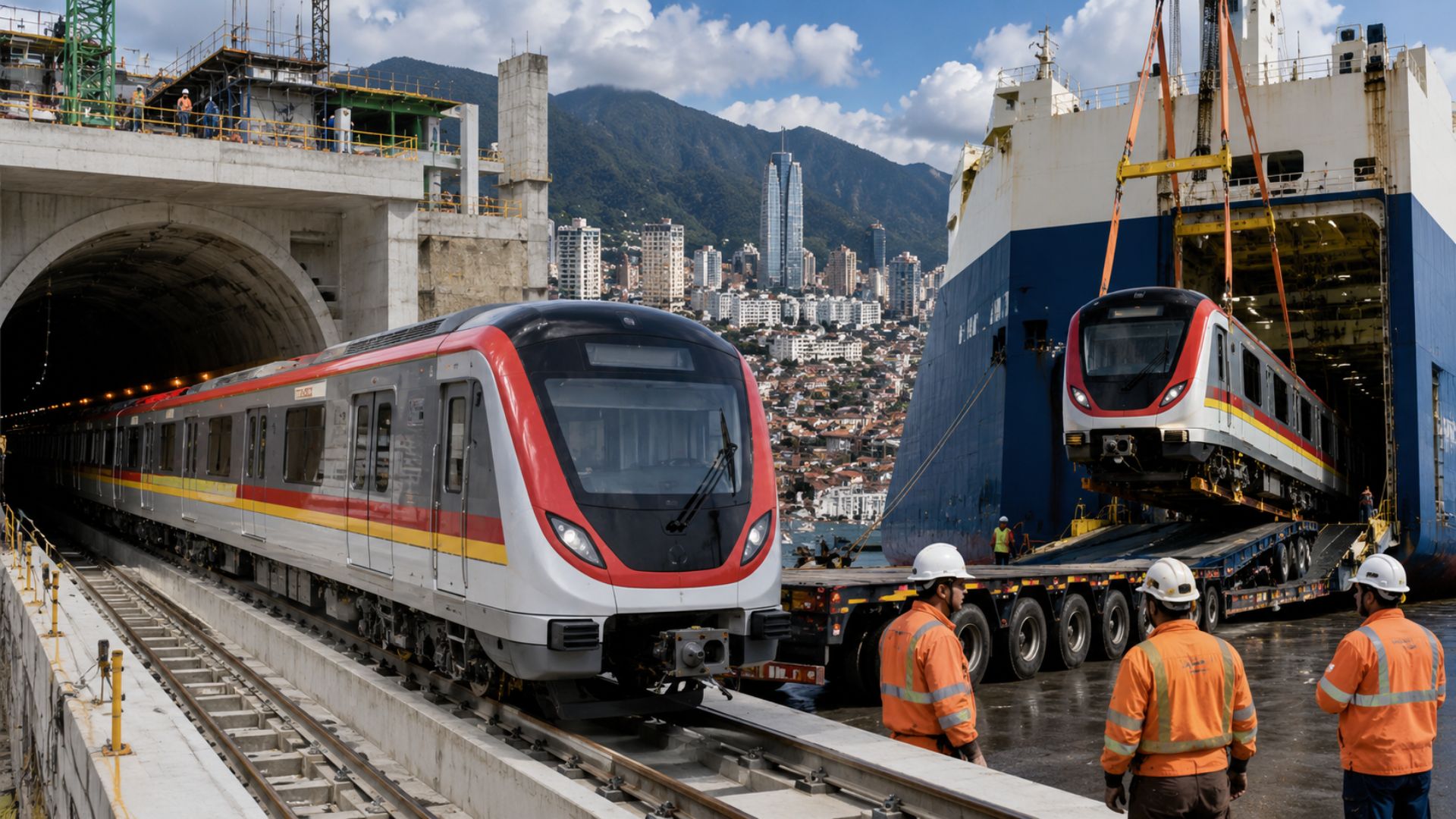


On May 22, 2026, one of the trains ran for the first time over the viaduct, a historic moment for a city that waited more than 80 years for this transportation. Ten of the 30 trains are already in Colombia, and the project advances towards commercial operation expected for 2028, in a multi-billion dollar project.
For the first time in the Americas, a metro is being built and will be operated from end to end by Chinese companies, and this is happening in Bogotá, the capital of Colombia. The city’s Metro Line 1 has already surpassed 75% of the works, with electric and automatic trains, driverless, manufactured in China and shipped by sea to the Colombian port of Cartagena. The project, with commercial operation expected for 2028, marks an unprecedented advance of Chinese presence in the urban infrastructure of the continent.
The historical nature of the enterprise gained a symbolic chapter on May 22, 2026, when the first of the trains made its inaugural test journey over the elevated viaduct, announced by the city’s mayor, Carlos Fernando Galán. For a capital that waited more than 80 years to have a metro, being the only major city in the region that still did not have this type of transport, seeing a train running on the tracks represented the realization of an old dream for the residents.
What makes this metro unprecedented in the Americas

Latin America already has metro systems with elevated sections, as is the case in São Paulo, Brazil. The true milestone is that this is the first metro in the Americas conceived, built, and that will be fully operated by a consortium of Chinese companies, from engineering to the future management of the system.
-
Two-Bedroom Home Built in a 40-Foot Shipping Container Delivered and Ready for Same-Day Living in São Paulo Countryside

-
China Constructs Artificial Island 32 km Offshore for Yangshan Port, Connected to Shanghai by 32 km Bridge, Unloading 3,000 Containers in 20 Hours
-
China’s $70 Billion River Diversion Project, the World’s Largest, Moves 44.8 Billion Cubic Meters Annually, Crosses Under the Yellow River, and Displaced 330,000 People
-
Indian Driver Spends 14 Years Digging 10-Meter Tunnel Through Mountain to Connect Isolated Village to the World




The responsible consortium is led by the China Harbour Engineering Company, CHEC, in partnership with Chinese companies in the railway sector, selected in an international bidding held in October 2019. This total leadership of Chinese companies in all stages, from civil works to decades of operation, is what sets the project apart from any other ever undertaken on the continent and transforms it into a symbol of Chinese expansion in Latin American infrastructure.
What is Line 1 of the Bogotá Metro like

There will be 16 stations along the route, ten of which will have direct connections with TransMilenio, the rapid transit bus system that is already the backbone of the city’s public transportation, enhancing the integration of the network.
Since it runs completely elevated, the metro does not cross traffic lights or compete for space with street traffic, ensuring greater speed and punctuality. The stations were designed not only as boarding points but as urban living spaces, with broad accessibility and connections to other means of transportation. The project, considered the largest mobility project in Colombia’s recent history, currently employs about 15,000 workers.
The trains that crossed the ocean

There will be 30 trains in total, each with six cars, capable of transporting about 1,800 passengers per trip. The trains are manufactured in China by the state-owned CRRC, in the city of Changchun, and then taken to the port of Qingdao, from where they embark on a long sea journey of about a month to the port of Cartagena, Colombia, followed by approximately a thousand kilometers overland to Bogotá.
The first train arrived in the Colombian capital in September 2025, and since then the compositions have been landing in a staggered manner. By early May 2026, ten of the 30 trains were already in the country, with the goal of all arriving by October 2026. Before boarding, each train undergoes static, dynamic tests, and routes of up to 2,500 kilometers in China, to verify its operation both in manual and automatic mode, ensuring the safety of the operation.
The pace of the works and the project’s numbers
The progress of the construction is closely monitored by the population. According to the Empresa Metro de Bogotá, by the end of April 2026, the project reached about 77.5% overall progress, with more than 13,000 linear meters of viaduct already built over important avenues of the city. The elevated structures are already visible in several points, and the first stations show significant progress, with coverings and installations in an advanced stage.
Regarding investment, it is important to handle the numbers accurately. The winning bid for the construction was around 4 billion dollars, but the total cost of the project, including long-term operation, financing, and complementary works, is estimated by development banks in a higher range, between approximately 5.3 and 5.8 billion dollars. The authorities’ goal is for the system to reach about 90% progress by the end of 2026, aiming for inauguration in 2028.
What this work means for Brazil
China has been expanding its role in transportation infrastructure throughout Latin America, and Bogotá’s case is the most advanced example. In Chile, hundreds of Chinese electric buses already circulate through the cities, and in Brazil, trains manufactured by Chinese companies already operate in systems like the São Paulo metro. The difference with the Colombian Line 1 is the complete control of the project by a Chinese consortium, from construction to operation, a qualitative leap in the country’s presence on the continent.
For Brazil, which has been discussing projects like the high-speed train between São Paulo and Rio de Janeiro for years, Bogotá’s work serves as a mirror. While debates on major mobility projects drag on here, the Colombian capital already has a viaduct erected, trains arriving at the port, and compositions running in tests. The Colombian case is likely to influence future electric mobility tenders in other cities in the region in the coming years.
Bogotá and the future of mobility in Latin America
With completion scheduled for 2028, Bogotá is expected to become a reference in sustainable urban mobility for other capitals facing similar challenges, such as rapid growth, aging transport fleets, and emission reduction targets. The 100% electric trains eliminate the burning of fossil fuels during trips, contributing to the improvement of air quality in a city that suffers from severe congestion.
At the same time, the Chinese leadership in the project raises legitimate debates about technological and strategic dependence, present in several countries receiving investments from China in key sectors. Bogotá’s experience will be closely watched by governments throughout the region, both for the benefits in clean mobility and for the geopolitical issues involved in handing over such strategic infrastructure to foreign companies.
Line 1 of the Bogotá metro is much more than a transportation project: it is a milestone in the new relationship between Latin America and China, and the realization of a dream of more than 80 years for the residents of the Colombian capital. With driverless electric trains crossing the ocean and a viaduct already cutting through the city, the project advances towards 2028 as a symbol of transformations in urban mobility on the continent, while also opening debates about the future of infrastructure in the region.
Do you think it is positive that such a strategic metro is built and operated entirely by Chinese companies, or does this bring risks of dependence? Do you believe that Brazil should accelerate its rail mobility projects? Leave your comment, tell us what you think about China’s expansion in Latin America’s infrastructure, and share the article with those interested in transportation, technology, and geopolitics.






