Portuguese
  Spanish


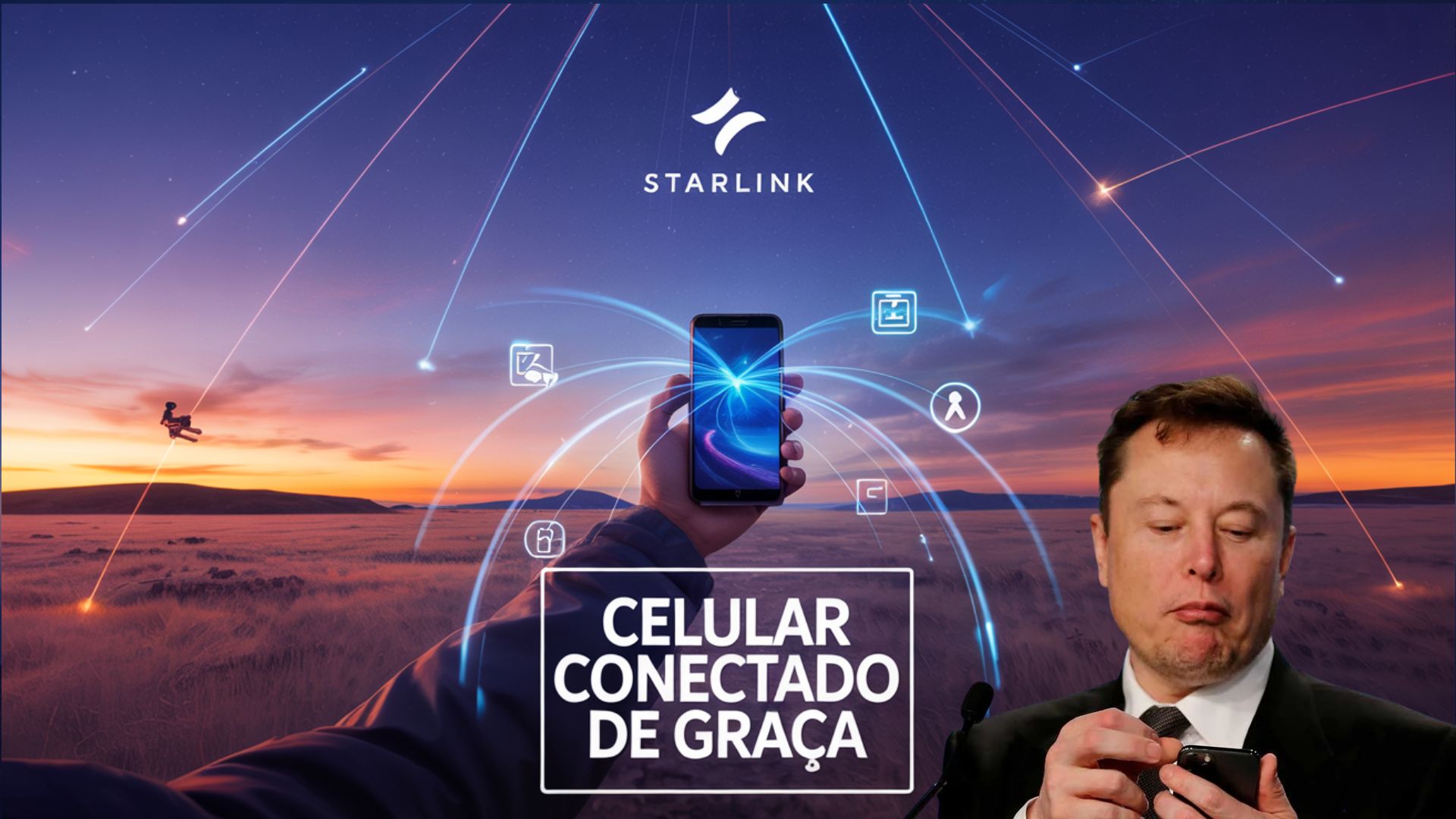


Satellite Technology Promises to Transform Internet Access in Remote Areas, Benefiting Those with Compatible Smartphones and Expanding Global Digital Inclusion. Discover the Details of the New Phase of Mobile Connectivity.
Starting in July 2025, Starlink, the space technology company founded by Elon Musk, will begin offering free satellite internet for certain models of mobile phones.
The initiative aims to primarily expand access to digital connectivity, especially in remote areas or those with unstable coverage, using the advanced satellite infrastructure developed by SpaceX.
The global launch of this new service was confirmed by representatives of Starlink and is already scheduled to reach the public.
-
Engineers Develop Fridge-Sized Machine to Produce 95-Octane Synthetic Fuel from Air and Water, Aiming to Sustain Combustion Engines Without Oil

-
Two-Armed Robot Uses AI to Reassemble Destroyed Pompeii Frescoes, Solving an “Impossible” Puzzle
-
New Law in Brazil Requires Breaks for Type 1 Diabetes Management at Work, School, and Public Exams

-
Scientists Confirm “Greening” of Antarctica: Ice on the World’s Coldest Continent Turns Green as Mosses Multiply Over Tenfold in Four Decades


Users of compatible smartphones will have access to a free emergency connection, without relying on traditional mobile carrier networks.
This means that in areas without conventional signal, access to the internet or sending messages can be done directly through Starlink satellites, enhancing the potential for digital inclusion on a global scale.
Smartphones Compatible with the Free Starlink Service
Among the confirmed phone models that will receive the satellite internet feature are devices from Apple, Samsung, Google, and Motorola.
For Apple, all iPhones from model 14 onwards will be compatible.
Google Pixel 9 and variants, as well as smartphones from Motorola released starting in 2024, are also included.
Regarding Samsung, the free Starlink connection will be available for the Galaxy A14, A15, A16, A35, A53, A54 lines, as well as the Galaxy S series starting from the S21.
However, the benefit will only be activated on devices with up-to-date hardware components and systems, which is essential for the functioning of satellite technology.
How the Automatic Satellite Connection Works
The operation of the free Starlink connection will be automatic in situations where the user is outside the coverage of traditional mobile networks.
In these cases, the smartphone’s system will detect the lack of conventional signal and activate the satellite connection.
The phone’s screen will display the identification “T-Mobile SpaceX”, indicating the use of the Starlink network.
In this first phase, services will be limited to sending and receiving text messages, location sharing, and access to emergency services, such as the number 911.
The expectation, according to SpaceX, is that voice calls and full internet browsing will be gradually enabled as devices receive new system updates.
Differentiators of Starlink Satellite Internet
The Starlink satellite connectivity technology stands out for using low Earth orbit satellites, positioned about 550 kilometers from Earth.
This positioning significantly reduces latency – the time between sending and receiving data – and increases connection stability, even in isolated areas or places difficult for traditional terrestrial infrastructure to reach.
Currently, the Starlink network has more than 7,000 satellites in operation and serves approximately 5 million users worldwide, according to data from June 2025.
The expansion of this network of satellites allows the company to offer a stable and reliable signal in areas lacking fiber optic or cellular towers.
Step by Step to Use Free Starlink on Mobile
To ensure access to the free service, users must keep their smartphones always updated, as the functionality relies on specific updates in the devices’ software.
There is no need to download extra apps or perform complex configurations: the activation of the connection is fully automatic whenever there is no signal from conventional carriers.
The company’s recommendation is for users to regularly check for system updates, as the feature may be rolled out gradually, depending on the device model and region.
Starlink emphasizes that, initially, the experience will be limited to messaging and emergencies.
However, the expectation is that over the coming months, features like voice calls and full browsing will be gradually incorporated, expanding access and utility of the free service.


Digital Inclusion and Global Reach of Free Starlink
The free access to the internet via mobile phone, promoted by Starlink, represents an advancement for digital inclusion on a global scale.
By enabling remote or infrastructure-poor regions to have access to a communication channel, the company directly contributes to reducing inequalities and expanding opportunities.
With the growth of the satellite network, rural areas, indigenous communities, small towns, and hard-to-reach locations will have an effective alternative for emergency situations, distance learning, telemedicine, and basic communication.
The project underscores the importance of keeping devices updated, as compatibility with the free Starlink service depends on technical and operational factors.
For this reason, manufacturers like Apple, Samsung, Google, and Motorola are already working together to ensure that upcoming releases are prepared to receive satellite internet technology, which is expected to become more popular in the coming years.
Future of Mobile Connectivity and Sector Challenges
The release of free internet by Starlink marks a new chapter in the telecommunications sector and poses a challenge for traditional carriers, which need to seek innovative solutions to maintain competitiveness.
Satellite access, besides expanding coverage, paves the way for new possibilities of integration among different technologies, making connectivity increasingly accessible and democratic.
With the expectation that Starlink will continue to expand its satellite network and broaden the range of compatible devices, the question remains: how will the arrival of this technology transform the daily lives of Brazilians and millions of people around the world who still live without quality mobile internet access?