






 Portuguese
  Spanish


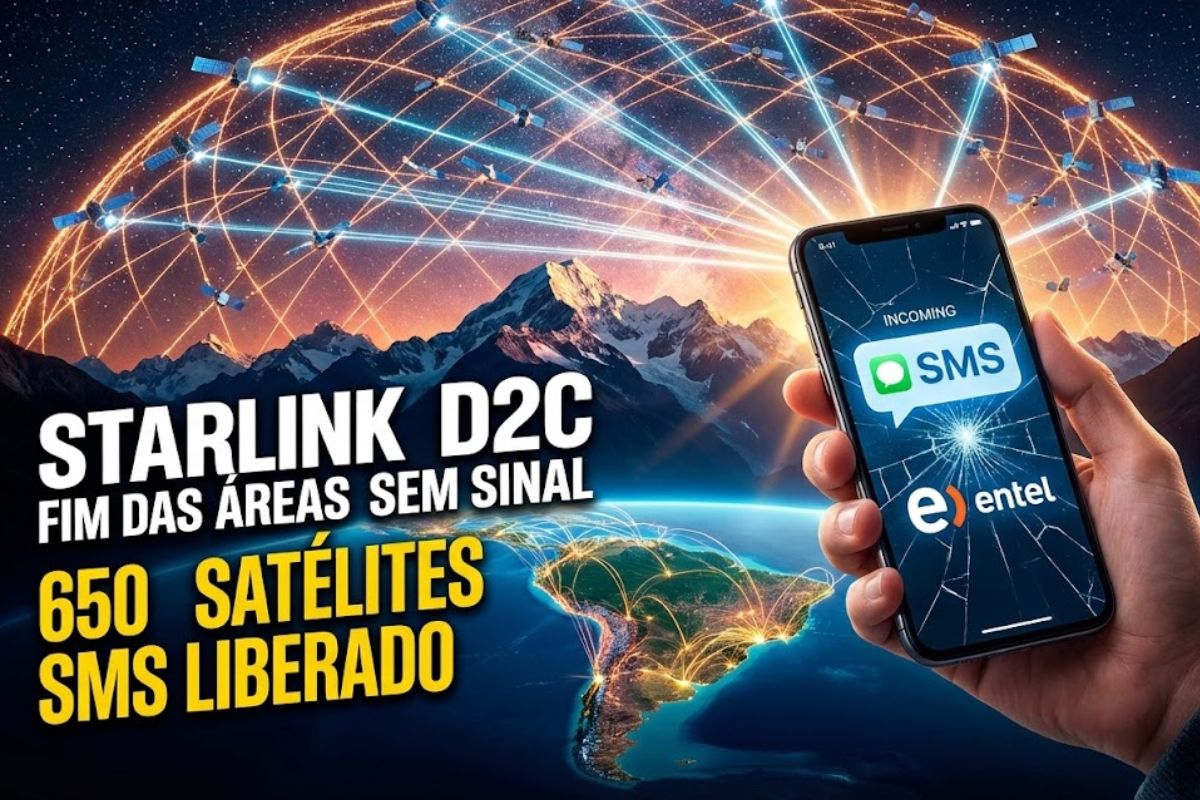

With Chile as the First Laboratory in the Region, Starlink Launches Direct to Cell Service in Partnership with Entel, Promising to Reduce Coverage Gaps Using 650 Satellites and, For Now, Limits Satellite Connection to SMS Sending on Compatible Smartphones Approved by the Carrier in the Andean Country.
Starlink began operating its direct satellite connection for mobile phones in Latin America with a clear objective: tackle the chronic problem of areas without signal using its low-earth orbit satellite constellation. The first step was taken in Chile, in cooperation with Entel, and marks the regional debut of the Direct to Cell model, which connects the smartphone directly to the satellite without the need for a parabolic antenna.
In the initial phase, however, the service is still limited. Starlink’s connection in Chile is restricted to sending and receiving SMS on compatible smartphones, while the provision of mobile data via satellite is promised for a later time. The strategy places the Andean country on the same list as a few selected markets, such as the United States, Japan, and Canada, that are testing D2C as an alternative to cover deserts, mountains, and rural areas outside the traditional antenna grid.
How Starlink’s Direct to Cell Connection Works

The D2C model, short for Direct to Cell, is based on a simple principle: the smartphone connects directly to Starlink satellites, without the need for dedicated antennas or additional equipment at the user’s home.
-
AI Video Generator Automatically Creates Subtitles and Animated Captions

-
São Paulo Unveils Latin America’s Largest Underground Reservoir, Holding 900 Million Liters, in the Greater São Paulo Area

-
Chinese Teen Wins Gold in Germany for Invention Turning Air Moisture into Underground Irrigation in Drought-Stricken Areas

-
Desertification Threatens Brazil’s Caatinga: 85% of Semi-Arid Region Affected, 30 Million at Risk, and Efforts Underway to Restore 10 Million Hectares by 2045




The only requirement is that the phone has an unobstructed view of the sky so that the signal is not blocked by buildings or physical obstacles.
To sustain this coverage, Starlink uses about 650 satellites specifically prepared for the D2C service, integrated into a larger constellation already known for broadband packages via antenna.
In Chile, the focus is on covering remote areas, such as the Atacama Desert and rural regions, where conventional mobile networks do not reach or operate with low reliability.
The central promise is that, with the direct link to the satellite, the idea of completely uncovered areas will start to fade from the map.
Chile Becomes Starlink’s Showcase in Latin America
Chile is the first Latin American country to officially access mobile connectivity via Starlink in Direct to Cell mode, serving as a technological showcase for the region.
The partnership was established with Entel, which incorporated the service into its highest data allowance plans and premium portfolio.
The satellite coverage is available to Entel customers with 150 GB and 450 GB plans, as well as Entel Black plans, with monthly fees starting at 12,990 pesos, amounting to a little over 70 reais.
In practice, Starlink serves as an additional layer of coverage in scenarios where conventional antennas fail, especially on highways, desert areas, and isolated locations.
The announcement was made by the company itself, which highlighted the ability to keep users connected in forests, deserts, and other extreme environments.
Current Limits: Only SMS and Compatible Devices
Despite the potential, Starlink’s initial offering in Chile is deliberately restricted.
The D2C service is limited to traditional text messages via SMS, without mobile internet browsing or data usage in applications.
The company indicates that the enabling of satellite data should come in a subsequent stage but does not tie the advancement to a detailed public timeline.
From the user side, the second filter is the hardware.
Entel maintains a list on its website of smartphones compatible with Starlink satellite connectivity, which already includes over 40 models from Samsung, more than a dozen devices from Xiaomi, and options from manufacturers like Honor, Vivo, and Motorola.
It was noteworthy that no iPhone model has appeared yet on the list of approved devices, which restricts the first wave of adoption to a specific set of Android devices.
What Changes for Areas Without Signal in Practice
The most immediate gain from Starlink’s arrival in the D2C segment in Latin America is both symbolic and operational.
Symbolic because it shows that satellite coverage is no longer a resource exclusively associated with fixed antennas and begins to directly engage with the ordinary mobile phone user.
Operational because, even with the limitation to SMS, the ability to send messages in remote areas can be crucial in emergency situations or field work.
The elimination of so-called “dead zones” depends on additional factors, such as large-scale adoption by customers, the level of integration of local carriers, and the evolution of Starlink’s own infrastructure.
The requirement for an unobstructed view of the sky remains an unavoidable physical restriction and, for now, the user experience is far from the full navigation in 4G or 5G.
Still, the combination of low-orbit satellites, compatible smartphones, and adapted mobile plans creates a new layer of connectivity that tends to expand as data and voice are incorporated into the package.
Competitive Pressure and Next Steps for the Technology
The entry of Starlink into the direct mobile connection market in Latin America also has a competitive effect.
Mobile operators now coexist with a hybrid model in which part of the coverage no longer depends exclusively on ground towers.
At the same time, smartphone manufacturers need to adapt to support communication with low-earth orbit satellites, which explains the growing list of compatible models with the D2C service.
Meanwhile, other global players are exploring similar solutions, either with their own satellite networks or through partnerships with existing constellations.
How Starlink will transform a pilot based on SMS into a complete satellite mobile data offering will be the great test of the technology’s maturity, both from a technical and regulatory perspective.
The Chilean experience is likely to be closely watched by regulators, operators, and users throughout the region.
In your case, if Starlink and a local carrier offered SMS today and, in the future, complete internet via satellite on your phone, would you be willing to pay more to never be without signal, or do you still think the cost wouldn’t justify this extra coverage?







1
Muito bom
Não vejo a hora disso chegar ao Brasil.