






 Portuguese
  Spanish


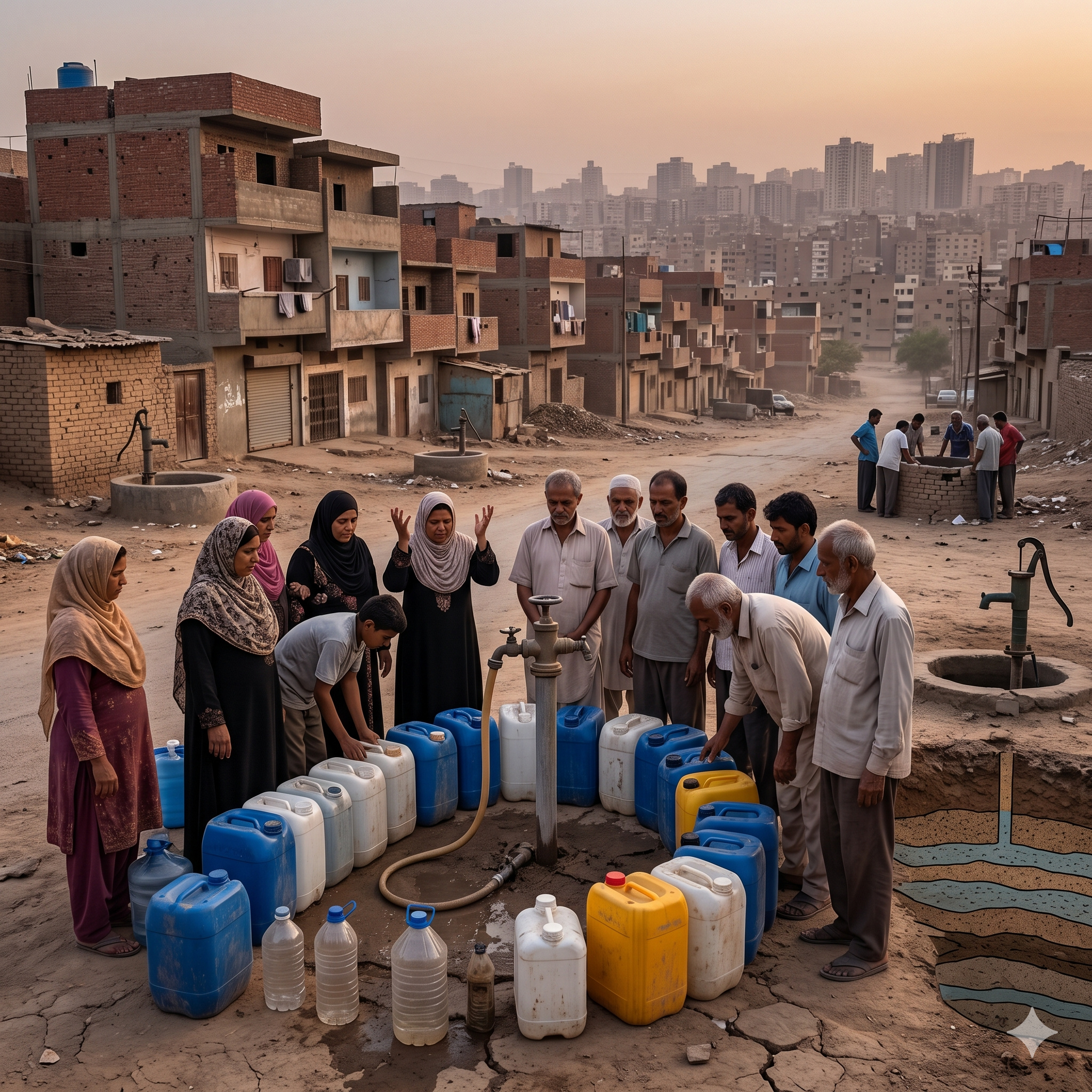


CNN-cited report warns that the world has entered an era of water bankruptcy, with megacities like Kabul, Tehran, Karachi, and Mexico City pressured by collapsing aquifers, dry wells, land subsidence, and urban growth exceeding the physical capacity for groundwater recharge.
According to CNN, the Global Water Bankruptcy report, published by the UN on January 20, 2026, documents that the world has entered an era of water bankruptcy. The cities closest to total collapse are not small isolated rural municipalities, but megacities of millions of inhabitants that have grown for decades ignoring the physical limits of the aquifers that sustained them.
Kabul, with 7 million people, could become the first modern capital to run completely out of water by 2030. Its aquifers have dropped between 25 and 30 meters in the last ten years, extraction exceeds natural recharge by 44 million cubic meters per year, and almost half of the city’s artesian wells have already dried up.
Tehran follows a similar trajectory in a country where Lake Urmia, once the largest lake in the Middle East, has been reduced to a salt desert. Karachi, a megacity of 15 to 20 million people, has been identified as one of the world’s four megacities with extremely high water vulnerability. “Everything seems fine until it isn’t,” said Kaveh Madani, a UN water expert. And then it’s too late.
-
Real Estate Agent Buys Marvel Movie Subway Car for $5,000 and Converts It into Themed Airbnb
-
Real Estate Agent Buys Marvel Movie Subway Car for $5,000 and Converts It into Themed Airbnb
-
Former Roma and Fiorentina Player Filipe Gomes Returns to Brazil to Found Empório do Galeto, Aiming for $10 Million Revenue by 2026
-
Canada Builds 6.2-Hectare Containment Box to Trap 615,000 Cubic Meters of Toxic Sediment in Lake Ontario


What is an aquifer and why is groundwater collapse different from a common drought
To understand why the water collapse of megacities like Kabul is different from a conventional drought, which can be alleviated when rains return, it is necessary to understand how an aquifer works. An aquifer is a porous underground layer of rock, sand, or gravel capable of storing water.
It functions like a giant sponge. When it rains, part of the water infiltrates through the soil and slowly percolates until it reaches the aquifer, where it is stored. This recharge process is slow. In some deep aquifers, the water pumped today fell as rain a thousand, ten thousand, or even a hundred thousand years ago.
The problem with megacities in Asia and the Middle East is that they pump aquifers with a recharge rate measured in decades or centuries, while extraction occurs at a pace of years. It’s like consuming savings built over generations at a speed fast enough to deplete them in a single generation.
When the aquifer empties, the soil compacts and loses part of its capacity to store water forever
There is a second physical problem, less intuitive but equally serious. When an aquifer is emptied, the soil that was once supported by water pressure begins to compact. The pores that stored water collapse under the weight of the upper layers.
When these pores collapse, they do not return to their original state. Even if the water returns, part of the physical space that stored it disappears. This process is called irreversible subsidence and already affects cities that overexploit urban aquifers.


It is this mechanism that causes Mexico City to sink up to 25 centimeters per year and also causes cracks in foundations, streets, and infrastructure networks in Tehran and dozens of cities dependent on groundwater.
Kabul could become the first modern capital to reach Day Zero by 2030
Kabul grew from less than 1 million inhabitants in 1990 to over 7 million in 2025. This sevenfold growth in three decades was fueled by conflict, internal displacement, and accelerated urbanization, without corresponding water infrastructure.
The city relies on groundwater for almost its entire supply and has developed an uncontrolled extraction system. There are about 120,000 unregulated wells in Kabul, according to Mercy Corps data, drilled by residences, hydroponic farms, factories, and businesses without adequate monitoring of depth, flow, or cumulative impact.

The bill has arrived. Aquifers have dropped between 25 and 30 meters in ten years, and 49% of artesian wells are already dry, according to a 2023 UN report. The remaining wells need to go deeper and deeper, raising drilling and pumping costs beyond the capacity of poorer residents.
Extraction exceeds recharge by 44 million cubic meters per year and pushes Kabul to its physical limit
Current extraction in Kabul exceeds natural recharge by 44 million cubic meters per year. This means the aquifer is being consumed as capital, not income. The water extracted is not being replenished at the same rate.
If the trend continues without intervention, the UN projects that Kabul’s aquifers could dry up completely by 2030. UNHCR estimates that between 2 and 3 million people could be forced to leave the city in search of water, while FAO projects a 40% drop in harvests in Kabul province by 2035.
Obaidullah Rahimi, an urban water management researcher at the University of Kaiserslautern-Landau, summarized the physical limit: the city’s groundwater only covers 44 million cubic meters, enough for 2 million people with a modest consumption of 50 liters per day. Kabul has 7 million inhabitants. The numbers don’t add up.
Panjshir River pipeline exists on paper, but frozen funding stalled the technical solution
The technical solution for Kabul exists: the Panjshir River pipeline, designed to bring surface water to approximately 2 million residents. The project reached the design phase but was never built.
The blockage came from politics and funding. More than US$3 billion in international funds have been frozen since the Taliban’s return to power in 2021, and 80% cuts in American funding via USAID eliminated any prospect of timely execution.

The problem, therefore, is not just geological. It is also institutional. The city has a designed solution, but lacks sufficient resources, governance, and stability to execute it before the aquifer reaches its limit.
Tehran shows how water collapse affects cities, lakes, and infrastructure simultaneously
Iran offers one of the most visible demonstrations of regional water collapse. Lake Urmia, in the country’s northwest, was the second-largest saltwater lake in the world, covering 5,200 square kilometers in the 1970s. Today, it is less than 500 square kilometers and continues to shrink.
The cause combines groundwater extraction above recharge, dams that interrupted natural flows, intensive agricultural irrigation, and climate warming that accelerates evaporation. This is exactly the mechanism the UN identifies as central to water failure: withdrawing more water than the system can replenish.
Tehran, a city of 17 million people in an arid region, relies on aquifers and mountain reservoirs fed by snow and rain. Regional warming has reduced snow cover in the Alborz mountains, the main source of reservoir recharge, while groundwater extraction has advanced beyond sustainable limits.
Subsidence in Tehran exposes the physical cost of growing beyond water capacity
Kaveh Madani cited Tehran when describing cities where expansion and development were encouraged despite limited water supplies. The result appears in the soil, foundations, and urban networks.
Parts of Tehran are already sinking up to 25 centimeters per year in peripheral areas where aquifer extraction is most intense. Cracks in the asphalt, misalignments in foundations, and problems in water distribution networks are already visible in sectors of the city.
Subsidence shows that the water crisis doesn’t end when the well dries up. It transforms into permanent urban damage, deforming infrastructure that relies on stable ground to function.
Karachi depends on the Indus River and rainfall generated by distant landscapes
Karachi is a different, but equally revealing, case. The Pakistani megacity, with 15 to 20 million inhabitants, does not only face local aquifer depletion. It depends on a distant hydrological landscape, from which part of the rain and flow that supplies the city originates.
A study published in Nature Communications identified Karachi as one of the world’s four megacities with extremely high water vulnerability, alongside Shanghai, Wuhan, and Chongqing. The vulnerability stems from a combination of high water stress, limited economic capacity to invest in alternatives, and critical dependence on the Indus River.
The Indus originates in Tibet, crosses Pakistani Punjab, and reaches the Sindh plain, where Karachi is located. What reaches the city is an increasingly smaller fraction of the original flow. The megacity depends on a long, climatically and politically vulnerable water chain.
Himalayan glacier melt may create temporary abundance before permanent scarcity
The warming of the Hindu Kush and Himalayan glaciers creates a two-stage risk for the Indus system. Initially, melting can increase river flow, giving the impression of greater availability.

Then, when glaciers lose enough mass, the trend reverses. Flow decreases, and structural scarcity becomes harder to compensate for. The window of glacial abundance is temporary; the subsequent reduction tends to be permanent on a human scale.
Karachi is at the end of this chain. When water arrives in smaller volumes, the city feels the cumulative effect of climate change, population growth, insufficient infrastructure, and regional pressure on the same river system.
Mexico City shows what happens after an urban aquifer collapses
To understand what happens after an urban aquifer collapses, Mexico City is the most documented and disturbing case study. The city was built on the ancient Lake Texcoco, drained by Spanish colonizers in the 17th century.
The soil on which the city grew is formed by lacustrine clay, highly porous when saturated with water, but compressible when dry. When the city began to intensely pump the aquifers beneath it in the 20th century, the ground began to sink.
Today, parts of Mexico City are sinking up to 25 centimeters per year, accumulating meters of subsidence since intensive pumping began. The aquifer collapse turned into ground collapse.
Subsidence breaks water networks, tilts buildings, and turns flooding and scarcity into simultaneous crises
Mexico City’s subsidence has produced cascading consequences. Water networks break because pipelines do not keep pace with differential ground subsidence. Historic buildings tilt, streets undulate, and sewage systems change behavior when altitude levels change.

The UN estimates that up to 60% of treated water in Mexico City is lost to leaks before reaching the consumer. In other words, the city pumps water, loses water, and needs to pump even more to compensate for infrastructure that breaks over moving ground.
At the same time, the city still faces severe floods in the rainy season. Not because there is excess water available, but because the drainage system was designed for an altitude that no longer exists. The same city that rations water for months can be flooded for days.
Water bankruptcy works like financial bankruptcy, but physics doesn’t renegotiate deadlines
Kaveh Madani uses the metaphor of financial bankruptcy deliberately, and it is more accurate than it seems. In financial bankruptcy, a point is reached where debts exceed repayment capacity, and recovery requires intervention, restructuring, and time.
In water bankruptcy, the mechanism is similar: accumulated extraction exceeds the system’s recharge capacity, and recovery, when possible, requires decades of reduced consumption, alternative sources, and investments that many populations do not have time to wait for.
The difference is that, in financial bankruptcy, there is a creditor who can renegotiate the debt. In water bankruptcy, the creditor is geology. When the aquifer dries up, it dries up. When the clay compacts, it compacts. When the well loses 30 meters, no central bank can print water.
UN report shows aquifers were treated as renewable until the physical bill arrived
The UN report of January 2026 documents decades of groundwater extraction as if aquifers were fully renewable. Cities grew in the desert, industries expanded, and urban systems became dependent on underground reserves without respecting the recharge rate.
Kabul’s annual water deficit of 44 million cubic meters is not an accounting problem. It’s a physical bill that will come due by 2030 if the trajectory doesn’t change. No international agency, government, or NGO can alter this limit by administrative decision alone.
Four years is Kabul’s deadline. Kabul is just the first. The question that remains is how many megacities will still treat groundwater as if it were annual income, when, in practice, they are spending the water capital that sustained their survival.






Karachi has only brackish water aquifer which is just as good as sea water of the coastal city. Therefore it is wrong to say that it is sinking due to excessive water mining!