Portuguese
  Spanish


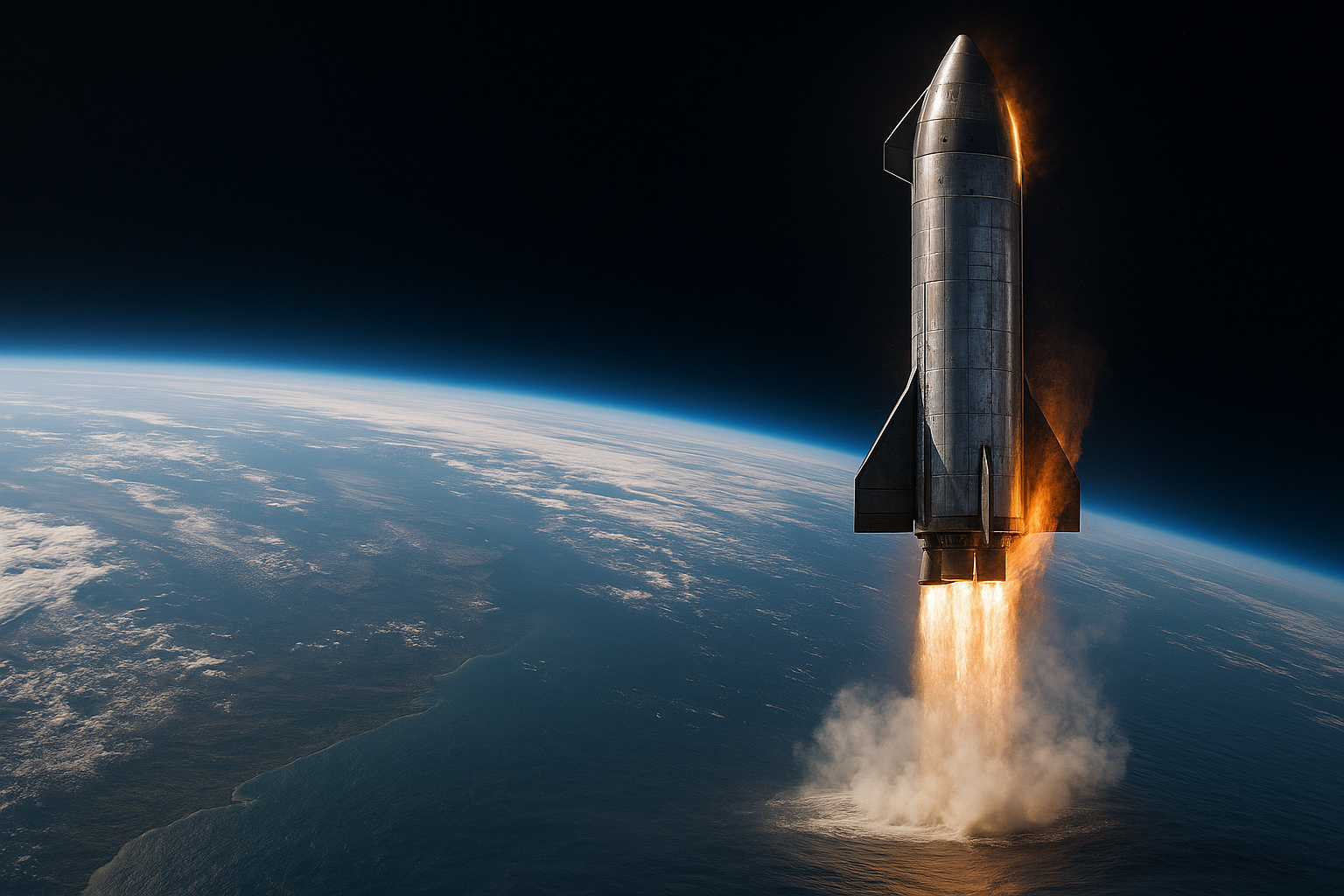

The Elon Musk Spacecraft Overshadows Previous Failures, Lands Accurately in the Indian Ocean, and Reinforces Plans for Moon Missions and Future Trips to Mars
The Starship, considered the largest spacecraft ever built, confirmed its second successful flight this Monday, October 13, 2025. This achievement marked a new advancement for SpaceX, the company of billionaire Elon Musk.
After nine attempts with previous failures, the craft completed the mission with a controlled landing in the Indian Ocean. This accomplishment reinforced confidence in the project. This project is part of the NASA Artemis program.
Unprecedented Performance and Stunning Images
During the journey, cameras attached to the structure captured clear images of the curvature of the Earth. The scenes highlighted a striking contrast between the planet and deep space.
Additionally, SpaceX’s live broadcast showed the exact moment of descent. Even at 10,000 km/h, the craft maintained stability at 40 kilometers in altitude.
Shortly thereafter, it slowed down to touch the water in a precise vertical landing, as per the original design. The intense heat generated flames and steam around the metal structure upon contact with the sea.
This natural phenomenon occurred due to the friction of reentry.
Nonetheless, the result was regarded as a technical and visual milestone. Therefore, the accomplishment solidified a new era for SpaceX’s orbital testing.
SpaceX Faces Risks with Followed Failures of Starship and Musk in 2025
ARTICLE CONTINUES BELOWSee also
Why did a company that was already earning US$ 1 million decide to completely change its strategy? The answer begins with used bottles, worms, and an unexpected decision.

Where it almost never rains, residents hung giant nets in the desert mountains and started to ‘fish’ drinking water from the fog: the nets can collect thousands of liters per day directly from the mist.

Young people from Minas created a robot without screws or metal parts, betting on a strong and flexible structure to compete against a thousand teams in Houston and took Brazil to the top of world robotics for the first time; Sofia, 15, also made history with an unprecedented leadership award.

Detectorist found a 900-year-old silver coin


Super Heavy Confirms Efficiency and Successful Reuse
The Super Heavy rocket, responsible for the initial propulsion of the mission, also demonstrated exemplary performance. Additionally, the reused booster from the eighth experimental flight returned to the Gulf of Mexico about 10 minutes after launch.
The success demonstrates consistent advancements in reusability technology. This is one of the company’s main goals. During the test, SpaceX adopted a new configuration of the Raptor engines.
The team adjusted the number of active boosters according to the stages of descent. Initially, 13 engines were activated. Then, the number dropped to five. Finally, only three remained active during the landing phase.
This sequence ensured millimeter precision and stability, reinforcing the technological progress of the company. According to a technical report released by SpaceX on September 2, 2025, the performance met the objectives of the testing schedule.
Artemis Program and Future Plans
The Starship is part of a US$ 3 billion (about R$ 16.4 billion) contract signed with NASA. The agreement is part of the Artemis Program, which aims to return astronauts to the Moon by 2027.
Thus, the mission proved the spacecraft’s ability to take off, land, and refuel in orbit autonomously. These requirements are essential for the success of lunar and interplanetary operations.
In an official statement, SpaceX’s technical team said the test “confirms that the system can fulfill the milestones outlined in the lunar schedule”.
Furthermore, it emphasized that the current priority is to evaluate the performance of the Raptor engines in multiple reentries. This process is essential for long journeys in deep space.
Elon Musk Reaffirms Goal to Reach Mars
During an interview in Austin (USA) with SpaceNews, Elon Musk stated that the project “follows the plan to become the vehicle that will take humans to Mars”.
He also explained that if the current testing pace continues, the Starship will be ready to transport interplanetary cargo within five years.
SpaceX’s goal is to start missions to the red planet by 2030. Experts from the European Space Agency (ESA) classified the performance of the craft as a historic advancement in private space exploration.
With each successfully completed stage, SpaceX moves closer to making interplanetary travel a reality. The accomplishment reinforces confidence in its engineering and vision for the future.