






 Portuguese
  Spanish


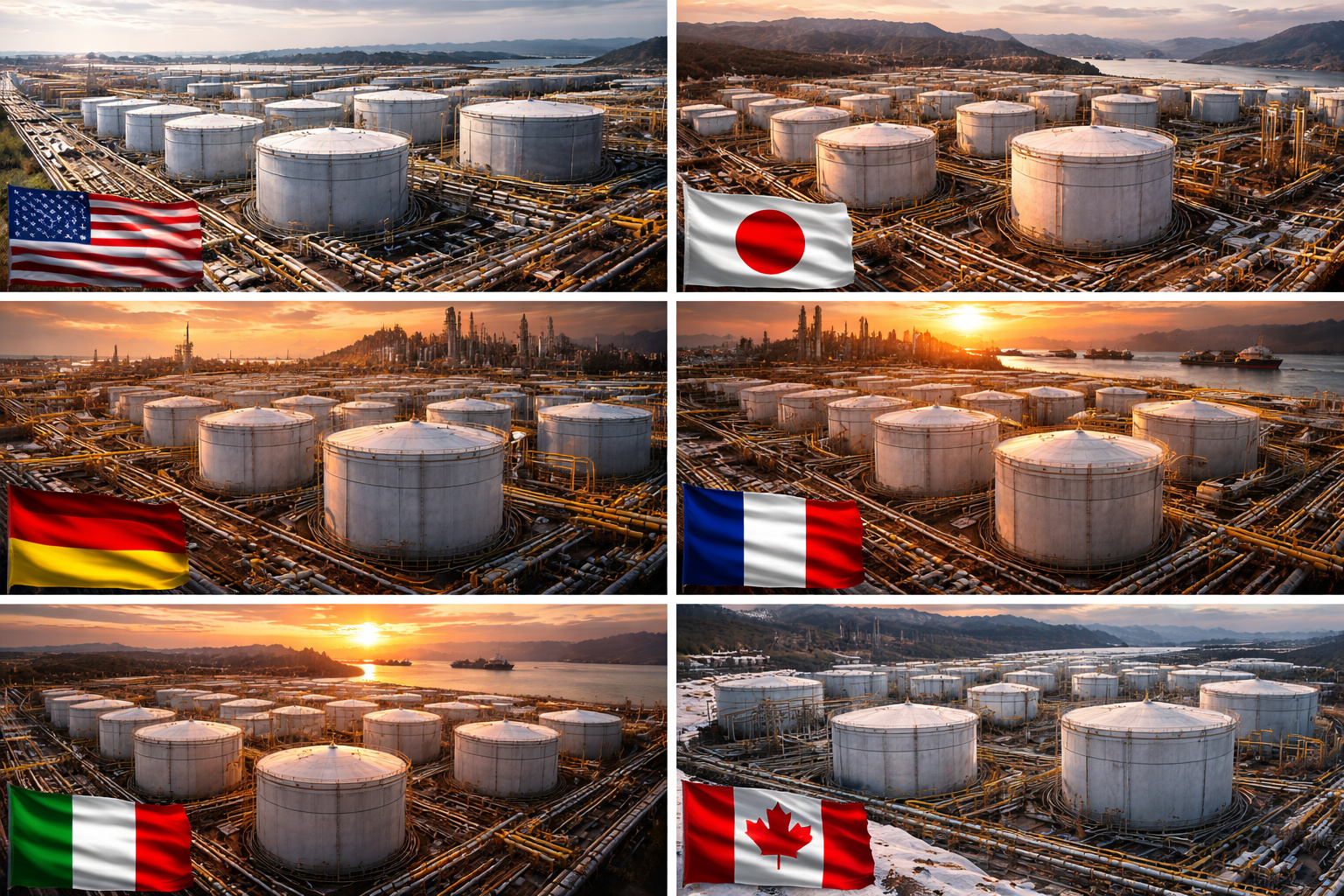

Emergency Stocks Held By G7 Countries Gain Attention Amid Oil Price Increase And Supply Crisis In The Middle East
A potential release of strategic oil reserves from G7 countries has entered international discussion.
The International Energy Agency (IEA) reported on March 9, 2026 that emergency stocks may be used to respond to the supply crisis in the Middle East.
At the same time, oil prices have risen rapidly, reaching nearly US$ 120 per barrel, increasing pressure on governments and energy markets.
-
Drivers are falling for these scams without realizing: operation reveals closed gas stations, adulterated fuel, and hidden losses when refueling.

-
New Fiat EV, priced at R$ 77,000, will bring a reinterpretation of the 147 and a consumption equivalent to 70 km/l.

-
Petrobras surprises the market by cutting diesel by R$ 0.35 per liter, and the decision may ease the tax impact for drivers and transport companies.
-
Gasoline at R$ 4.99 makes drivers wait more than an hour at Havan gas stations in Santa Catarina, during a “zero tax” promotion with a limit of 15 liters per car and 25,000 liters available across five units of the network.





According to the IEA’s own rules, member countries that are net oil importers must maintain stocks equivalent to at least 90 days of imports.
Therefore, these volumes serve as a global strategic reserve for moments of energy crisis.

United States’ Strategic Reserves Dominate Energy Security System
Firstly, the United States holds the largest volume of strategic oil among G7 countries.
According to the U.S. Energy Information Administration (EIA), as of February 27, 2026, the country had 415.4 million barrels of crude oil in the Strategic Petroleum Reserve.
Additionally, at the same time, commercial stocks held by private companies totaled 439.3 million additional barrels.
As a result, the United States maintains one of the largest energy security structures on the planet, although daily release depends on distribution infrastructure.
Japan Maintains Stock Covering Months of Imports
Meanwhile, Japan also maintains large strategic oil reserves.
According to the Ministry of Natural Resources and Energy of Japan, at the end of December 2025, the country had about 470 million barrels of oil equivalent in stock.
Of this total, 260 million barrels belong to the Japanese government.
Furthermore, these government reserves correspond to about 146 days of oil imports.
At the same time, private stocks hold approximately 180 million equivalent barrels of fuels, including 90 million barrels of crude oil.
Germany Maintains Reserves That Can Be Released Quickly
Moreover, Germany holds relevant strategic stocks of oil and derivatives.
According to the Ministry of Economy of Germany, the country has approximately 110 million barrels of crude oil.
Additionally, it also holds 67 million barrels of refined petroleum products.
As a result, these volumes can be released in a few days if necessary to stabilize the energy market.
France Combines Government Stocks and Private Reserves
Similarly, France maintains strategic reserves divided between the government and oil companies.
According to the most recent public data available at the end of 2024, the country held about 120 million barrels of oil and derivatives in stock.
Of this total, 97 million barrels are managed by SAGESS, the entity responsible for France’s strategic reserves.
Moreover, 39 million barrels are held by the country’s oil companies.
Within the reserves of SAGESS, the composition includes approximately:
• 30% crude oil
• 50% gasoil
• 9% gasoline
• 7.8% aviation kerosene
• small quantities of fuel oil
Italy Maintains Minimum Stock Required by the International Energy Agency
Meanwhile, Italy also maintains mandatory strategic reserves.
National legislation requires the country to hold approximately 76 million barrels of oil in stock.
This volume represents 90 days of the average net oil imports recorded in 2024.
However, as stated in the survey, the Italian Ministry of Economy did not respond to the request for comment on the current exact volume.
United Kingdom Utilizes Industrial Stock and International Reserves System
Furthermore, the United Kingdom maintains stocks distributed between crude oil and refined products.
According to the Department of Energy Security and Net Zero, on February 26, 2026, the country had:
• 38 million barrels of crude oil
• 30 million barrels of refined products
At the same time, the British government meets international requirements forcing the industry to maintain minimum stock levels.
Moreover, in July 2025, around 15% of reserves were stored on British soil to meet requirements of foreign countries.
Some of the volumes are also maintained abroad through the International Energy Agency’s ticket system, which ensures emergency purchase options.
Canada Does Not Maintain Strategic Reserve as It Is an Oil Exporter
Finally, Canada presents a different situation within the G7.
The country does not have a strategic oil reserve.
This is because Canada is a net oil exporter, and therefore is not obligated by the International Energy Agency to maintain strategic stocks.
Additionally, the country is the fourth largest producer of crude oil in the world.
According to energy sector data, Canadian production surpassed 5 million barrels per day in December 2025.
At the same time, the majority of these exports are destined for the United States, reinforcing energy integration between the two countries.
In light of this scenario, the strategic reserves held by G7 countries remain one of the main tools for global response during energy crises.
Considering the size of these stocks and market volatility, will these reserves play a decisive role in the stability of global oil if the supply crisis intensifies?


