Portuguese
  Spanish


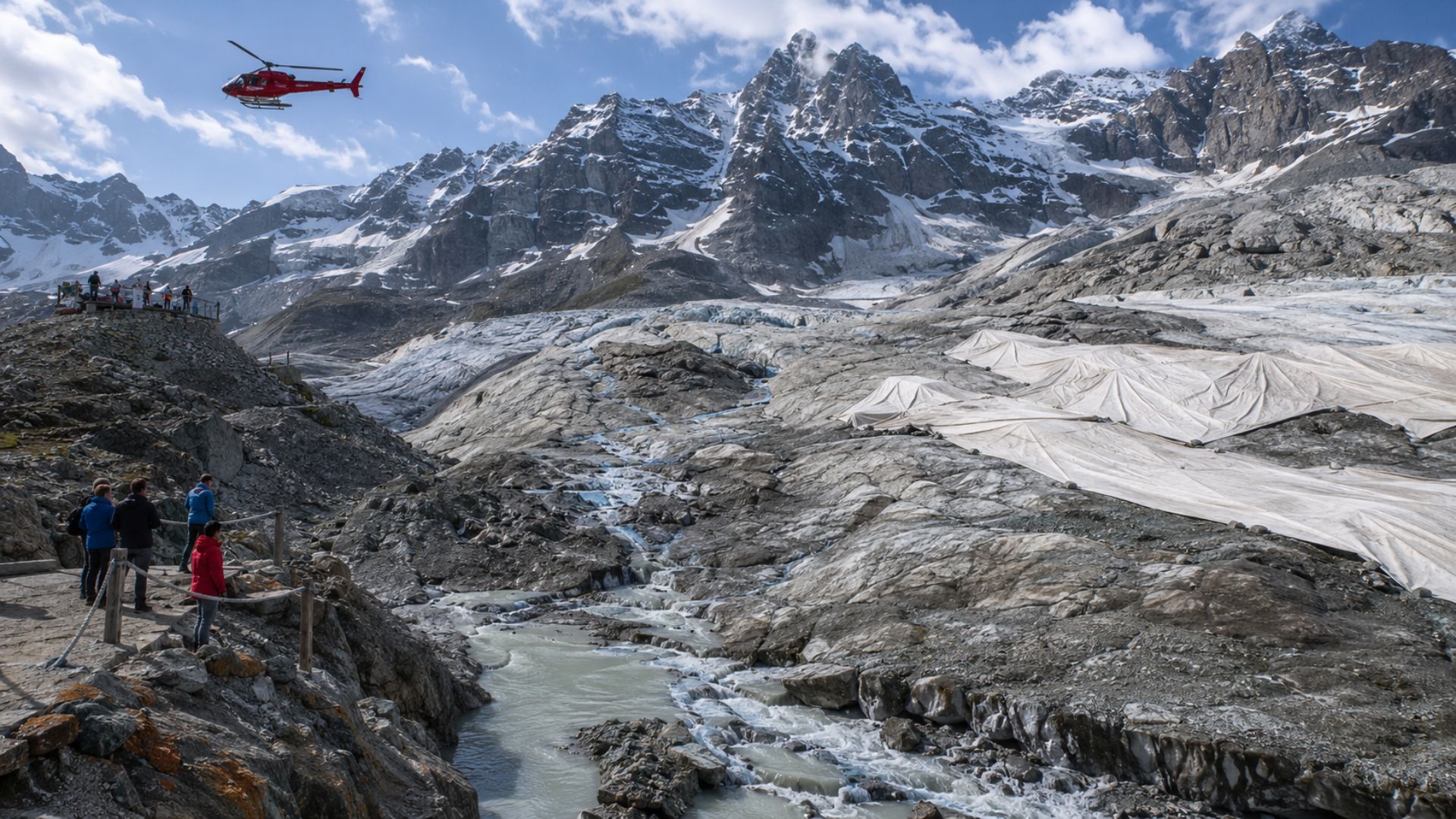

Researchers from an international team led by the University of Lausanne, Switzerland, warn in the journal Nature Climate Change that melting glaciers can be “loved to death” by last-chance tourism. The study criticizes adaptations such as ice covers with geotextiles and helicopter flights, stating that these measures do not combat the causes of climate change and can create additional problems, such as microplastic pollution.
According to information from the swissinfo portal, glaciers are melting at an accelerated rate in practically all mountainous regions of the planet, and this reality has created a paradoxical phenomenon: the more glaciers shrink, the more tourists want to visit them before they disappear completely. This behavior, known as “last-chance tourism“, is generating a growing flow of visitors to fragile glacial landscapes that cannot withstand human pressure, according to a study published this Monday by an international team of researchers led by the University of Lausanne, Switzerland. The article, published in the prestigious scientific journal Nature Climate Change, warns that tourism can threaten the very glaciers it seeks to make tangible to the public.
The problem is not limited to the number of visitors. The tourism industry is responding to melting glaciers with technical adaptations that researchers consider counterproductive. Geotextile covers over ice surfaces, expansion of infrastructure in high mountain areas, and the offering of tourist helicopter flights are some of the measures adopted to maintain tourist access to rapidly changing landscapes. According to the study’s authors, these adaptations do not address the causes of climate change and can create new environmental problems that accelerate glacier degradation instead of slowing it down.
What is last-chance tourism and why does it threaten glaciers

The concept of last-chance tourism refers to the motivation to visit a place or natural phenomenon before it disappears. In the case of glaciers, growing awareness of climate change has led millions of people to include glacial destinations on their travel lists, creating a demand that grows in proportion to the ice’s decline. Glaciers in the Swiss Alps, Iceland, Patagonia, and Alaska record an increase in visitors year after year, even as they lose volume and extent.
-
Nuclear Fusion Study Proposes Transforming Mercury into Gold Using Tokamak Neutrons, but Real-World Application Remains Uncertain

-
Brazilian Researchers Develop Floor Tiles That Convert Student Footsteps into Electricity to Reduce University Energy Costs

-
Cambridge Scientists Achieve Solar-Powered Plastic Recycling, Converting Waste into Valuable Chemicals Without Fossil Fuels, Paving the Way for a Low-Carbon Circular Economy

-
In Ghana, Makafui Awuku Turns 250-300 Water Sachets Into Each 30-Year-Lasting School Desk, Lifting Children Off Classroom Floors


The paradox is evident: the same environmental concern that motivates travel generates environmental impact. Each tourist who travels by plane to see a glacier contributes to carbon emissions that accelerate global warming. Each group that walks on the ice compacts the surface and can alter the albedo, the ability to reflect sunlight that helps keep glaciers cold. And each infrastructure built to facilitate visitor access modifies the landscape around the ice in ways that can be irreversible.
Geotextiles and helicopters: adaptations criticized by researchers
To keep glaciers accessible to tourists even during melting, tour operators and local governments have adopted protection measures that include covering ice surfaces with geotextiles, synthetic blankets that reflect solar radiation and reduce the melting rate. Researchers at the University of Lausanne criticize this practice for generating microplastic pollution, as geotextiles degrade over time and release synthetic particles that infiltrate meltwater and contaminate downstream aquatic ecosystems.
Tourist helicopter flights are another target of the study’s criticism. Operators offer overflights and landings on glaciers as a premium experience for tourists who cannot or do not want to do high-mountain hikes. Each flight, however, emits greenhouse gases that contribute directly to the warming that melts the visited glaciers. For researchers, offering helicopter flights over melting glaciers is equivalent to selling tickets to watch a fire while throwing gasoline on it.
“Loved to death”: the researchers’ warning
The phrase used by the study’s authors in Nature Climate Change summarizes the central dilemma: glaciers can be “loved to death” by tourism. The attraction people feel for these landscapes, motivated by their beauty and the urgency to see them before they disappear, is becoming one of the forces contributing to their destruction. It is not the main cause, which remains global warming caused by fossil fuel emissions, but it is an aggravating factor that adds pressure to already collapsing ecosystems.
The study argues that the tourism sector needs to rethink its relationship with glaciers instead of simply adapting its infrastructure to continue operating as the ice disappears. According to researchers, covering glaciers with plastic, building cable cars, and offering helicopter rides are solutions that treat the symptom and ignore the disease. A more responsible approach would include limiting the number of visitors, eliminating high-impact activities, and investing in environmental education that transforms glacial tourism into a genuine awareness tool, not a consumer product with an expiration date.
Switzerland at the center of the debate on glaciers and tourism

Switzerland is one of the countries most affected by glacier melt and also one of the biggest beneficiaries of glacial tourism. The Swiss Alps have lost more than 60% of their ice volume since the mid-20th century, and iconic glaciers like the Aletsch shrink at a measurable rate each year. At the same time, mountain tourism is a pillar of the Swiss economy, generating billions of francs annually and supporting entire communities that depend on the alpine landscape to attract visitors.
The fact that the University of Lausanne is leading this warning is significant because Switzerland faces the conflict between preservation and economy more intensely than most countries. Limiting glacier tourism means reducing revenue in regions that lack immediate economic alternatives. But allowing tourism to continue growing without restrictions means accelerating the degradation of a natural heritage that, once lost, cannot be recovered. The Nature Climate Change study does not offer a simple solution but makes it clear that inaction has an environmental cost that tourism revenue cannot cover.
Infrastructure that grows as ice disappears
One of the most critical points raised by the study is the increase in infrastructure in glacier areas. As the ice recedes, new terrain is exposed, and tour operators take advantage to build trails, viewpoints, parking lots, and visitor centers in places that were covered by ice just a few years ago. This expansion of infrastructure permanently alters periglacial landscapes, areas that should function as ecological transition zones between the ice and high-altitude ecosystems.
Researchers warn that these constructions can accelerate erosive processes, alter meltwater courses, and fragment habitats of species that naturally colonize the terrain exposed by glacier retreat. Instead of allowing nature to gradually occupy the spaces left by the ice, the installation of tourist infrastructure imposes immediate human use on geologically unstable terrain. Landslides, avalanches, and moraine collapses are real risks in periglacial areas that are being transformed into tourist spots before their geological stability is understood.
See glaciers before they disappear, or protect them so they don’t disappear
The study published in Nature Climate Change poses a question that goes beyond science: is it more valuable to see glaciers while they still exist, or to protect them so they exist longer? Researchers led by the University of Lausanne argue that last-chance tourism, as practiced today, contributes to accelerating precisely the end that tourists want to witness. Covering with geotextiles pollutes. Helicopters emit carbon. Infrastructure destroys periglacial landscapes. And the volume of visitors pressures ecosystems that are already at their limit.
Would you visit a glacier knowing that tourism might contribute to its disappearance? Tell us in the comments what you think about last-chance tourism, whether the solution should be to limit access or invest in environmental education, and how you evaluate geotextile covers over the ice. We want to hear your opinion on the balance between experiencing nature and protecting it.