






 Portuguese
  Spanish


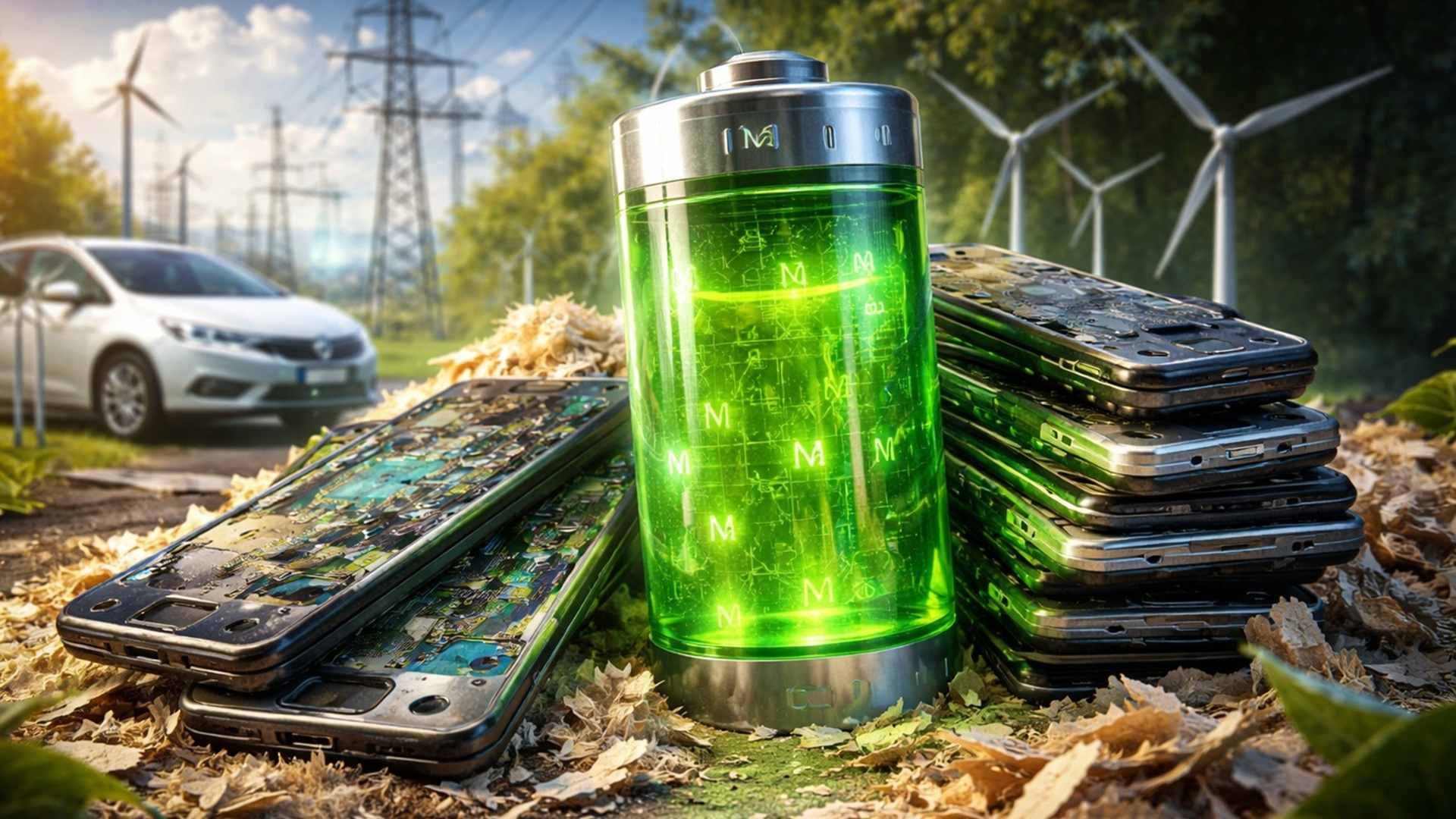

New Method Transforms Discarded Old Phones and Industrial Lignin into Composite for Sodium-Ion Batteries, Achieving Initial Capacity Over 1,000 Milliampere-Hours per Gram and Proposing Sustainable Alternative for Storage in Electric Vehicles and Power Grids
A new method converts old phones and industrial lignin into material for sodium-ion batteries, using hydrothermal synthesis to extract nickel and cobalt and form composite with initial capacity over 1,000 milliampere-hours per gram, with potential application in electric vehicles and power grids.
New Method Converts Old Phones and Industrial Lignin into Composite for Sodium Storage
The new method converts old phones and paper industry waste into a composite of nickel-cobalt sulfides and carbon derived from lignin for use as an anode in sodium-ion batteries.
The proposal repurposes discarded mobile phone batteries and industrial lignin, avoiding disposal in landfills or incineration and directing materials to a high-tech application in energy storage.
-
Self-Driving Harvester Now Operating in Brazil’s Vast Farmlands

-
Astronomers Discover Two Giant Exoplanets as Light as Cotton Candy, Challenging Current Scientific Models 1,110 Light-Years from Earth
-
NASA’s Plan to Dump ISS Debris in Ocean Sparks Environmental Concerns Among Scientists
-
14-Year-Old Invents Eco-Friendly Water Pump Using Recycled Materials to Aid Communities Without Water Access


When tested as a sodium-ion battery anode, the composite exhibited what researchers described as robust electrochemical performance.
Process Uses Hydrothermal Synthesis to Recover Metals and Integrate Carbon from Lignin
For the conversion of waste, the team used hydrothermal synthesis technique, allowing for the extraction of essential metals such as nickel and cobalt from used batteries.
After extraction, the metallic compounds are melted with carbon derived from lignin, a relevant byproduct of paper and biofuels production, forming a functional composite.
Lignin acts as a carbon coating, enhancing electrical conductivity and stabilizing the electrode, while the recovered metal sulfides provide necessary reaction sites for sodium ion storage.
The material’s structure facilitates efficient ion transport and ensures long-term structural integrity, according to data presented in the study.
Electrochemical Performance Exceeds 1,000 Milliampere-Hours per Gram in Initial Tests
During laboratory tests, the material achieved an initial discharge capacity exceeding 1,000 milliampere-hours per gram.
Even under high current densities, it maintained what was deemed remarkable capacity, demonstrating an ability to withstand rapid charge and discharge processes.
“Even at high current densities, the material maintained remarkable capacity, demonstrating its ability to withstand rapid charge and discharge processes,” researchers stated.
Scientists from Shenyang Agricultural University in China highlighted that sodium-ion batteries are attractive because sodium is abundant, low-cost, and environmentally friendly.
“However, developing efficient electrode materials remains a significant challenge. Our work shows that residual resources can provide a solution,” they stated in a press release.
Circular Economy Links Electronic Waste and Industrial Byproducts in Energy Technology
The method simultaneously addresses the problem of electronic waste and the valorization of industrial byproducts by transforming discarded batteries and lignin into advanced energy material.
Sodium-ion batteries are considered a sustainable alternative due to their lower cost and greater abundance of sodium compared to lithium.
The developed components can be used in energy storage for power grids, electric vehicles, and portable electronics, expanding application possibilities.
To meet the growing demand for sustainable energy, materials that combine accessibility and high performance are needed.
The project establishes a recycling pathway for millions of discarded and replaced batteries each year, while also repurposing industrial lignin as an essential component.
“We wanted to go beyond traditional recycling and demonstrate true reuse of waste with high added value,” the authors noted.
“By converting discarded batteries and industrial lignin into advanced energy materials, we can reduce costs, conserve resources, and support cleaner technologies,” they added.
Although the laboratory results represent a milestone, there is still no confirmation on scaling the technique for larger scale applications.
If large-scale application is successful, the method could reduce manufacturing costs and accelerate the commercial adoption of sodium-ion batteries.
The research findings were published in the journal BiocharX, consolidating the proposal for the synergistic conversion of old phones and industrial lignin into green battery technology.


