Portuguese
  Spanish


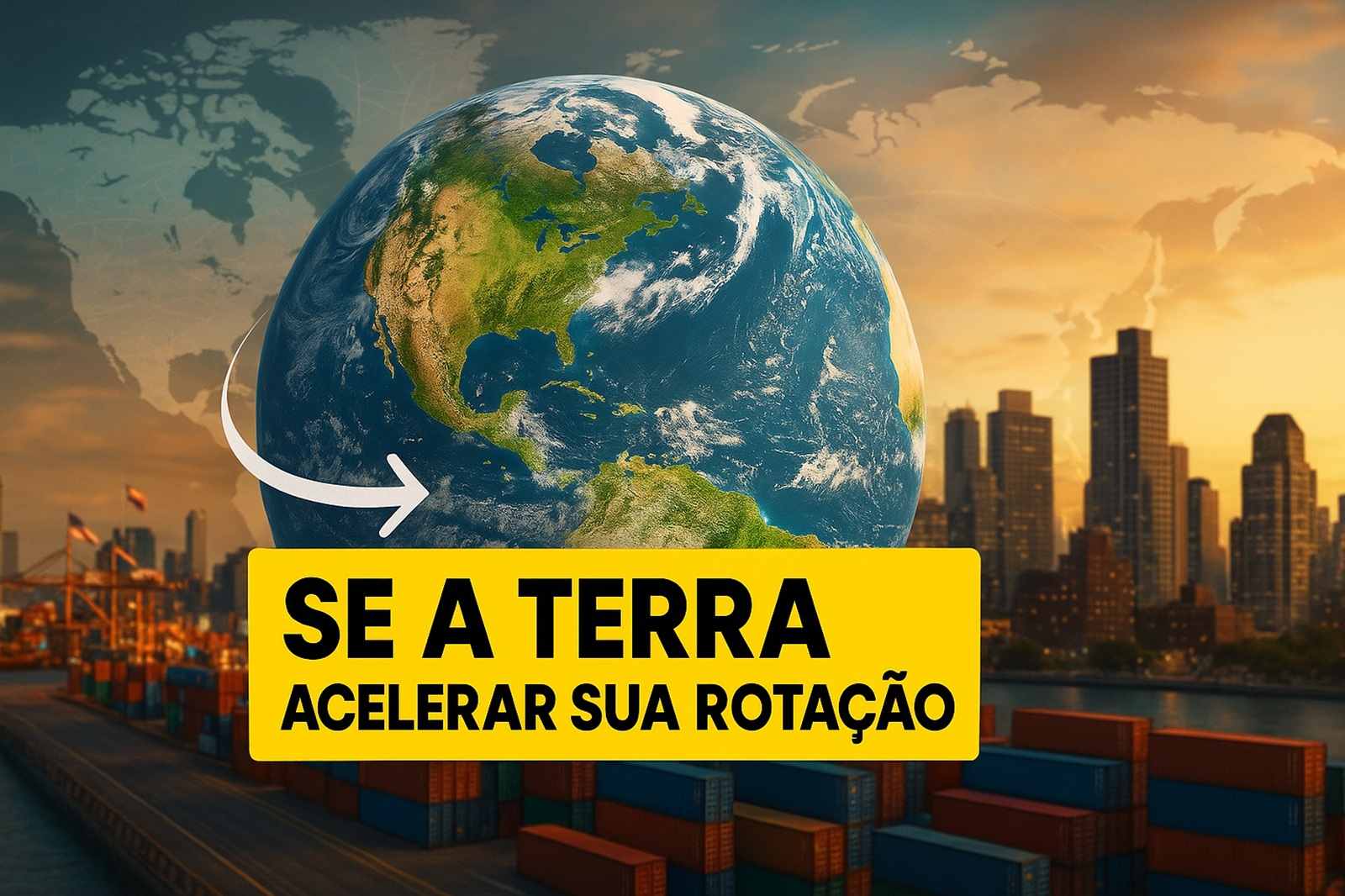


Scientists Are Discussing What Could Happen If The Earth Began To Spin Faster. Although It Seems Unlikely, The Effects Described Include Floods, Earthquakes, and More Intense Hurricanes. Studies Warn of Severe Impacts on Ecosystems and Daily Life
Recently, scientists observed that the Earth has been spinning slightly faster, reducing the length of days by milliseconds. Because of this, many have wondered: what would happen if the Earth spun faster?
Although the change seems minimal, studies are already discussing what the consequences would be if this acceleration increased. As reported by New Scientist, the risks range from catastrophic floods to more intense climatic and geological events.
Oceanic Changes and Water Expansion
One of the first effects of a faster rotation would be an increase in centrifugal force on the planet. This force would push large volumes of water toward the equator, altering the shape of the Earth.
-
China Tests Giant 582-Ton Magnets to Contain Plasma Hotter Than the Sun’s Core, Aiming to Cut Superconductor Costs and Generate First Electricity from “Artificial Sun” by 2030

-
Seventh Grader Builds Nuclear Fusion Machine at Home, Aiming for Guinness World Record

-
Ancient Ritual Circle, Hidden for 5,000 Years, Discovered in Scotland’s Machrie Moor Using Sensors, Revealing a “Phantom Stonehenge”

-
Engineers Develop Fridge-Sized Machine to Produce 95-Octane Synthetic Fuel from Air and Water, Aiming to Sustain Combustion Engines Without Oil



As a result, equatorial regions could face severe flooding, while polar areas would suffer from reduced water levels. The redistribution would create an imbalance scenario.
Professor Duncan Agnew, a geophysicist at the University of California, San Diego, told The Daily Mail that even a 10% increase in rotation would already cause noticeable changes in tides.
According to him, some regions would experience much higher tides and others much lower, disrupting predictable patterns.
Therefore, coastal ecosystems and infrastructures located near the sea would be severely impacted. Coastal cities and entire islands could face situations of permanent risk.
Stronger and More Frequent Earthquakes
The rotation of the Earth not only affects the oceans. It also influences the movement of tectonic plates. When the speed increases, the stresses in the Earth’s crust grow, raising the chances of earthquakes.
According to Professor Agnew, a faster-spinning Earth could accelerate tectonic activity. This would generate more frequent and destructive earthquakes in different parts of the planet.
Alex Foster, cited by New Scientist, explained that centrifugal force reduces the perception of gravity. “The faster the Earth spins, the more gravity will be canceled out, and the lighter you will feel,” he noted. This same force would amplify the effects on geological faults.
Therefore, regions already known for their seismic instability, such as Japan and Chile, could face even greater risks.
Hurricanes and Devastating Storms
Another serious effect would be the impact on climate systems. The intensification of rotation would enhance the so-called Coriolis effect, responsible for the rotation of hurricanes and cyclones.
According to NASA astronomer Dr. Sten Odenwald, the consequence would be direct: “Hurricanes will spin faster and carry more energy.” This would mean more violent storms, with winds capable of destroying entire areas in a short time.
Furthermore, climatic patterns would undergo accelerated changes. This could increase the frequency of extreme events, such as heat waves, intense droughts, and torrential rains. The planet would enter a cycle of continuous climatic instability.
Gravity and Impact on Daily Life
One of the most curious points would be the effect on the gravity felt at the surface. The faster the Earth spins, the greater the centrifugal force acting against gravity.
This would make people feel lighter. In extreme scenarios, objects could even be thrown off the planet if the centrifugal force exceeded gravitational attraction.
Although this is an extreme scenario, it illustrates how even simple everyday tasks would be altered. Walking, running, or carrying objects could become completely different experiences.
The effect might seem fun at first, almost like living in reduced gravity. However, experts warn that loss of balance and difficulty in maintaining stable structures would be constant dangers.
The Long Process of Natural Deceleration
Despite all these projections, scientists remind us that the Earth’s natural trend is precisely the opposite: deceleration.
According to Duncan Agnew, about one billion years ago, days were approximately 19 hours long. This demonstrates that, throughout geological history, the rotation has been decreasing.
In the last century, the actual shortening was only 1.7 milliseconds. This change shows how slow the alterations are at the natural pace.
Researcher Judah Levine from the National Institute of Standards and Technology (NIST) also pointed out that significant acceleration would require a massive transformation in the planet’s angular momentum. This could involve, for example, changes in the Moon’s orbit.
He observed that “if history is loosely connected to reality, then the acceleration of the Earth would have to be accompanied by something else, the loss of angular momentum, perhaps the Moon’s orbit.”
Therefore, even though the hypothesis of acceleration raises important alerts, it is a theoretical scenario without practical records in the recent history of the Earth.
Between Theory and Alert
The studies published by New Scientist and experts like Agnew, Odenwald, Foster, and Levine show that the consequences of a faster spinning Earth would be dramatic.
From floods to earthquakes and devastating hurricanes, life on the planet would be profoundly altered. The natural balance of the oceans, climate, and even gravity would collapse.
On the other hand, the confirmation that the Earth is in a process of natural deceleration gives some relief. This means that, at least within the observed reality, these scenarios remain in the realm of scientific speculation.
Still, the research serves as a warning. Understanding the physical limits of the planet helps reinforce the importance of continuous scientific monitoring and the study of the forces that shape life on Earth.