Portuguese
  Spanish


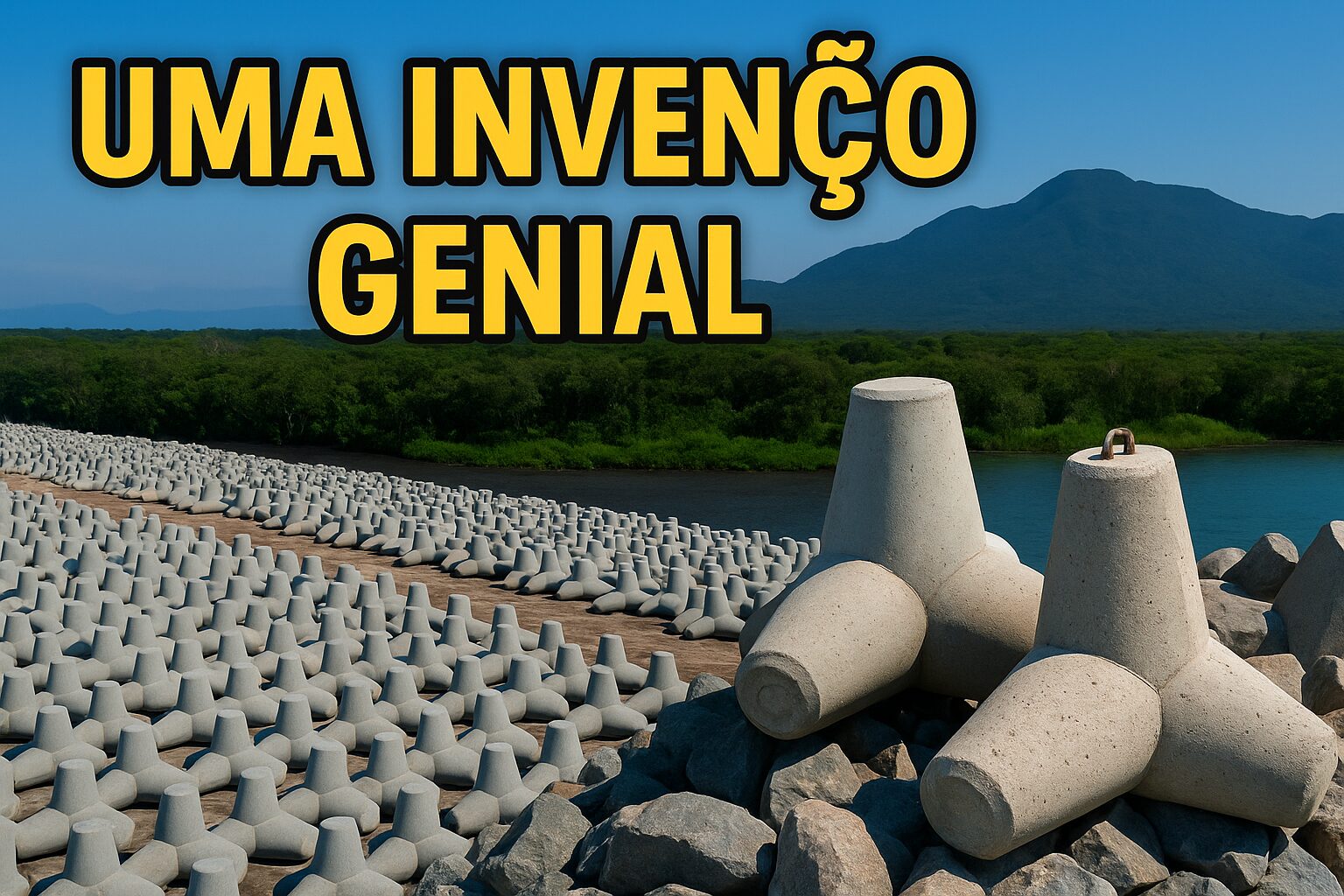


Concrete Tetrapods Form Barriers Against Strong Waves and Help Protect Beaches, Ports, and Rivers from Erosion and Sea Impacts.
On beaches around the world, there are structures that stand out for their peculiar shape and essential function. Known as tetrapods or breakwaters, these blocks of concrete with cylindrical arms are one of the main defenses against erosion caused by waves.
Installed parallel to the coastline, they help preserve land and structures near the sea.
In addition to preventing soil loss on beaches, these constructions fulfill other fundamental roles.
-
Rural Worker Spotted “Flying” on a Drone in Brazil

-
Turkish Cave Suggests Neanderthals and Homo Sapiens Shared Cultural Traditions for Millennia; Discovery Unveils Similar Tools, Hunting Techniques, and Shells at a Major Prehistoric Site
-
Burkina Faso Bans NGOs from Photographing Vulnerable People Without Consent and Outlaws Fundraising Campaigns Exploiting Suffering
-
Giant Earthworms up to 2 Meters Long Secretly Sustain Fertility in the Amazon Rainforest



Despite their simple appearance, tetrapods are the result of technical calculations and specific materials, designed to withstand the ocean’s assaults.
Throughout this article, you will better understand how they work and why they are so important.
The tetrapods were invented in 1950 in France, by engineers from the Laboratoire Dauphinois d’Hydraulique (LDH), an institution specialized in hydraulic engineering.
What Are Tetrapods or Breakwaters
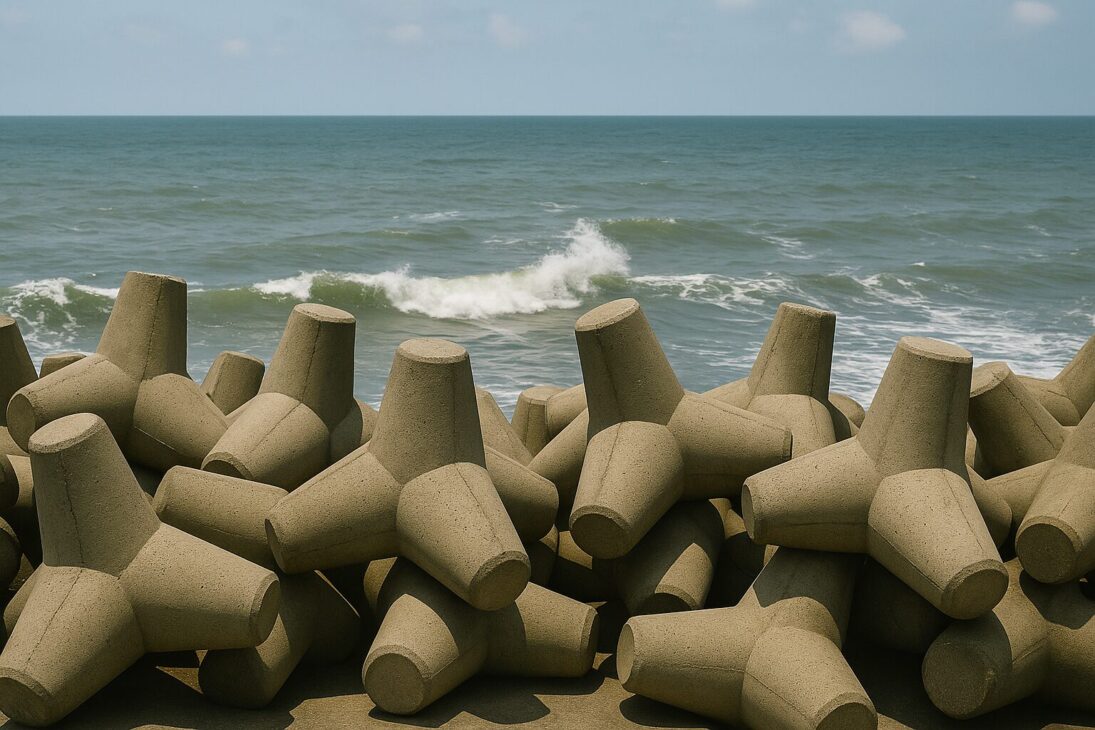
Tetrapods or breakwaters are concrete structures with four arms that absorb wave energy.
These units are stacked in an interlinked manner, creating barriers that resist the advancing sea.
Each block typically has a visible number on its body.
This marking facilitates technical control over its position, allowing monitoring of displacements caused by the continuous action of water or by construction work in the area.
The construction of the breakwater includes several layers. The core is made of coarse aggregates, free from sand or dust.
Above it is the first base layer, also called the filter layer, made with stones weighing between 500 kg and 1 ton. Its function is to prevent the core from being washed away by the waves.
Finally, comes the main armor layer. In it, even larger stones, weighing between 1 and 3 tons, are used.
In some cases, they are replaced by concrete stones with special shapes. This last layer is responsible for absorbing the direct impact of the sea.
Main Functions of Breakwaters
The primary function of tetrapods is to control erosion. When waves carry sediments, they can slowly destroy the coastal environment.
Breakwaters block part of this force, reducing material loss and stabilizing the soil.
Another utility is to protect river estuaries. When the sea invades these areas, it hinders the drainage of freshwater. Tetrapods reduce the impact of the waves, allowing rivers to continue flowing normally.
The structures also promote the commercial use of the coast. In areas with few waves, ports and ships operate more safely.
The same applies to tourist areas, where calm seas attract visitors and businesses.
Additionally, breakwaters help protect other maritime structures, such as levees, jetties, and docks. By softening the impact of the water, they prevent damage and ensure greater durability of these constructions.
In some cases, tetrapods are still used to expand beach space. They deflect the currents that cause erosion and allow the recovery of previously lost areas. This makes the location more suitable for new constructions or public use.
Varieties of Breakwaters
Not all breakwaters are the same. There are variations in shape and position relative to the coast.
An example is connected breakwaters, typically used to protect harbor waters. Offshore types are placed a bit further from the beach, acting as shields against erosion.
Other models stand out for their construction characteristics.
The shallow water breakwater, for example, is made with small and large steps, allowing vessels to approach easily. It is ideal for areas with heavy maritime traffic.
The so-called mound breakwater is constructed with rock fragments of various sizes, arranged in layers.
It starts with larger stones at the base and progresses to lighter materials on top. It may also include concrete blocks, providing additional resistance.
The type known as under shallow water breakwater is shorter and uses less material. Its reduced shape is ideal for locations with calm seas, where wave strength is less and does not require as much protection.
Importance of Materials
The effective results of breakwaters depend directly on the quality of the materials used. The concrete of the tetrapods needs to be strong and durable.
The use of stones with suitable shapes also influences the performance of the structure.
The layers that compose the breakwater must be constructed with care. The core, for instance, needs to have good drainage, which is only possible with aggregates free of fine particles.
The filter layer protects the core, while the outer armor absorbs the most severe impacts.
With the right choice of materials, tetrapods can last for many years, maintaining their function and avoiding frequent repair costs. In regions with rough seas, this durability is even more important.
Even though they may seem like merely stacked blocks on the beach, tetrapods are the result of careful engineering. They protect lives, property, and environments.
Their presence helps to contain the advance of the sea, ensuring that ports, cities, and natural areas can continue to exist.
The proper functioning of these breakwaters requires maintenance, monitoring, and the use of quality materials. Ignoring these factors may compromise the protection offered by these structures.
Therefore, their installation needs to follow strict technical criteria, respecting the environment where they will be placed.
Without them, many coastal regions would have already disappeared.