






 Portuguese
  Spanish


Lilac Solutions completed direct lithium extraction (DLE) tests at Great Salt Lake with 87% recovery and 99.97% purity from brine of only 70 ppm, and plans to open the first commercial DLE plant in the US in 2027 with 5,000 tons per year, doubling American production.
While automakers worldwide rely on mines that evaporate millions of liters of water per ton of lithium extracted in deserts like Chile’s Atacama, American startup Lilac Solutions has developed direct lithium extraction (DLE) technology that, in tests completed in August at Utah’s Great Salt Lake, recovered 87% of available lithium with 99.97% purity using proprietary ceramic beads that attract lithium ions from water and which, according to the company, consume one-tenth of the water required by the alumina sorbent technology that dominates the DLE industry. The company plans to build its first permanent commercial lithium plant at the same location, with production expected to begin in the second half of 2027, a capacity of 5,000 tons per year that would double the United States’ annual production, and has already secured about two-thirds of the necessary funding for the project that could become the first commercial DLE facility in history. Lilac CEO Raef Sully stated that the company chose Great Salt Lake precisely because of its difficulty: with only 70 parts per million of lithium in the water, success there demonstrates that the technology works in much worse conditions than those found in the world’s major lithium deposits.
Lilac’s strategy differs from most lithium competitors in one fundamental aspect: the company does not want to be a miner. Instead of extracting and selling lithium, Lilac aims to sell its DLE technology to companies already operating in the sector, such as Exxon Mobil, Chevron, Rio Tinto, and Occidental Petroleum, which are competing to develop lithium reserves in locations like the Smackover region in Arkansas, where the U.S. Geological Survey has identified up to 19 million metric tons of unexplored lithium in groundwater. “We believe our technology is the next generation. If we end up working with an Exxon, a Chevron, or a Rio Tinto, we want to be the DLE technology provider for their lithium project,” declared Sully, a position that Kwasi Ampofo, head of minerals and metals at BloombergNEF, considers unusual and potentially smarter than the vertical integration that most lithium companies pursue.
How direct lithium extraction works and why it consumes less water

Direct lithium extraction eliminates the two most problematic steps of traditional methods: hard rock mining (used in Australia, the world’s largest producer) and evaporation in ponds (used in Chile, the second largest source). In the traditional evaporation method used in the Atacama Desert, lithium-rich water is pumped into enormous ponds and left to dry for months in the sun, a process that consumes millions of liters of water per ton of lithium produced and occupies vast areas of land in one of the planet’s driest deserts, while DLE filters lithium from brine through chemical or physical processes and returns the water to the environment in a matter of hours. Lilac’s technology uses patented ceramic beads manufactured at the company’s Nevada plant, with an entirely American supply chain, which selectively attract lithium ions from water. Once saturated, the beads undergo an acid wash to separate the lithium, which is then processed into battery-grade lithium carbonate.
-
A fossil kept for years in a small museum in Montreal concealed 450-million-year-old soft tissue, a discovery that has only happened once before in history.

-
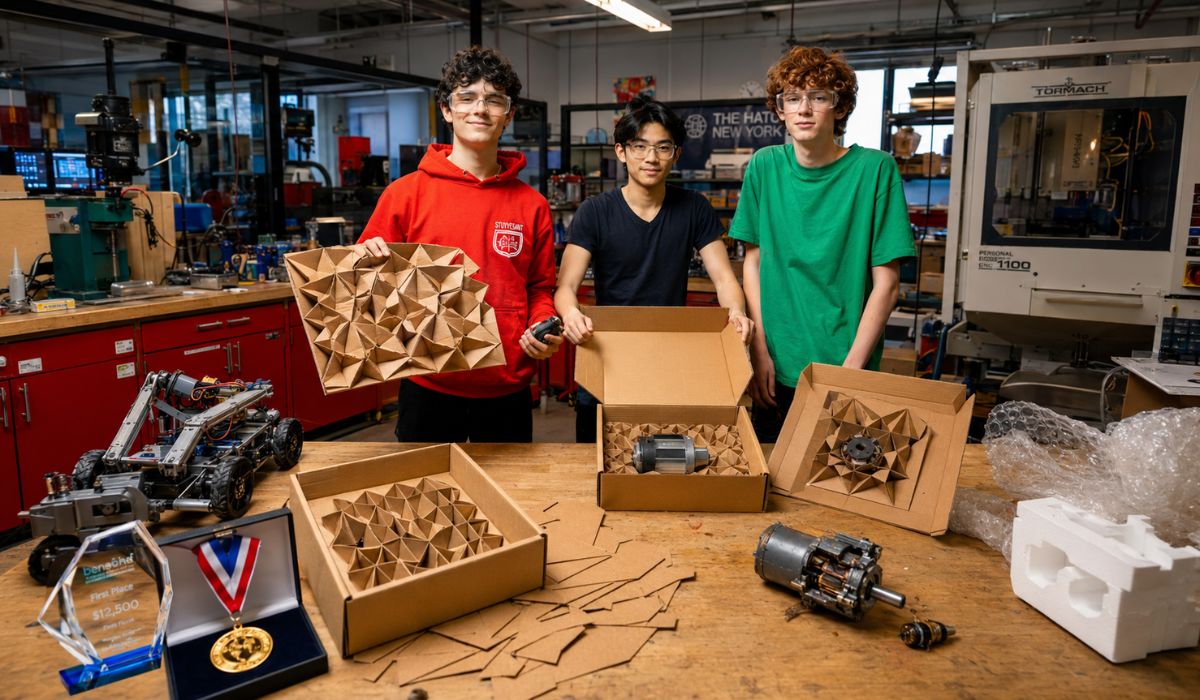
Three teenagers transform cut cardboard into Japanese origami-style packaging that promises to retire styrofoam and bubble wrap, win a $12,500 prize, and target giants like Amazon, FedEx, and Home Depot after a robot motor arrived broken.

-
The large jar blender has a rival: Oster Ultra Power bets on 1,000 W, six stainless steel blades, and two portable cups with leak-proof lids.

-
Tesla injected an additional $250 million into the German factory, doubled the battery cell target, and opened its own production line for startups.


The process Lilac developed solves two simultaneous problems: it reduces water consumption and works with low-concentration lithium brines. While California’s Salton Sea has about 200 parts per million of lithium and deposits in Argentina exceed 700 ppm, the Great Salt Lake where Lilac tested its technology has only 70 ppm, a concentration so low that Sully compares it to “three people in a 45,000-seat stadium,” yet the equipment recovered 87% of available lithium with 99.97% purity, numbers that Milo McBride, a researcher at the Carnegie Endowment for International Peace, classifies as a convincing demonstration of the technology’s versatility. The ability to extract lithium from dilute sources opens up possibilities that traditional methods cannot achieve and can significantly expand the world’s exploitable lithium resource base.
Why the United States needs domestic lithium and what China has to do with it
The race for lithium extraction in the US is inseparable from the geopolitical dispute with China for control of the battery supply chain. China processes more than two-thirds of all lithium extracted globally and is developing its own DLE technologies to expand domestic production, a position that gives the country control over an essential input for electric vehicles and energy storage that the United States considers a national security issue. The 5,000 annual tons that Lilac’s plant in Utah would produce would double the American lithium supply, but a full-scale plant using the same technology would yield three to five times that volume, a leap that would begin to reduce US dependence on Chinese processing.
The largest proposed lithium project in the United States, the controversial Thacker Pass hard rock mine in Nevada, faces uncertainties that reinforce the importance of alternatives like DLE. Environmentalists, ranchers, and Native American tribes oppose the Thacker Pass project, arguing that mining would destroy underground freshwater reservoirs, and the Trump administration renegotiated a federal loan of over US$2 billion in October 2025 to secure a 5% equity stake in the operation, a scenario of instability that makes Lilac’s DLE attractive by promising lithium production with a much lower environmental and political impact. Energy giants like Exxon Mobil, Chevron, and Occidental Petroleum are already competing to develop lithium reserves in the Smackover region of Arkansas, and Lilac aims to be the preferred DLE technology provider for these projects.
What obstacles does Lilac face to transform testing into commercial lithium operation

The gap between test results and commercial-scale lithium production is the challenge that will determine the future of Lilac and the DLE industry as a whole. Utah regulators are restricting companies that pump water from the Great Salt Lake, which continues to shrink due to droughts, although Lilac claims to be protected from restrictions by returning water to the lake after lithium extraction. Ashley Zumwalt-Forbes, a mining engineer who served as deputy director for battery minerals at the US Department of Energy, acknowledges that “the Great Salt Lake is probably the worst possible place to do this because of the real challenges related to taking water out of the lake,” but agrees that “if it’s just being used as a test for the technology, it makes sense.”
The commercial plant Lilac will build at the test site in Utah will be erected under a separate limited liability company, a structure that facilitates a potential sale if the operation is successful. The company has already secured two-thirds of the necessary funding and needs to complete the remainder before starting construction aimed at commercial lithium production in the second half of 2027, a timeline that, if met, would make the facility the first new commercial source of lithium in the US in years and the first DLE plant in history to operate at commercial scale. Lilac’s business model as a technology seller, not a lithium producer, is a bet that the DLE market will grow enough to justify a company dedicated exclusively to supplying hardware for miners, a path that BloombergNEF considers promising but still needs to prove financial viability in an industry where vertical integration is the norm.
What DLE’s success would mean for the global lithium and battery market


If direct lithium extraction scales as projected, the impact on the global metal market could be structural. DLE promises to unlock lithium sources that traditional methods cannot economically exploit, from diluted brines like the Great Salt Lake to underground waters like those in Smackover, Arkansas, an expansion of the resource base that could reduce the geographical concentration of production and diminish the market power that Chile, Australia, and China currently exert over the lithium supply chain. Demand for the metal continues to grow as electric vehicles gain market share and increasingly larger batteries are used to support renewable energy grids, a context that makes any technology capable of increasing supply with less environmental impact relevant to automakers, governments, and investors.
For the energy sector, the convergence between oil companies and the lithium industry is a trend that DLE accelerates. Exxon Mobil, Chevron, and Occidental Petroleum already have experience in drilling, underground fluid management, and operation in remote environments, competencies that transfer directly to lithium extraction from brines, and Lilac’s technology was designed to be the equipment these companies would install in their lithium projects in the same way they buy turbines or drilling equipment from specialized suppliers. The lithium these plants would produce would supply battery factories and automakers that today depend on supply chains passing through China, closing a cycle that begins with American brine and ends with the electric vehicle parked in the consumer’s garage.
And you, do you think direct extraction can change the game for lithium and batteries? Leave your opinion in the comments.


