Portuguese
  Spanish


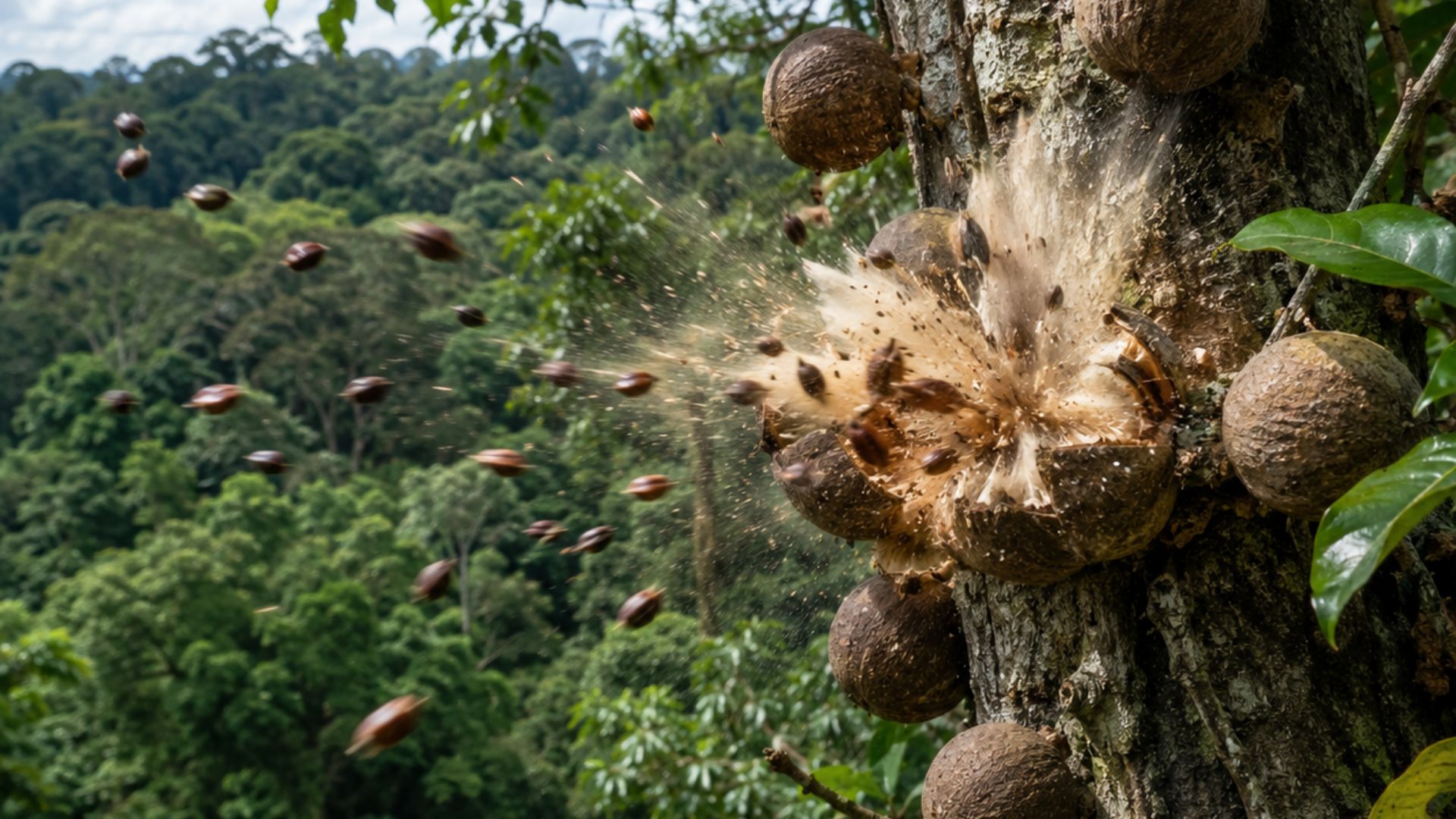


The native species Hura crepitans, known as assacuzeiro or dynamite-tree, produces woody fruits that rupture with explosive force and launch seeds at up to 70 m/s (252 km/h) within a radius of up to 100 meters from the mother tree in the Amazon Rainforest, according to studies by Embrapa Amazônia Oriental.
Amidst the diversity of the Amazon Rainforest, there is a native species that combines characteristics that seem straight out of science fiction: a trunk entirely covered with sharp spines 1 to 2 centimeters long, toxic sap capable of causing blindness upon contact with the eyes, and woody fruits in the shape of a small pumpkin that explode violently when they ripen. Hura crepitans, a native species of the Euphorbiaceae family popularly known in Brazil as assacuzeiro, açacu, areeiro, or dynamite-tree, has developed one of the most spectacular seed dispersal mechanisms in the plant kingdom: explosive dehiscence, a phenomenon in which the fruit capsule accumulates mechanical tension during drying until it ruptures with a bang similar to a gunshot, launching flat, disc-shaped seeds at speeds that scientific measurements have recorded at up to 70 meters per second, equivalent to 252 kilometers per hour. Embrapa Amazônia Oriental, based in Belém do Pará, published a study in 2017 on the germination of seeds of this native species as part of broader research on the propagation of Amazonian species.
The native species is not exclusive to Brazil: Hura crepitans occurs throughout the tropical region of the Americas, from Mexico to Bolivia, and has been introduced in Tanzania, where it is considered invasive. In Brazil, the dynamite-tree inhabits the Amazon Rainforest and areas of the Atlantic Forest, preferably in floodplains, riverbanks, and swampy terrains, humid environments that have nothing to do with the Cerrado (a savanna biome with a prolonged dry season that is sometimes erroneously associated with the native species in popular science publications). The tree can reach up to 60 meters in height with a trunk up to 1 meter in diameter, dimensions that make it an imposing presence in the canopy of Amazonian riparian forests, where the sound of its explosions during the fruiting season can be heard dozens of meters away.
How the explosion of the native species known as the dynamite-tree works
The mechanism that earned Hura crepitans the nickname dynamite-tree is an example of evolutionary engineering that the native species developed over millions of years to disperse seeds. The tree’s fruits are woody capsules 5 to 8 centimeters in diameter, resembling small pumpkins divided into segments, and each segment contains a flat, disc-shaped seed that will be launched when the fruit dries enough for the tension accumulated in the capsule walls to overcome the structure’s resistance. When this point is reached, the fruit ruptures violently, and the seeds are launched radially in all directions, a mechanism that botany calls explosive dehiscence and which, in practice, functions like a small plant fragmentation bomb.
-
A Brazilian street cleaner built a machine to recycle PET bottles in the hinterlands of Paraíba, transforming the trash he swept from the streets into threads, brooms, and equipment sold even outside Brazil, and began earning about R$ 7,500 per month with his own invention.

-
In a city where every piece of land is worth gold, he began buying plots in the 1960s and built a real estate empire with over a thousand properties.

-
An artist sank over 500 life-sized human statues at the bottom of the Caribbean Sea, and what seemed like macabre art turned into a living reef covered with corals that attracts divers from all over the world.

-
A fossil kept for years in a small museum in Montreal concealed 450-million-year-old soft tissue, a discovery that has only happened once before in history.


The speed and distance that the seeds reach are what make the native species exceptional even among plants that use explosive dispersal. Scientific measurements have recorded exit speeds of up to 70 meters per second (252 km/h) and a range of up to 100 meters from the mother tree, numbers that make the assacuzeiro one of the species with the most powerful ballistic dispersal in the plant world. The evolutionary function of this mechanism is to ensure that seeds germinate far from the shade and competition of the mother plant: the greater the distance, the higher the chance of finding illuminated soil and nutrients without competing with the tree that generated it, a strategy that allowed the native species to successfully colonize the Amazonian floodplains throughout its evolutionary history.
Why the native species is considered one of the most dangerous trees in the world


The explosion of the fruits is just one of the three dangers that Hura crepitans presents, making it a native species respected by riverside communities and researchers working in the field. The tree’s trunk is entirely covered with sharp spines 1 to 2 centimeters long that prevent climbing by humans and animals, a characteristic that earned the species the Caribbean English name “monkey no-climb,” and the sap contains toxic compounds that cause severe skin irritation and can cause blindness upon contact with the eyes. Amazonian indigenous peoples have historically used the sap of the native species to poison arrows and as a fishing poison, taking advantage of properties that paralyze fish and make them float to the surface, and the tree bark has insecticidal properties documented in scientific literature.
Despite the dangers, the native species has economic applications that local communities have explored for generations. The wood of Hura crepitans is light and easy to work with, used in civil construction for ceilings and internal works, in the manufacture of plywood, in crating (wooden packaging), and in the production of cellulosic pulp for the paper industry, in addition to having been historically used in the manufacture of matchsticks. In English, the tree is also called the “sandbox tree” because, before the invention of blotting paper, its dry, empty fruits were used as fine sand containers to dry fountain pen ink in colonial European offices, a use that gave the native species a curious role in the history of writing.
What Brazilian science studies about the native Amazonian species
Brazilian scientific research on Hura crepitans is conducted mainly by Embrapa Amazônia Oriental and institutions such as the National Museum of UFRJ and Inpa (National Institute of Amazonian Research). Embrapa Amazônia Oriental published a study in 2017 on the germination of sandbox tree seeds as part of a research program on the propagation of native Amazonian species, a work that documents ideal conditions of temperature, humidity, and substrate for Hura crepitans seeds to successfully germinate in a nursery, essential knowledge for reforestation programs and the recovery of degraded areas in the Amazon. The National Museum of UFRJ maintains detailed records of the native species in its Botanical Garden, with a complete morphological description that serves as a reference for field identification.
International researchers investigate pharmacological applications of compounds present in the native species that could have controlled use. Studies published by teams from the University of Basilicata in Italy and the University of Los Andes in Venezuela evaluated the antioxidant properties of Hura crepitans extracts, and Brazilian research investigated the acaricidal (against cattle ticks Boophilus microplus) and anthelmintic (against nematode worms) potential of compounds isolated from the tree, applications that require the isolation of toxic molecules before any practical use. The native species thus represents a case where danger and pharmacological potential coexist in the same tree, a paradox that justifies continuous scientific interest and the need for conservation of the Amazonian ecosystems where it naturally occurs.
What to know before encountering the native species in the Amazon
For those who hike trails, navigate rivers, or work in the field in the Amazon Rainforest, the native species deserves special attention during the fruiting season. Botanists’ recommendation is direct: keep a distance from trees with visible fruits in the canopy, because the explosion is unpredictable and seeds launched at 252 km/h can cause serious injuries to anyone nearby, and the sound of dehiscence, although audible dozens of meters away, happens too quickly to allow for reaction. The fruits can be recognized by their small pumpkin-like shape divided into segments and by their woody texture that becomes progressively drier and more brittle as it approaches the breaking point.
The conservation of habitats where the native species occurs is a condition for future studies on its pharmacological compounds and its dispersal mechanism to remain possible. Hura crepitans depends on floodplains and riparian forests, which are among the ecosystems most threatened by agricultural expansion and deforestation in the Amazon, and each hectare of destroyed riparian forest may contain specimens of the native species whose properties science has not yet fully cataloged. The dynamite tree is, in this sense, a symbol of what the Amazon Rainforest holds in terms of extreme biological mechanisms: fascinating when studied from a safe distance, dangerous when ignored, and irreplaceable when lost.
And you, did you already know about the Amazonian dynamite tree? Did you know it launches seeds at over 250 km/h? Leave your reaction in the comments.