






 Portuguese
  Spanish
  5 min of reading
  0 comments


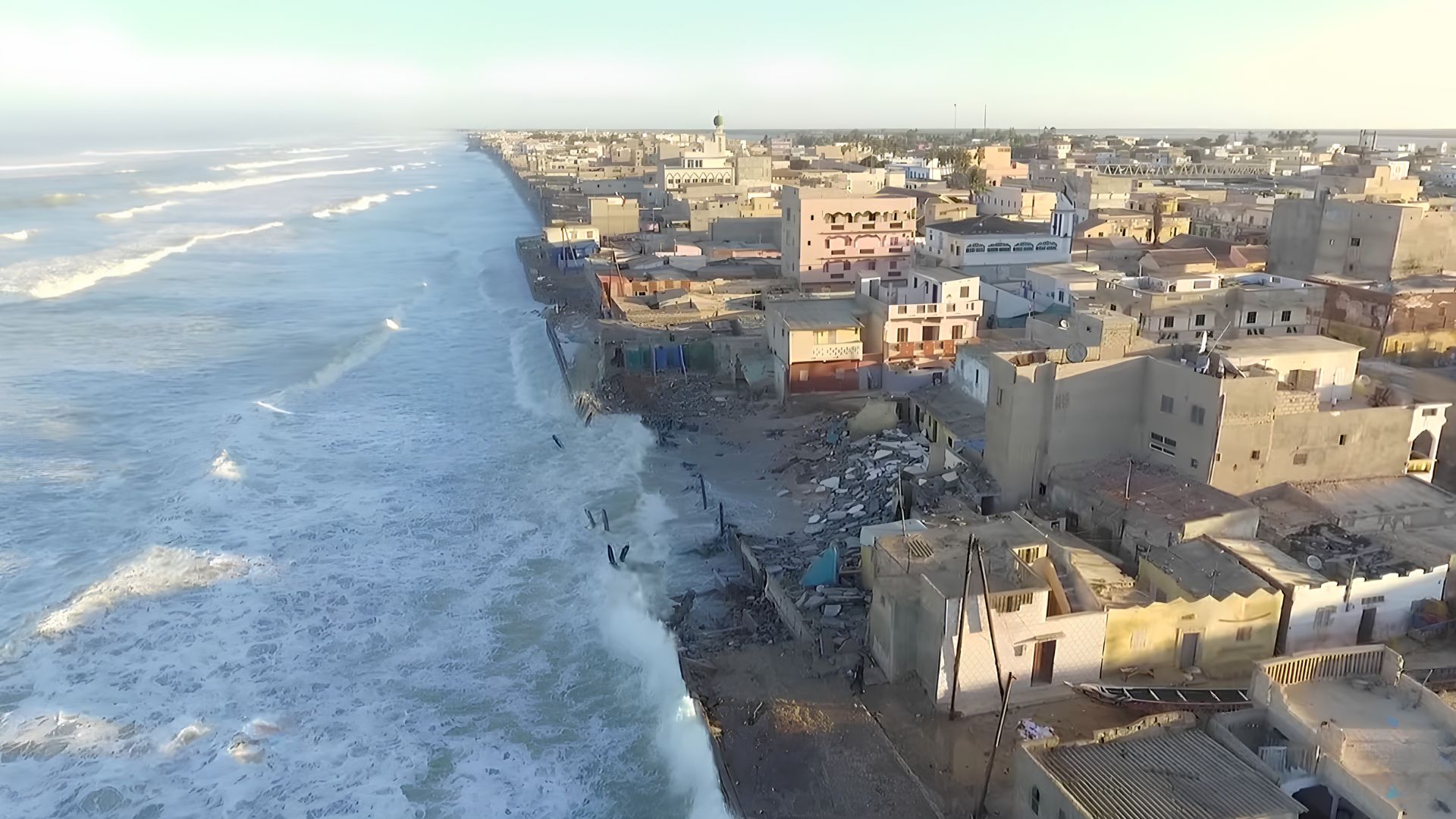
Saint-Louis, Senegal, faces sea encroachment, erosion, and resident displacement as scientists warn of increasing risk until 2100.
On the coast of Senegal, the historic city of Saint-Louis, known as the “African Venice” for its position between the Senegal River and the Atlantic Ocean, has entered a critical phase of coastal erosion, sea encroachment, and human displacement. According to a report by Le Monde published on October 30, 2025, hundreds of homes in vulnerable areas have already been destroyed and over 3,000 residents have been displaced, placing the city at the center of the global debate on planned coastal population retreat.
The impact is particularly concentrated in Guet Ndar, a dense and traditional fishing district situated on the Langue de Barbarie, a narrow strip of sand separating Saint-Louis from the Atlantic. A Human Rights Watch report published on August 18, 2025 indicates that coastal floods and erosion have displaced families since 2017 and 2018, while resettlement projects attempt to move residents from high-risk zones.
What was once treated as a future threat is now appearing in the city’s daily life: invaded streets, lost homes, and the growing perception that part of Saint-Louis may not remain habitable in the coming decades.
-
Survivor of 1966 SS Daniel J. Morrell Shipwreck in Lake Huron Recounts 38-Hour Ordeal in Extreme Cold

-
The Greatest Hoax in World Cup History? The Film That Denied Brazil’s 1958 Victory and Exposed How Fake Evidence Can Seem Convincing on TV
-
Fake South Korean Online Stores Offer Shopping Thrill Without Spending Money or Receiving Products
-
The War of Jenkins’ Ear: How a Severed Ear Sparked One of the 18th Century’s Most Unusual Conflicts


Saint-Louis emerged between river and ocean and became an historical heritage of Africa
Founded in the 17th century, Saint-Louis was one of the most important colonial cities in French West Africa. Located on an island between the Senegal River and the Atlantic, the city developed as a strategic commercial, political, and cultural center.
Its historical architectural ensemble led the city to receive recognition as a UNESCO World Heritage site.
Over time, canals, bridges, and colonial buildings earned the city the nickname “African Venice.” Today, however, part of this heritage faces increasing pressure from the ocean.
Guet Ndar became a symbol of the Senegalese coastal crisis
The Guet Ndar neighborhood is at the center of the crisis. The region is home to one of Senegal’s best-known fishing communities.


Thousands of people live on an extremely narrow strip of sand between the ocean and the river. With advancing erosion, the sea began to directly hit streets and homes.
According to Le Monde reports, hundreds of buildings have already been destroyed or abandoned in recent years. In some sections, residents describe the Atlantic’s advance as a continuous process of territorial loss.
Over 3,000 people have already been displaced
The human impact of erosion has begun to alter the city’s urban organization itself. According to data cited by Le Monde, over 3,000 people have been displaced from areas considered critical.
Some of these families have been transferred to settlements like Diougop, created to receive residents removed from the most vulnerable zones.

The change involves not only loss of housing but also the disruption of social networks, economic activities, and local traditions linked to fishing. For many families, leaving the coast means abandoning the historical core of their community identity.
Artificial opening on the coast aggravated erosion in Saint-Louis
One of the most discussed points by experts involves an intervention carried out in 2003. In an attempt to alleviate floods caused by the Senegal River, authorities artificially opened a channel in the Langue de Barbarie to improve water drainage.
The problem is that the canal expanded rapidly under the action of sea currents. Over time, coastal erosion drastically accelerated in some nearby areas. What started as a hydraulic solution ended up profoundly altering the region’s coastal dynamics.
Scientists warn of increasing risk until 2100
Climate and coastal models used by researchers indicate that Saint-Louis may face an even more delicate situation throughout the 21st century.

The global rise in sea level, combined with local erosion and extreme events, can increase the frequency of floods and territorial loss. Some studies suggest that important areas of the city may become chronically vulnerable by 2100.
Although projections vary depending on global climate scenarios, the risk is no longer treated as a distant hypothesis. The city has officially joined the group of coastal regions considered highly exposed to the ocean’s advance.
Traditional fishing is also being affected
The crisis does not only involve housing. Guet Ndar relies heavily on artisanal fishing. With the gradual destruction of the coast, infrastructure linked to fishing work also suffers impacts. Boats, nets, landing points, and storage areas have begun to face frequent damage.
Furthermore, oceanic changes and environmental pressure further complicate the local economic scenario. Part of the population simultaneously faces the physical threat from the sea and increasing economic instability.
Saint-Louis has become a global example of “planned retreat”
In recent years, researchers have begun to use Saint-Louis as an important example of coastal adaptation and planned retreat. This concept involves the organized displacement of populations in the face of environmental risks considered difficult to contain in the long term.
Instead of waiting for a total collapse of infrastructure, governments try to anticipate gradual removals. The problem is that these processes often generate complex social, cultural, and economic conflicts. Moving entire communities means much more than building new homes away from the water.

Despite increasing risks, local authorities still invest in coastal barriers, protection works, and erosion containment. Residents also organize improvised adaptations to try to protect streets and homes. However, many experts state that these measures only partially slow down the problem.
The phrase quoted by Le Monde summarizes part of the local sentiment: “We are buying time, but we will not win the fight against the sea.” Saint-Louis today lives between the attempt to resist and the growing need for inevitable adaptation.
Saint-Louis crisis shows that climate change is already affecting real cities
For a long time, sea-level rise was treated primarily as a future threat. The case of Saint-Louis shows that some cities have already begun to face concrete consequences now.
Destroyed homes, population displacements, and continuous erosion are no longer abstract projections. The Senegalese city has become one of the most visible examples of how coastal changes can directly affect historical heritage and entire communities.
The Atlantic has already begun to redraw parts of the “African Venice” while residents try to decide how long it will still be possible to remain there.
Given cases like Saint-Louis, do you believe that historic coastal cities will be able to adapt to sea-level rise in the coming decades, or have some regions of the planet already entered an inevitable process of gradual human retreat?





Be the first to react!