Portuguese
  Spanish


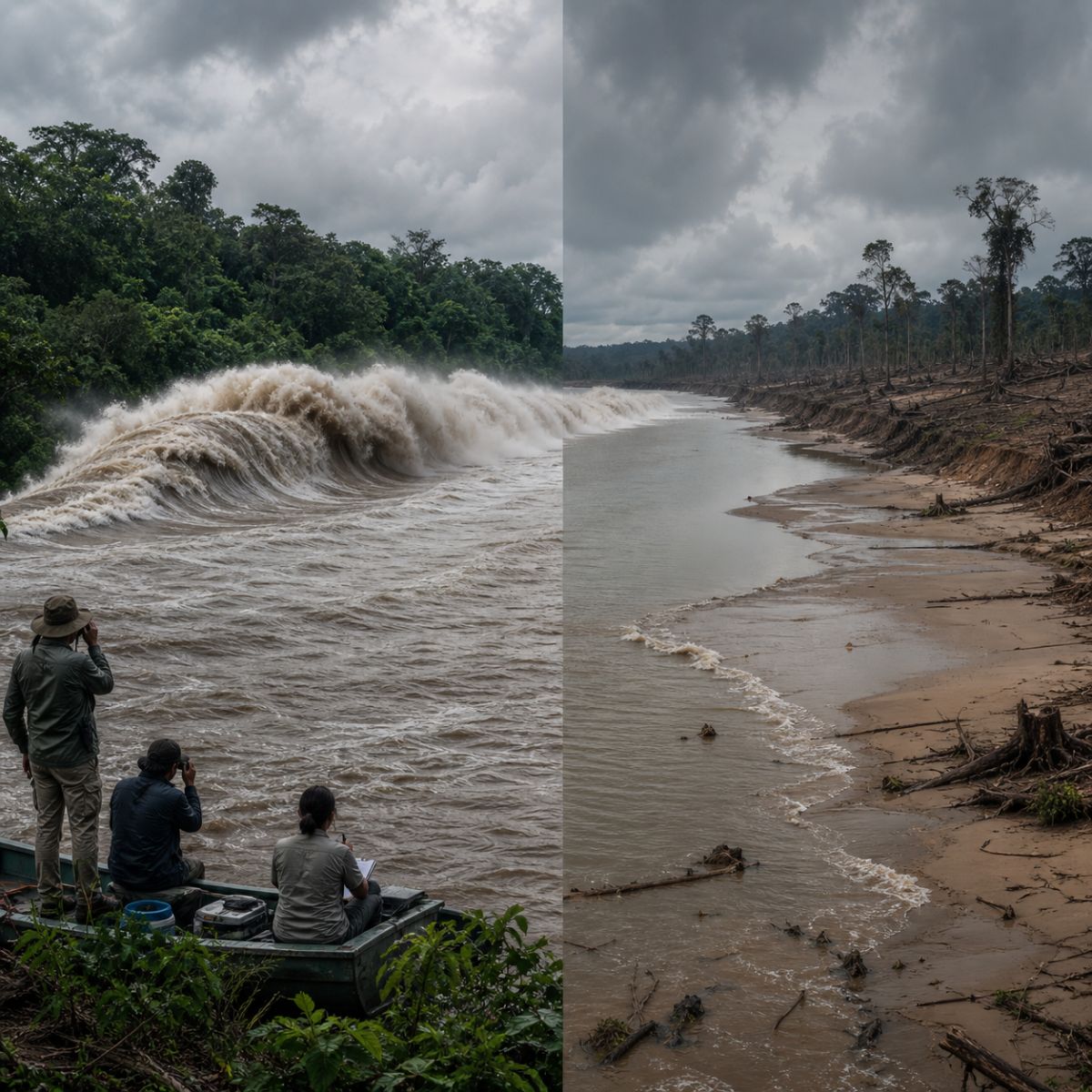

According to information released by the *Metrópoles* portal, the Amazonian pororoca, a phenomenon in which Atlantic Ocean water invades rivers and forms waves up to four meters high that advance against the current, is becoming shorter and less intense. The last wave considered strong occurred in 2020, according to residents of São Domingos do Capim, in Pará. Researcher David Lopes, from the Geological Survey of Brazil, warns that reduced rainfall, silting, and deforestation affect the hydromorphology of rivers and could make the pororoca disappear if environmental balance is not restored.
The pororoca of the Amazon is losing the **strength** that transformed it into one of the planet’s most impressive natural phenomena. The giant **wave** that could reach four meters in height and advanced against the **current** of the Amazonian **rivers** has not appeared with **intensity** since 2020, and the explanation lies in the very dynamic that creates the **phenomenon**: for the **pororoca** to emerge with **strength**, it’s not enough for the **ocean** **tide** to push water into the **river**. The channel must have shallow sections, capable of concentrating the water’s **energy** and transforming the advance into a large front.
When there is less rain, changes in the riverbed, silting, deforestation, or alteration in sediment transport, this natural mechanism is affected. Geosciences researcher David Lopes, from the Belém unit of the Geological Survey of **Brazil** (SGB), was invited by the São Domingos do Capim city hall to study the **phenomenon** during the 2026 **Pororoca** Festival. “The objective of this study was to collect data, listen to local residents, and understand the recent changes in the **pororoca**,” he explains. The conclusion is alarming: if environmental conditions continue to deteriorate, the **wave** could simply disappear.
What is the pororoca and how does it form

The **pororoca** is a hydrological **phenomenon** that occurs when the waters of the Atlantic **ocean** forcefully enter the Amazonian **rivers** and meet the outflow of fresh water flowing in the opposite direction. **This collision between tide and river would only create a gentle ripple if the channel bottom did not become shallow**, but the change in depth is precisely what concentrates the **energy** and transforms the advance into a large **wave** that can reach four meters.
-
Engineers Develop Fridge-Sized Machine to Produce 95-Octane Synthetic Fuel from Air and Water, Aiming to Sustain Combustion Engines Without Oil

-
Two-Armed Robot Uses AI to Reassemble Destroyed Pompeii Frescoes, Solving an “Impossible” Puzzle
-
New Law in Brazil Requires Breaks for Type 1 Diabetes Management at Work, School, and Public Exams

-
Scientists Confirm “Greening” of Antarctica: Ice on the World’s Coldest Continent Turns Green as Mosses Multiply Over Tenfold in Four Decades


Researcher David Lopes explains the mechanics: “The **pororoca** is a **phenomenon** in which oceanic waters enter the continent. It would only be what is called a backwater curve if the topography of the **river** bottom did not become shallow. **This change in depth is what generates the pororoca wave. Without it, it would just be a ripple.”** The difference between a ripple and a four-meter **wave** depends entirely on the shape and depth of the channel, factors that are being altered by human action.
Why the pororoca has not appeared with strength since 2020
The last **wave** considered strong, long, and high occurred in 2020, according to reports from residents of the community of São Domingos do Capim, in **Pará**, where the **Pororoca** Festival is held. **Since then, with reduced rainfall, the phenomenon is said to be occurring in a shorter and lower form**, losing the grandeur that attracted surfers, tourists, and researchers from all over **Brazil** and the world.
The most notable episodes of the **pororoca** usually occur in the high-water months, in March and April. During this period, the flow of the **rivers** increases and intensifies the dispute between the descending fresh water and the rising **tide**. **Rain plays a decisive role because it raises river levels and influences sediment transport.** When it rains less, the **river** becomes lower, the competition between fresh water and oceanic **tide** weakens, and the **wave** loses height, extent, and **intensity**.
The role of deforestation and silting in the destruction of the phenomenon
Deforestation is the most insidious factor because its effects are indirect but devastating. When the soil is unprotected, without forest, rainwater drags more material into the river, accelerating silting which alters the channel’s depth. The tide acts by depositing these sediments on the riverbed, especially when the water’s speed decreases, and the result is a river that becomes shallower in points where it should be deep and deeper where it should be shallow.
This alteration in the so-called hydromorphology, the shape and functioning of the river, unbalances the conditions that produce the pororoca. The phenomenon is a “fight” between the river level and the ocean tide, but this dispute only turns into a wave when there is the right shallow part in the right place, with a shape and depth that concentrate energy into a single front. Lopes is direct: “If there’s no rain, if there’s silting, if there’s deforestation, there’s no pororoca. And this harms the entire local economy.”
The Moon’s role in stronger waves
The Moon also helps explain why the pororoca appears with more force in some periods and almost disappears in others. The phenomenon is usually more intense during full moon and new moon phases, when the alignment between the Sun, Moon, and Earth intensifies the gravitational forces responsible for tides. This alignment, called a syzygy tide, produces higher and lower tides than usual.
Biologist Joana Rosar Corbellini, from Faculdade de Pinhais (FAPI), explains that under these conditions “the volume and energy of the oceanic water are greater, favoring the formation of waves of greater height, speed, and reach.” The pororoca does not have a fixed date on the calendar: it follows the tide cycles and is usually observed with more force in the three days following the full moon, between March and April. If the environmental conditions of the river are degraded, even the syzygy tide may not be enough to produce the wave that the phenomenon requires.
The economic and cultural impact if the pororoca disappears
The pororoca is not just a natural phenomenon: it is the center of a local economy that depends on tourism, surfing, and the cultural identity of riverside communities. The Pororoca Festival in São Domingos do Capim attracts visitors, generates income, and puts the region on the map of unique natural events in Brazil. If the wave disappears, the community loses not only a spectacle of nature but also a source of livelihood that no alternative can replace.
For freshwater surfers who travel from all over the world to ride the pororoca, the possibility that the wave is disappearing is devastating. The phenomenon offers an experience that no other place on the planet reproduces: a wave that advances for kilometers against the current of an Amazonian river, surrounded by forest and wild fauna. If deforestation and silting continue to alter the channel’s conditions, this experience may become just a memory.
Did you know that the Amazonian pororoca is losing strength and could disappear, or did you think that natural phenomena of this magnitude were eternal? Tell us in the comments if you’ve seen the pororoca live and what you think should be done to protect the balance of the Amazonian rivers.