





 Portuguese
  English
  Spanish
  3 min of reading
  0 comments


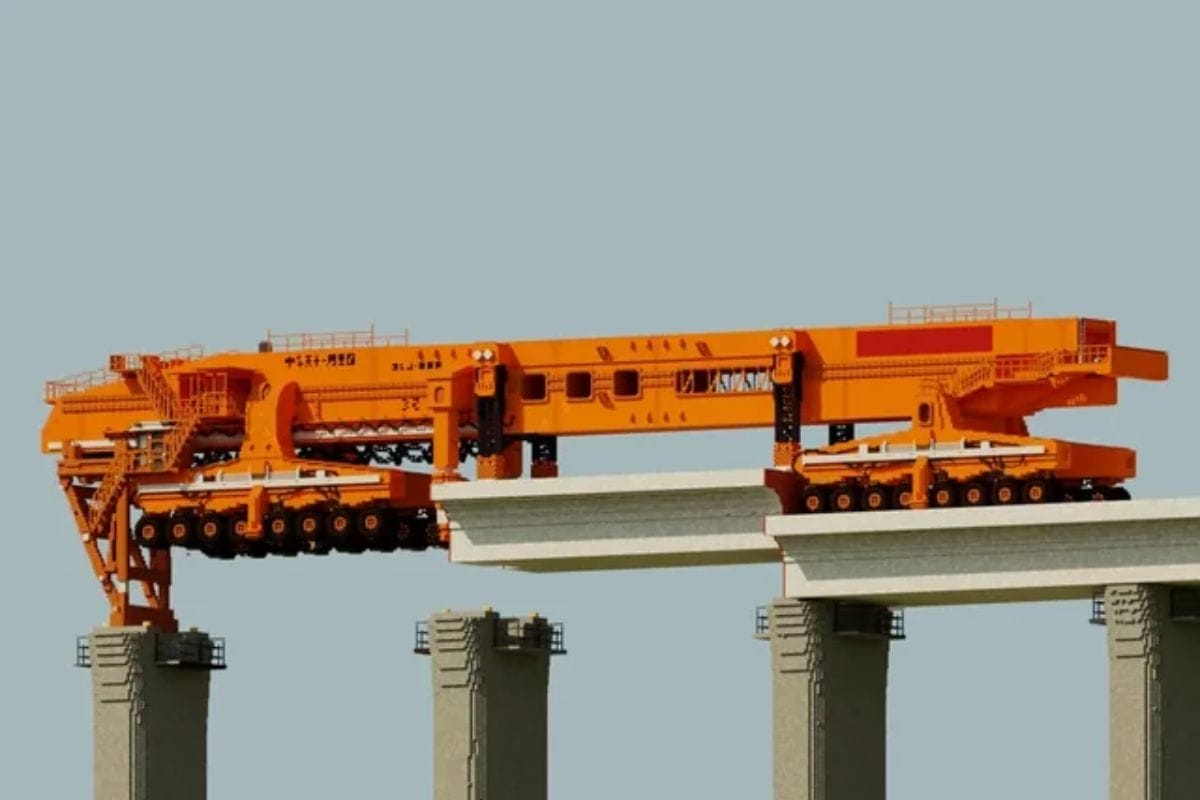
Meet the SLJ900/32 Bridge Launching Machine, a 91-meter Chinese giant that transports and installs precast beams all at once, optimizing mega infrastructure projects.
The SLJ900/32 bridge launching machine, nicknamed the “Iron Monster”, represents a remarkable advance in construction technology. This Chinese heavy-duty gantry stand out for its ability to transport and install large precast beams in a single operation, marking a significant evolution from conventional methods.
Weighing 580 tons and spanning 91 meters in length, the SLJ900/32 meets the growing demand for rapid infrastructure development, such as high-speed railways. This article details the specifications, operation, and impact of this revolutionary machine, a strategic asset for China.
Getting to Know the Revolutionary SLJ900/32 Bridge Launching Machine
The SLJ900/32 bridge launching machine is an innovative engineering solution for the accelerated construction of viaducts. Its “all-in-one” functionality enables it to transport and install precast bridge beams, optimizing the construction process. This equipment is crucial in the context of China’s ambitious infrastructure plans, including the Belt and Road Initiative (BRI).
-
Reusing Styrofoam that would otherwise be discarded, a single bag of cement yields about 50 lightweight blocks measuring 30 by 60 centimeters, intended for partition walls and boundary walls that do not bear structural loads.

-
After decades of neglect, a hospital with its original electrical network from the 1940s begins a historic turnaround in SC, receives R$ 700,000 in investments, expands beds, and prepares for a new phase of modernization that could transform care.
-
The largest bridge in São Paulo reaches 75% completion with a R$ 387.3 million project, a new structure over the Tietê River, and a promise to improve traffic on SP-333 later this year.

-
Farm in Mato Grosso replaces traditional masonry with an 85 m² thermal panel house: quick, economical construction with PIR insulation gains a porch, external laundry, two bedrooms, and an adaptable living room to accommodate family or team during harvest periods.


The development of machines like the SLJ900/32 highlights the interconnection between technological innovation and a country’s ability to execute megaprojects. It is not only an engineering marvel but also a facilitator for achieving national development goals and projecting global technological influence.
Specifications and Engineering of the SLJ900/32 Bridge Launching Machine

The SLJ900/32 boasts impressive specifications. It weighs 580 tons, measures 91 meters in length (or 91.8m), 7 meters in width (or 7.4m), and 9 meters in height. Its propulsion is ensured by a system of 64 wheels, divided into four sections of 16, each capable of rotating 90 degrees, allowing lateral movement to collect beams. The machine achieves speeds of 8 km/h when unloaded and 5 km/h when loaded.
The nominal lifting capacity of a beam is 900 tons, for spans of up to 32 meters. Manufactured since 2015 by Beijing Wowjoint Machinery Company and designed by the Shijiazhuang Railway Design Institute, the SLJ900/32 has an estimated lifespan of 730 spans. Its robust structure and auto-stabilizing support system are crucial for its operation.
Innovative Operation
The operational method of the SLJ900/32 bridge launching machine is a linear and self-sufficient cycle. First, it collects a precast concrete beam, positioning it beneath its central structure. Next, it transports the beam over the already constructed section of the bridge to the next span.
Upon reaching the installation point, the machine anchors to the existing pillar and extends its arms or a temporary track to the next pillar. The beam is then lowered and precisely positioned between the two pillars. After securing the beam, the SLJ900/32 retreats over the newly placed beam to repeat the cycle, eliminating the need for cranes and extensive ground scaffolding.
The Transformation in Bridge Construction in China
The SLJ900/32 bridge launching machine has drastically reduced construction times for viaducts in China. Its ability to install entire sections at once accelerates progress, being critical to the country’s high-speed railway network expansion goals. The elimination of scaffolding and complex shoring results in savings in materials and labor.
In terms of safety, mechanization minimizes the manual handling of heavy beams and work at heights. The SLJ900/32 also demonstrates adaptability to remote sites and challenging topographies, with a reduced environmental footprint due to the lesser need for ground support structures. Studies indicate that launching gantries can reduce Global Warming Potential (GWP) by 25%.
The Legacy of the SLJ900/32 Bridge Launching Machine and New Technologies
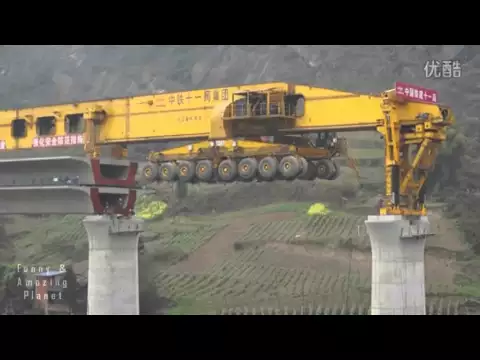

The SLJ900/32 bridge launching machine is not an isolated phenomenon but a hallmark of China’s prominence in heavy machinery. Newer and even larger machines, such as the “Kunlun” (1000t, spans of 40m) and the “Luwu” (1000t, optimized for tunnels), demonstrate ongoing innovation. This evolution is driven by significant domestic demand for infrastructure.
Despite its capabilities, the SLJ900/32 faces challenges such as logistics for transportation and assembly and the need for a continuous supply of beams. The future points to even smarter and more autonomous machines, utilizing advanced robotics and AI, transforming bridge construction into an even more efficient and safe process. The SLJ900/32 has set a milestone on this journey.





Be the first to react!