






 Portuguese
  Spanish
  6 min of reading
  1 comment


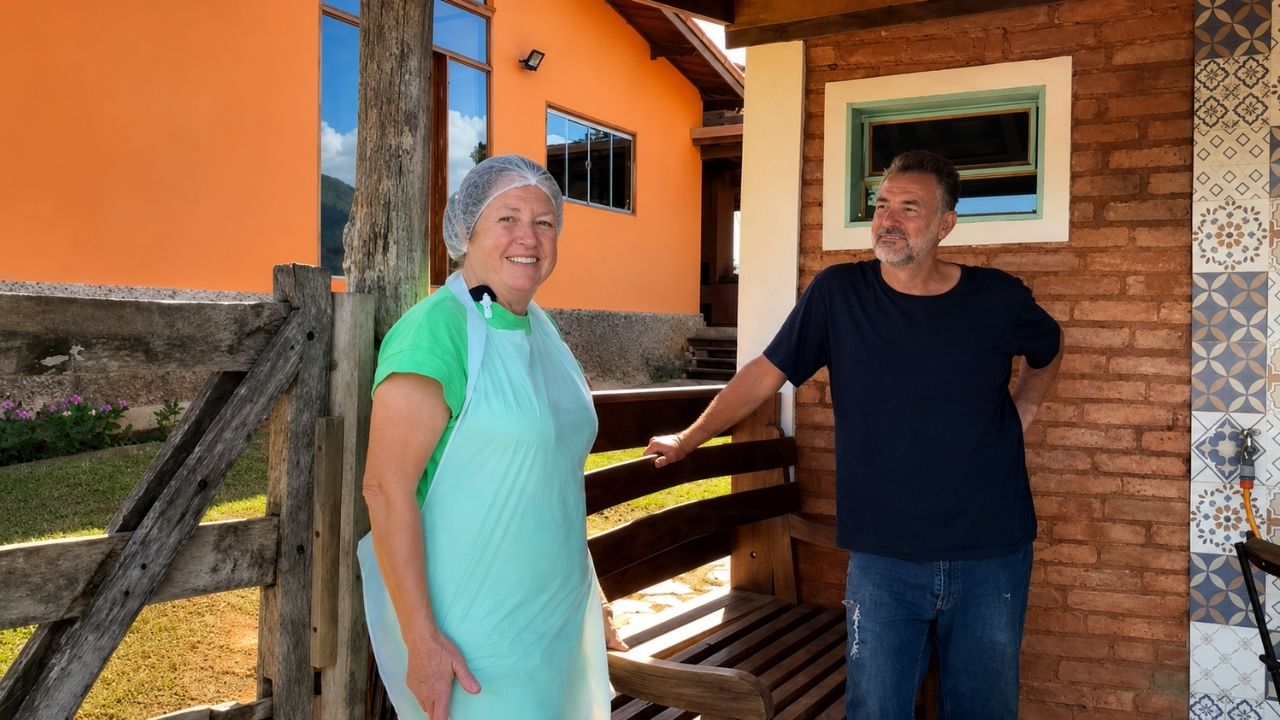


The couple Ademar and Marisa traded decades of business in Passos for the family farm in São João Batista do Glória, at the edge of Serra da Canastra, where today they transform each hand-milked liter of milk into artisanal cured, fresh, and “pingo” cheese, using wood from their own land and preserving the history of three generations.
There are stories that only the countryside produces. Ademar was born on the farm that belonged to his grandparents, was raised by a second mother in Passos, studied administration in Belo Horizonte, met Marisa in an apartment building, got married, set up a pharmaceutical distribution company that supplied the entire region, and spent decades away from the land where he was born. The couple built a solid business, put down roots in the city, and when the time came, made a decision that many dream of but few execute: they sold everything and returned to the farm.
It wasn’t just any farm. It was the property of Ademar’s paternal grandparents, located 12 kilometers from São João Batista do Glória and 1,500 meters from Cachoeira da Capitinga, at the edge of Serra da Canastra, one of the most recognized regions in Brazil for the quality of artisanal cheese. According to Canal Vida no Campo, the couple renovated the historic headquarters using wood taken from old bridges and barns on the property, set up a cheese factory, and today they transform 230 liters of milk per day into cheeses that don’t last: the demand arrives before the product is finished, with orders coming from São Paulo and Belo Horizonte.
The farm that came from the grandparents and preserved three generations

The property in São João Batista do Glória is not a recent acquisition. It passed from the grandparents to Ademar’s father and from the father to him, a line of inheritance that crossed decades without losing the address. The original headquarters was already there when Ademar was a child, and it was there that he learned to milk cows from the age of five, alongside his father and brother João.
-
Bali transformed volcanoes into a sacred system with 5 rice terraces, water temples, and 19,500 hectares, but the ancient engineering that supports farmers now faces tourism, construction, and the risk of losing its living landscape on the volcanic island.

-
Two young inventors create a terracotta brick that uses water, air, and solar energy to cool cities, and the idea points to buildings that stop worsening urban heat.

-
Without power for millions, Madagascar receives a proposal for a floating hydroelectric plant inspired by the baobab that promises clean energy, greenhouses, and tourism, but still needs to be realized.
-
China has a giant rice terrace carved over 1,300 years in the mountains, with up to 3,000 terraces, 82 villages, and 445 km of canals, but the ancestral work that overcame droughts now faces growing tourism, landslides, and rural abandonment.


When the couple decided to return, the house needed care, but the structure was intact. Ademar and Marisa chose to preserve the original architecture as much as possible, making only necessary adaptations, new bathrooms, a kiosk in the back, and a garage.
Everything that was added used material from the farm itself: dry wood taken from old bridges, deactivated corrals, and sheds that were no longer useful. A four-meter-long maçaranduba table, which belonged to Ademar’s father and on which all the siblings studied, remains in the same place it has always been.
230 liters of milk per day, all hand-milked

The process starts at five in the morning. The dairy cattle on the farm are raised exclusively on pasture, without feed and with only one milking per day, a choice that reduces the animals’ stress, preserves the quality of the milk, and results in a product with less chemicals and more flavor. Each cow has a name, recognizes the milkers, and maintains contact with the calf throughout the morning, being separated only for an hour for milking.
The 230 liters daily are transferred from the milking area to the cheese factory in batches of 30 liters, kept at the temperature of 37 degrees as they come from the cow. The rennet is added immediately, batch by batch, until the day’s total is complete.
This technique, which Ademar describes as the oldest way of making canastra cheese, ensures that each batch curdles at the right time, with the milk still fresh and at natural temperature, without industrial pasteurization and without additives beyond those required by law.
The cheese that Marisa started as a hobby and keeps growing

The cheese factory was not part of the original plan. The couple returned to the farm thinking of living off milk production, but Marisa, who admits she can’t stay still, started experimenting with cheese production in February of the previous year almost as a hobby. The first compliments came quickly, enthusiasm grew, and the amount produced increased along with demand.
Today the cheese factory produces three types of cheese: fresh, cured, and cheese with whey, a matured version that uses the natural whey from the process as a ferment, following the oldest tradition of canastrinha production.
No cheese is yet sent by mail regularly, but the couple is open to negotiating orders directly through the cheese factory’s phone. Dulce de leche and yogurt are produced to order on a smaller scale, and expansion to these products regularly is planned as soon as the legal documentation is complete.
The cheese factory and the care that became the house standard

The farm’s cheese factory was designed with the support of architect Cristina Grilo, from Passos, and has a feature that draws attention: the milk enters from the outside through a funnel, without anyone needing to enter the production environment during the process. This contamination barrier is the heart of the quality control that Marisa and Silvia, the farm’s cheesemaker, established from the start.
The water used in the cheese factory comes from an artesian well, with chlorine in the measure required by law. The mountain water, which naturally reaches the property, supplies the animals’ watering and fills the pond that Ademar built by reusing stones from an old corral.
The flow is controlled: during periods of heavy rain, the water is diverted to the reservoirs. In dry times, it is redirected to fill the pond. It’s the kind of water management that those who have always lived in the city can rarely imagine in detail.
The preserved house and the memory the place holds


Sitting at the kiosk at the back of the headquarters, looking at the Serra da Canastra in the background and listening to the wind is, for Ademar, almost a therapy. He says that when he arrives at the farm and looks at the hills, he sees the image of his father and grandparents, the work they did, the choices they made, what they left behind. Marisa adds: the desire to travel has diminished, and the two always want to return quickly when they leave.
The four-meter table where the siblings studied is still there. Ademar’s father’s chairs have been refurbished but not replaced. The counters next to the wood stove were made from dismantled mangers.
Each object tells a part of the story that the couple decided not to let disappear, and which now receives visitors, cheesemakers, tourists passing through the Serra da Canastra road, and curious people who call asking for cheese after seeing the video on YouTube.
Did you know the story of Canastra cheese made with milk hand-milked from pasture-raised cows? Have you ever visited a farm in the Serra da Canastra or bought cheese directly from the producer? Leave a comment, and if you also dream of trading the city for the countryside, tell us what still holds you back.


Thanks alot. for sharing such awonderful true to life story.