Portuguese
  Spanish


The homemade recipe uses leftover expanded polystyrene, sand, and cement to create pieces that weigh less than 6 kilograms, but the technique is only for closure, never to support slabs or loads, according to the technical literature of civil construction.
The reuse of discarded styrofoam for the production of lightweight concrete blocks resurfaced in June 2026, driven by videos from Maciel na Reforma, which demonstrate step-by-step homemade fabrication of the pieces. The proposed method is based on a simple principle, that is, replacing the gravel of common concrete with recycled expanded polystyrene flakes, material that would be discarded, obtaining a hollow block of low weight intended for non-load-bearing walls.
The mix shown in the recordings that went viral again combines about 2 kilograms of cement, 2.5 kilograms of sand, 3 liters of water, a low-cost additive, and approximately 15 liters of crushed styrofoam per unit. As each commercial bag of cement contains 50 kilograms, the author calculates that the material would yield around 50 blocks in the format of 30 by 60 centimeters, with an approximate height of 10 centimeters, intended for sealing and boundary walls that do not perform a structural function.
What is lightweight styrofoam concrete and why it doesn’t support load
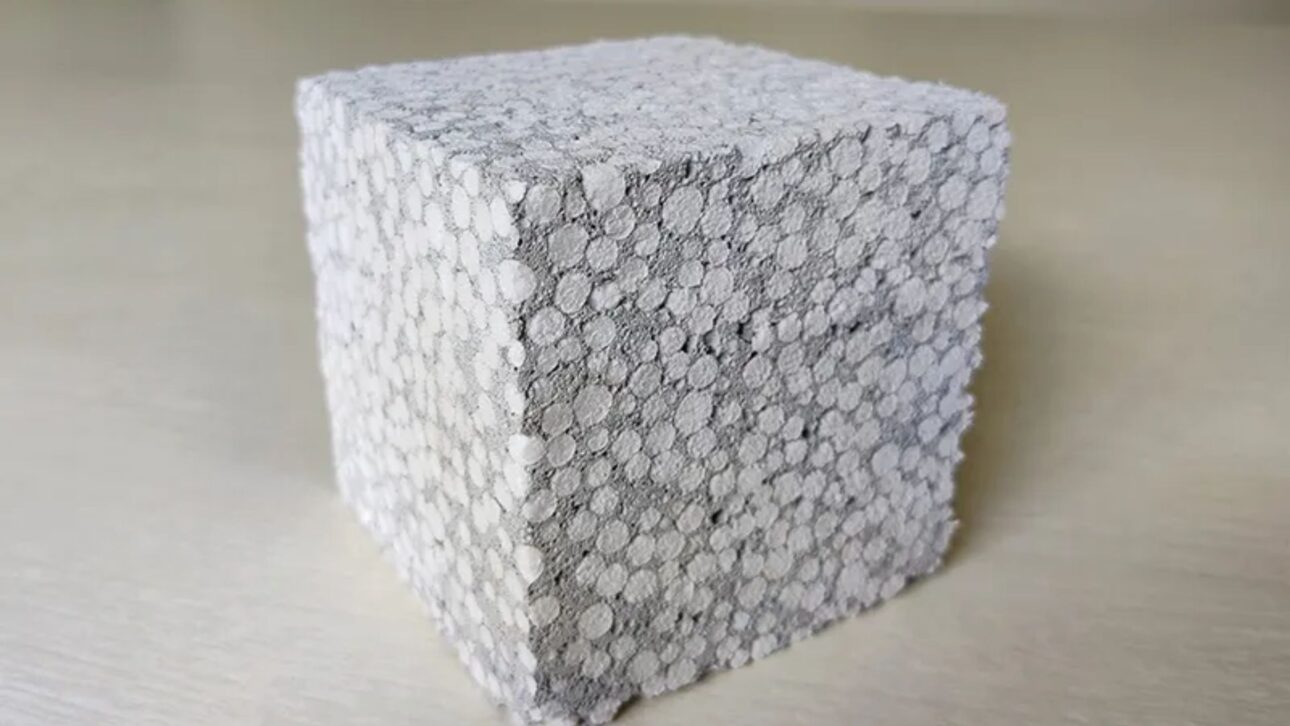
Although the term styrofoam is the most known to the public, it is a registered trademark of Knauf, and the technical name of the material is EPS, an acronym in English for expanded polystyrene, composed of about 98 percent air and only 2 percent petroleum-derived raw material, according to information from the manufacturer itself.
-
Concrete-filled PVC homes could be cheaper than traditional masonry, UPF research finds; with ready modular panels, less waste, and faster construction, the Concrete-PVC system aims to cut costs and transform affordable housing in Brazil.

-
Brazilian House Built with 32.8 Tons of Construction Debris Offers Affordable Housing Solution
-
Americans Build Entire Homes in a Day Using Compact Sand Foundations and Pre-Made Wooden Trusses, Reducing Construction Costs

-
China’s Largest Floating LNG Plant, NGUYA, Sets Sail for Congo: 2.4 Million Tons Annually for Italy’s Eni


The low density is precisely the reason why these pieces cannot support structural loads.
According to technical material published by the AECweb portal based on the Isorecort Group, while conventional concrete with gravel reaches about 2,400 kilograms per cubic meter, EPS lightweight concrete varies between approximately 400 and 1,600 kilograms per cubic meter, depending on the proportion of polystyrene in the mix.
The same source notes that the material has lower strength and greater deformability, being recommended for situations with weight limitations, such as floor filling, partition walls, and furniture.
The step-by-step demonstrated in the videos
The sequence shown in the recordings follows the logic described in the sector’s technical literature, with the difference of being adapted for manual and artisanal production.
First, mix the cement, sand, and water with an additive, then gradually add the crushed polystyrene, beating the mixture until the flakes stop rising and are incorporated, forming a homogeneous mixture that holds on the trowel without falling apart.
The additive fulfills a specific function in this homemade recipe, which is to prevent the polystyrene particles from floating and separating from the water during mixing.
The content creator claims to use detergent instead of white glue for cost reasons, reporting having paid 21.55 reais for half a kilo of glue, a price he considered disadvantageous.
Manufacturers and technical sources, on the other hand, recommend using diluted PVA white glue in water to soak the beads before mixing, precisely to ensure the material adheres to the cement.
Mix demonstrated by the content creator (per block)
- Cement: 2 kg, measured by weight
- Sand: 2.5 kg, fine or coarse, also by weight
- Water: 3 liters, no more, no less, according to the author
- Additive: about 50 ml of detergent, or PVA white glue as an alternative
- Crushed polystyrene: approximately 15 liters per unit
- Cited format: 30 by 60 centimeters, with about 10 cm in height
- Demolding time: between 3 and 4 hours, depending on the climate, according to the author’s account
After mixing, the mass is gradually poured into a lubricated mold with taps to eliminate air bubbles, and the finish is done with a trowel or a piece of pipe.
The author states that the tubes creating the holes in the block can be removed between three and four hours later, a period that varies according to ambient temperature, and mentions the possibility of using drying accelerators available on the market for those in a hurry.
The weight, the economy, and what to actually expect
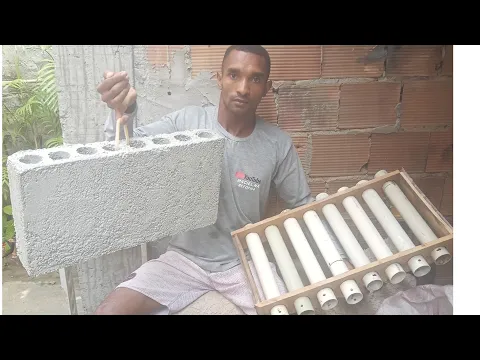

At the end of the demonstration, the finished block was weighed on a scale and registered 5.713 kilograms, according to the measurement made by the content creator himself.
The value confirms the central characteristic of the piece, that is, the lightness that facilitates transport and handling on site, even though this number corresponds to an individual measurement and not a standardized test by technical standards.
The claimed economy focuses on reducing the consumption of conventional materials and reusing waste.
The author argues that in regions where sand is abundant and styrofoam would be discarded, the main cost is restricted to cement, which would make production advantageous for boundary walls and partition walls.
It is worth noting that these yield and cost calculations are based on the creator’s account and depend on local variables such as cement price, availability of styrofoam, and labor.
Thermal comfort and the limits of the promise
One of the advertised advantages is the improvement of thermal comfort, with the claim that the block would reduce heat in the environment by 60 to 80 percent.
This specific percentage is not found in the technical literature consulted and should be treated as an estimate by the author, not as an audited data.
What technical sources confirm is that EPS has low thermal conductivity, with a coefficient lower than 0.033 watt per meter-kelvin according to experts consulted by the AECweb portal, which indeed increases the thermal resistance of a wall and contributes to cooler environments in hot climates.
Even so, the actual thermal performance depends on variables such as wall thickness, regional climate, and quality of execution.
The performance standard ABNT NBR 15575 establishes that the building must meet thermal requirements according to the bioclimatic zone in which it is located, which means that no isolated material guarantees comfort by itself.
The block’s own structural limitation reinforces that it is a sealing solution, useful for closing openings and dividing spaces, and not a substitute for elements that support the building.
Risks, caveats, and what the technique requires
The homemade production of styrofoam blocks requires attention to points that videos do not always detail, starting with fire safety.
Expanded polystyrene is a petroleum-derived material and, when exposed to fire, can propagate flames, which is why the industry uses flame-retardant versions identified by the letter F in the nomenclature.
In an artisanal production with recycled styrofoam of unknown origin, there is no guarantee of this characteristic, which recommends caution in applications near heat sources.
Another point is that the absence of structural function must be strictly respected in any construction.
Using these pieces to support slabs, beams, or any load poses a risk to construction safety, as the material has low compressive strength.
For boundary walls that do not bear weight and internal partition walls, the solution may work, but always within the limits for which EPS lightweight concrete was designed by engineering.
The reuse of styrofoam to manufacture lightweight sealing blocks is an idea that combines economy and waste disposal, but it only makes sense when its technical limits are understood.
The piece weighing less than 6 kilos is real, the approximate yield of 50 blocks per cement bag is plausible under the reported conditions, and the thermal gain exists, even without the exact percentage disclosed.
The essential thing is to remember that it is a material for sealing, never to support the structure of a construction.
And you, have you seen or tried this type of lightweight block made with recycled styrofoam? Tell us in the comments if you trust this technique for walls and sealing partitions, what doubts you still have about safety and durability, and if you consider the reuse of styrofoam a good solution for civil construction. Your experience can help other readers decide.