






 Portuguese
  Spanish
  6 min of reading
  0 comments


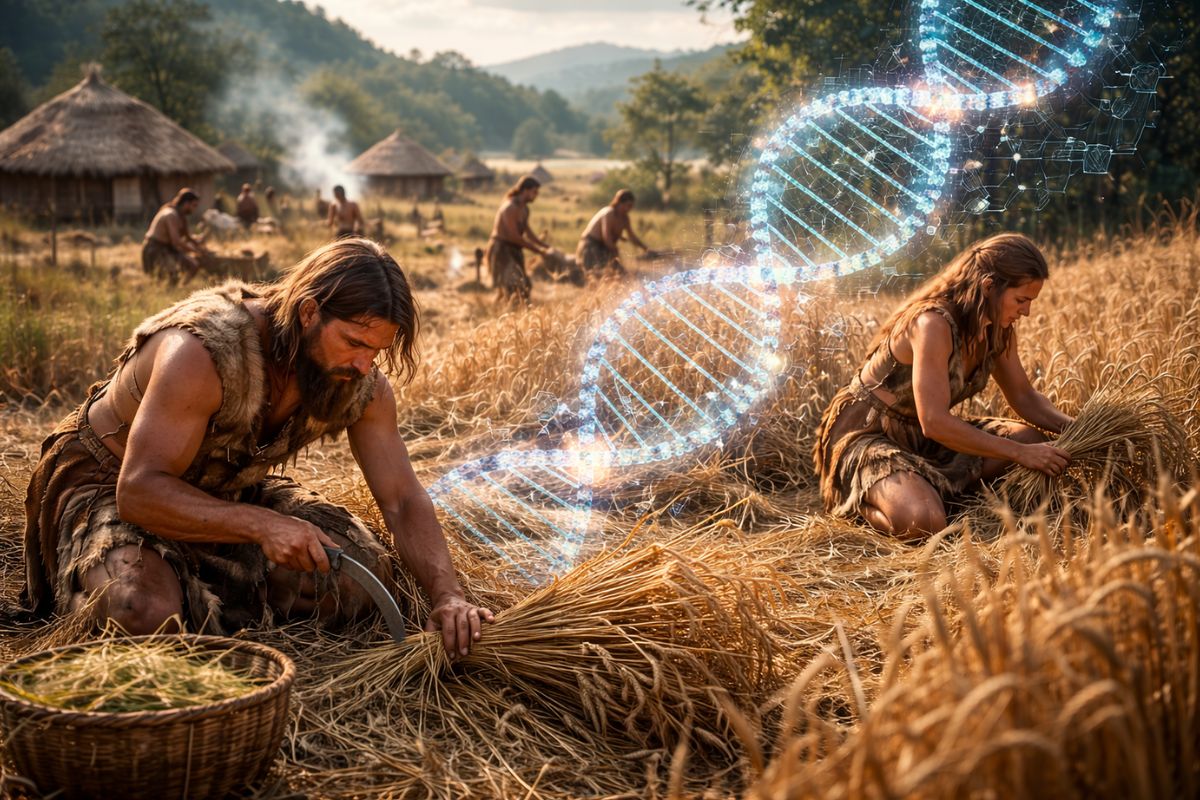
Harvard study published in Nature analyzed DNA of nearly 16 thousand individuals and demonstrated that agriculture accelerated natural selection in the human body in the last 10 thousand years, modifying hundreds of genes linked to infections and diet, with marks that still cause modern diseases.
Ali Akbari, a researcher at Harvard Medical School, coordinated an investigation published in Nature that tracked genetic changes in nearly 16 thousand individuals spread over millennia of history in Western Eurasia, and the results show that natural selection transformed hundreds of positions in the human genome since populations began cultivating food. The discovery contradicts the idea that human biological evolution would have slowed down after the emergence of civilization: according to Harvard’s data, agriculture caused exactly the opposite. Fixed and increasingly populous communities, dependent on a few cultivated foods and in daily contact with domesticated animals, faced unprecedented pressures that forced rapid adaptations in genes responsible for nutrient absorption and defense against pathogens.
David Reich, a professor of genetics at Harvard Medical School and co-author of the work, stated that this research alone doubles the volume of existing publications on the genomics of ancient populations. A previous investigation, from 2015, had identified only twelve strong markers of selection, exposing the limitations of the methods used at the time. The new study from Nature managed to isolate the action of natural selection from what results from population shifts and random variations, thanks to an unprecedented database and more precise statistical filters. Even accounting for only about 2% of the total variations in gene frequencies, this fraction reached hundreds of regions in the human genome with clear evidence of adaptive pressure.
How agriculture forced the human body to change

Before planting and raising animals, humans lived in small, mobile groups, with diverse diets consisting of hunting and gathering. The adoption of agriculture, about 10 thousand years ago, reversed this model: sedentary populations began to feed on a narrow repertoire of grains and tubers, while proximity to oxen, pigs, and chickens brought microorganisms to which the human body had never been exposed. Emerging urban agglomerations facilitated the spread of respiratory and intestinal diseases that previously had no means of spreading.
-
Space technology used to search for water on Mars is now hunting for invisible leaks under the streets of São Paulo, using satellites, AI, and chlorine signals to help Sabesp recover up to 6.7 billion liters of water.

-
Japan sends ship to extract mud rich in rare earths at nearly 6,000 meters deep in the Pacific, attempts to lift 350 tons per day from the seabed, and transforms sediments near Minamitori Island into a strategic weapon to reduce dependence on China.
-
Venus Aerospace promises a rotating detonation hypersonic engine that takes the Stargazer to Mach 9 and crosses oceans in 1 hour, but the flight that made history barely surpassed the speed of sound.

-
Brazilian student creates a cheap formula that makes plants grow up to 90% faster and wins an award in a global scientific competition.





The Harvard study demonstrates that, after the consolidation of agricultural practices, the speed at which certain genetic variants gained ground in the population progressively increased. Genes involved in the recognition of biological invaders, the inflammatory response, and the ability to process new nutrients were the ones that underwent the greatest selection pressure. The human body, therefore, did not remain static while civilization advanced: it adapted to the conditions that humanity itself created, and the Nature research documents this process with a precision that no previous work had achieved.
The genes that changed the most in the human body due to agriculture

Among the most intense signals of selection detected by the Harvard team are genes connected to infection, inflammation, and immune surveillance. A variant linked to celiac disease, for example, grew significantly in the population even during the period of wheat cultivation expansion, an apparently paradoxical result that suggests this same variant may have conferred protection against prevalent infections at the time, compensating for the digestive cost.
Another relevant change altered the distribution among blood types in the studied populations, indicating that pathogens from different periods continued to select distinct defenses over the centuries. Lactose tolerance in adults, perhaps the most cited case of recent adaptation in the human body, continued to gain ground over the last three millennia, as evidenced by Bronze Age records included in the Nature research. The crucial point is that a beneficial gene at a certain time can become a risk factor when diet, pathogens, and lifestyle change, exactly what happened during the transition to the modern world.
The price the human body pays today for yesterday’s adaptations
The Harvard research reveals that more than 60% of the variants that underwent selection in the last millennia have connections with currently measured health and behavior indicators. Groups of small genetic changes acted in a coordinated manner, decreasing DNA-based estimates for fat accumulation and certain psychiatric disorders, while simultaneously elevating indicators related to cognitive performance. The authors, however, are emphatic: these labels reflect categories constructed to understand contemporary society, and the characteristic effectively selected in the past may have been something different from what we can name today.
In practice, variants that protected against lethal infections in a Neolithic village may now disrupt the immune system in a 21st-century urban environment. Akbari stated that the tools and the volume of ancient genomic data available today allow for a direct tracking of natural selection’s action on the human body, opening pathways for medicine to understand why certain seemingly harmful variants actually carry legacies of survival. Ignoring this historical dimension may lead researchers to treat as a defect something that was once an advantage.
Why did science take so long to detect these changes in the human body
Previous work could not reliably differentiate the effects of natural selection from those produced by migration, interbreeding between populations, and statistical fluctuations in small groups. The result was a fragmented view, in which only a handful of isolated cases of adaptation appeared, fueling the assumption that the human body had stopped evolving. The study published in Nature overcame this problem by gathering data from nearly 16,000 individuals and applying filters capable of converting what seemed like noise into solid evidence.
Even with this expansion, Harvard researchers estimate that natural selection explains only 2% of the total genetic variation observed, with population movements and chance accounting for the rest. The difference is that, in a genome with billions of bases, this small fraction still affects hundreds of positions with verifiable impact on human biology. It is this combination of small individual effect with broad reach that had escaped previous methods and that Nature now documents in an unprecedented way.
The next step: testing other populations and rethinking medicine
Akbari and Reich have already made the data and code publicly available, allowing research groups at Harvard and other institutions to replicate the analysis in populations from Africa, Asia, and the Americas. The next step will be to verify whether the same pressures selected the same genes in different continents or if each region followed its own trajectory. Reich stated that the research allows, for the first time, to link specific moments and places to the forces that shaped the human body throughout history.
For medicine, the lesson published in Nature is straightforward: automatically classifying every seemingly harmful genetic variant as a mistake can be a misunderstanding. Many of these variants hold the record of adaptations that saved lives in the past, and understanding this heritage can transform how treatments are developed and genetic risks are assessed. The human body did not stop evolving when humanity decided to farm, and the genetic cost of that decision continues to be paid, silently, by all of us.
And you, have you ever thought that the food we planted 10,000 years ago may have rewritten our DNA? Do you think medicine should consider evolutionary history before classifying a gene as defective? Leave your opinion in the comments.


-

1 person reacted to this.