





 Portuguese
  English
  Spanish
  5 min of reading
  0 comments


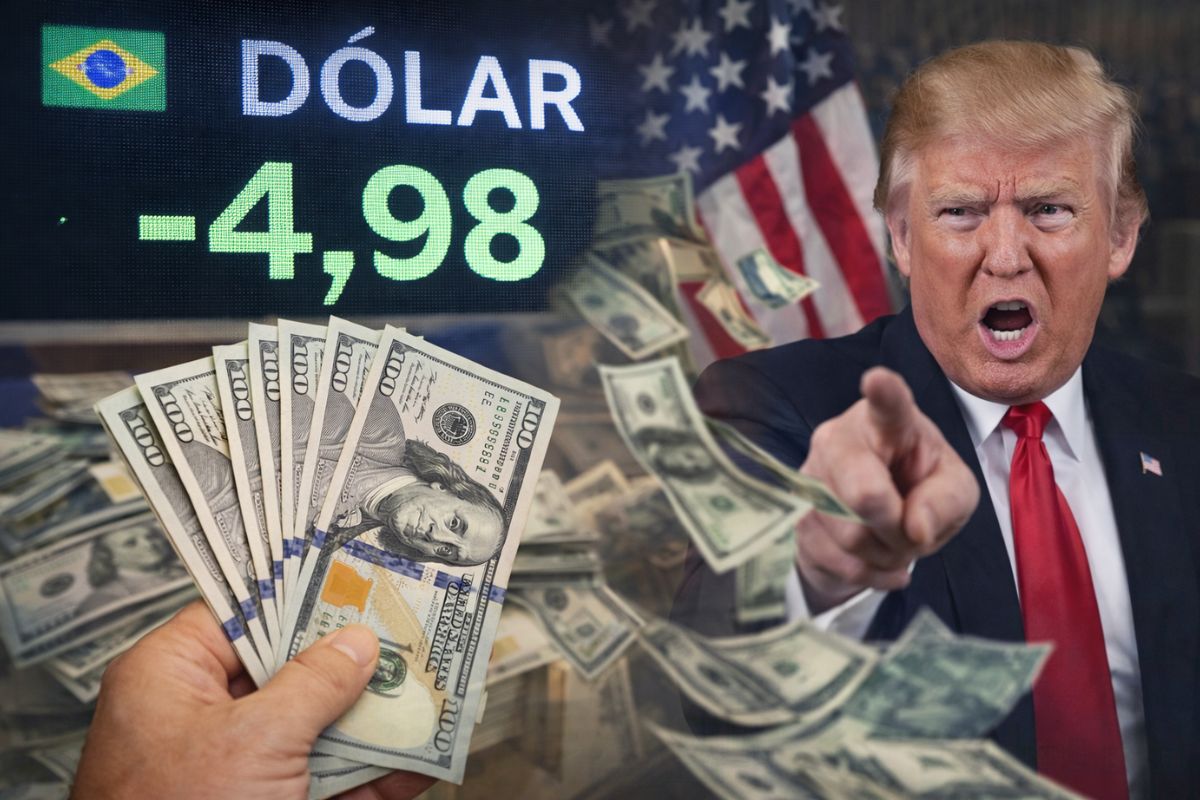
The dollar fell below R$ 5 this Monday (13), accumulating the fourth consecutive day of decline against the real. The devaluation reflects the flight of investors from the United States in light of Trump’s decisions, including the blockade of the Strait of Hormuz, and the repositioning of global capital in emerging markets such as Brazil.
The dollar closed below R$ 5 this Monday (13) for the first time in over two years, consolidating a trend of devaluation that has already accumulated four consecutive days of decline against the real. The movement is neither accidental nor temporary: it reflects a reorganization of global capital triggered by President Donald Trump’s foreign policy decisions, which have increased uncertainties in the American financial market and led investors to seek alternatives in other markets around the world. When more money enters Brazil than leaves, the supply of dollars in the domestic market increases and its price falls.
The fall of the dollar this Monday is directly linked to the developments of the war in the Middle East. After the failure of peace negotiations between the United States and Iran over the weekend, Trump ordered the blockade of the Strait of Hormuz to ships circulating on the route of Iranian ports. This decision reignited concerns about a new rise in oil prices, which are already fluctuating around US$ 100 a barrel, and reinforced the perception that investing in the United States has become riskier than investing in emerging markets that benefit from the scenario, such as Brazil.
Why the dollar is falling against the real
According to information from the G1 portal, the central explanation is simple: international investors are pulling money out of the United States and putting it into other countries, including Brazil. When this capital arrives in the Brazilian market, investors sell dollars in exchange for reais to buy local assets, which increases the supply of the American currency and pressures its price down. “There has been a rearrangement in the allocation of global capital, which has caused the dollar to lose strength not only against the real but also against several other currencies,” explains William Castro Alves, chief strategist at Avenue.
-
More than 220 Brazilian industries have already fled towards Paraguay and no one seems to be paying attention. The small neighbor is growing three times faster than Brazil and attracting billions in foreign investments while the South American giant remains stagnant.

-
Government prepares billion-dollar discount on electricity bills: Aneel will return R$ 5.5 billion to consumers in the North, Northeast, Mato Grosso, Minas Gerais, and Espírito Santo in the form of reduced energy tariffs.

-
Starting June 7, 27 European countries prohibit asking about previous salary in interviews, and Brazil has chosen a different path.

-
Billionaire Anne Marie Werninghaus, heir to WEG with R$ 9.1 billion, inaugurated the a.marie store at Casarão Emmendörfer in Jaraguá do Sul.




This flight from the dollar is not limited to Brazil. The American currency is depreciating against various currencies around the world, a sign that the problem is not that the real is artificially strong, but that the dollar is losing attractiveness in light of increasing political and economic uncertainties in the United States. Trump’s unpredictable decisions in foreign policy, particularly in the Middle East, act as a catalyst for this trend.
The role of Trump’s decisions in the devaluation of the dollar
The American president’s foreign policy decisions are the most visible factor behind the dollar’s decline. The blockade of the Strait of Hormuz, determined after the failure of negotiations with Iran, heightened geopolitical tension and reinforced the perception that the Trump administration operates unpredictably, which is exactly what financial markets fear the most. Investors price in risk, and the greater the uncertainty about the next decisions of the American government, the higher the premium required to hold money in dollar-denominated assets.
Investment specialist at Nomad, Bruno Shahini, noted that “the dollar started the session higher, but the movement lost strength, following a gradual improvement in external sentiment.” Specific signs of a possible resumption of negotiations in the Middle East and the recovery of stocks in New York helped to moderate the dollar’s decline, but were not enough to reverse the trend. The uncertainty about Trump’s next steps remains the main driver of the capital reallocation that benefits currencies like the real.
What favors Brazil while the dollar loses strength
Brazil is in a relatively privileged position among emerging markets to capture the capital fleeing from the United States. The interest rate differential between the Brazilian basic rate and the American one makes Brazilian assets more attractive to international investors: with the Selic at high levels and expectations of lower interest rates in the U.S., the returns offered by the Brazilian market are significantly higher than those in the U.S., attracting capital and pressuring the dollar down.
In addition to interest rates, Brazil benefits from being a significant net exporter of commodities. “This helps the Brazilian trade balance and improves external accounts”, says Castro Alves. With oil around US$ 100 a barrel, Brazil’s export revenues increase, generating more dollar inflow into the country and reinforcing the trend of the American currency’s decline. The high level of oil, which would normally hurt Brazil as an importer of derivatives, in this case works in favor because the country is a net exporter of crude oil.
The trend of the dollar’s decline is not new
The movement that brought the dollar below R$ 5 this Monday did not start this week. The American currency accumulated a decline of 11.8% against the real in 2025, the largest drop in nearly ten years, only comparable to the 17.8% devaluation recorded in 2016. Throughout this period, the dollar had been losing strength in light of expectations of lower interest rates in the United States and increasing political uncertainties in the country, factors that reduced the currency’s attractiveness and stimulated investors to seek other opportunities.
What changed in 2026 was the intensification of these factors. Trump’s decisions in the Middle East, the war with Iran, and geopolitical instability accelerated a trend that was already underway, pushing the dollar to levels not seen in over two years. For the Brazilian consumer, the dollar’s decline has practical effects: international travel becomes cheaper, imports tend to cost less, and inflationary pressure from dollarized products decreases. It remains to be seen whether the movement is sustainable or if a reversal in geopolitical tensions could bring the dollar back.
What to expect from the dollar in the coming weeks
The continuation of the dollar’s decline depends on factors that no analyst can control. If peace negotiations in the Middle East advance and tensions in the Strait of Hormuz decrease, capital may flow back to the United States, partially reversing the devaluation. On the other hand, if Trump maintains the pattern of unpredictable decisions and geopolitical instability persists, the dollar may continue to lose value against the real and other currencies.
For the Brazilian investor, the scenario requires attention without panic. The dollar below R$ 5 does not mean that the American currency will continue to fall indefinitely, but indicates that the market is pricing in a world where the United States is no longer the automatic safe haven it has been for the past decades. Diversifying investments and monitoring American foreign policy decisions are the best strategies to navigate a scenario that changes with each presidential statement.
The dollar closed below R$ 5 for the first time in two years. Do you think the decline will continue or is it temporary? How does the devaluation of the dollar affect your daily life? Leave your opinion in the comments.








Be the first to react!