Portuguese
  Spanish


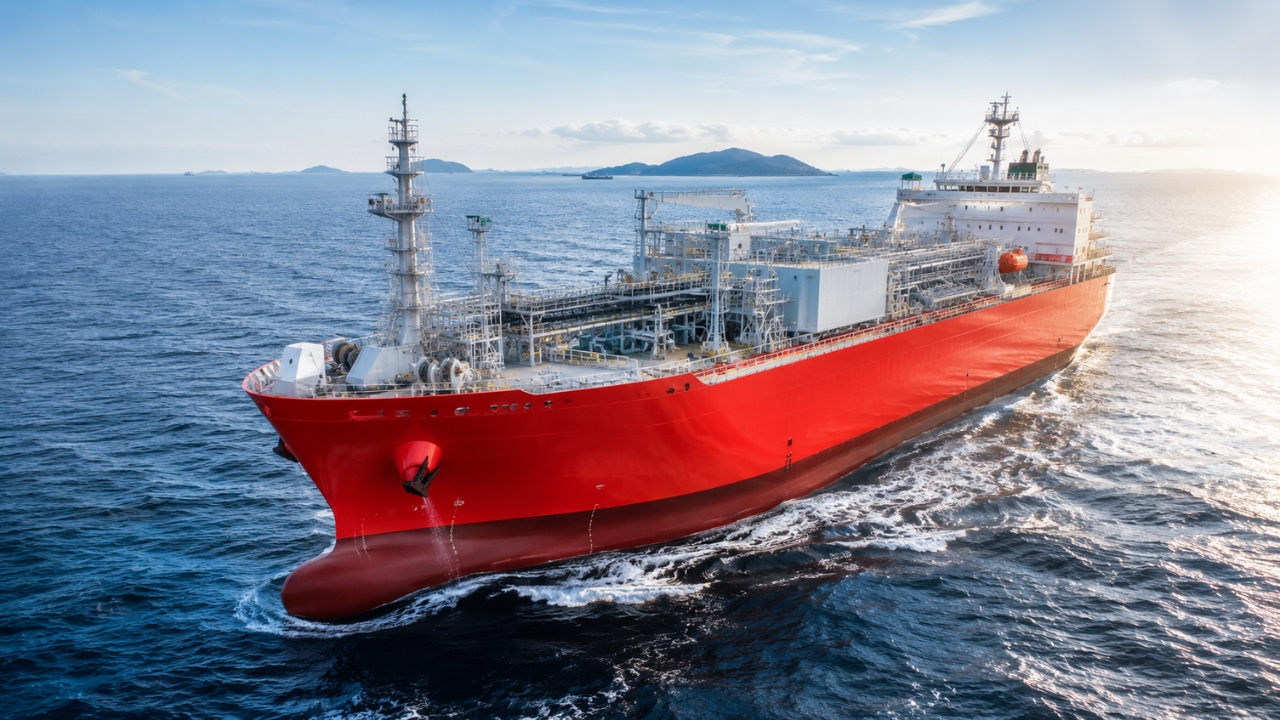


Maritime transport is entering a new phase. After decades of relying on heavy fossil fuels to move cargo ships, tankers, and large vessels, one of the world’s largest shipbuilders has just unveiled a milestone that could change the industry: a cargo ship powered by ammonia.
The company responsible for the project is HD Hyundai Heavy Industries from South Korea, which announced the construction of the first medium-sized ships equipped with engines capable of using ammonia as fuel. The two cargo ships have a capacity of 46,000 cubic meters, were named Antwerpen and Arlon, and are part of an order from the Belgian company Exmar.
The investment is noteworthy because ammonia does not contain carbon in its molecule. This means that when used as fuel, it can drastically reduce direct CO₂ emissions during combustion, one of the biggest problems in global maritime transport.
-
Engineers Develop Fridge-Sized Machine to Produce 95-Octane Synthetic Fuel from Air and Water, Aiming to Sustain Combustion Engines Without Oil

-
Two-Armed Robot Uses AI to Reassemble Destroyed Pompeii Frescoes, Solving an “Impossible” Puzzle
-
New Law in Brazil Requires Breaks for Type 1 Diabetes Management at Work, School, and Public Exams

-
Scientists Confirm “Greening” of Antarctica: Ice on the World’s Coldest Continent Turns Green as Mosses Multiply Over Tenfold in Four Decades


Why is an ammonia-powered ship so important?

Cargo ships are essential to the global economy. They transport fuels, food, minerals, machinery, vehicles, chemicals, and practically everything that sustains international trade.
The problem is that this fleet consumes enormous volumes of fuel. And the larger the ship, the more difficult it is to replace traditional fuel with batteries or simple electric solutions.
That’s why ammonia has started to gain traction in discussions about the future of navigation. Unlike pure hydrogen, it can be stored and transported more easily in certain industrial contexts. Moreover, there is already a global chain for the production, transportation, and use of ammonia, mainly linked to the fertilizer sector.
HD Hyundai itself states that ammonia could represent 46% of global maritime fuel by 2050, if the technology advances and environmental regulations continue to pressure the naval sector.
The ships Antwerpen and Arlon have 46,000 m³ and were made to transport liquefied gases
The first two ships presented by HD Hyundai are medium-sized gas carriers. Each was designed with 46,000 m³ capacity and equipped with ammonia dual-fuel engines, meaning they are prepared to operate with technology that paves the way for lower-emission fuels in maritime transport.
They were built at the Ulsan shipyard in South Korea, one of the most important centers of the global shipbuilding industry. The naming ceremony brought together representatives from HD Hyundai, Exmar, and Belgian authorities, reinforcing the strategic nature of the project for international navigation.
According to information released by the company, the ships are part of a series of four vessels ordered by Exmar LPG France, a subsidiary of the Belgian Exmar. Deliveries are scheduled to occur after the final finishing work.

Can ammonia become the “green fuel” for large cargo ships?
The great advantage of ammonia is that it can function as a direct carbon-free fuel. Since its chemical formula is NH₃, it does not carry carbon in its composition.
This does not mean that the entire ammonia cycle is automatically clean. For the technology to have a real impact, ammonia production also needs to be decarbonized, using renewable energy or low-carbon processes. This is where the so-called green ammonia comes in, produced from hydrogen obtained by electrolysis with clean energy.
Even so, the advancement of ammonia-powered ships shows that the shipping industry is looking for a solution to a difficult problem: how to decarbonize giant vessels that need to cross oceans carrying thousands of tons.
Batteries can work for ferries, smaller vessels, and short routes. But for large cargo ships, energy density, space, and operating time are still huge obstacles.
Technology requires extreme safety
Despite its potential, ammonia also brings challenges. It is toxic and requires strict systems for storage, ventilation, monitoring, and leak control.
Therefore, ships of this type need to be designed with additional layers of safety. The fuel needs to be stored in appropriate tanks, refueling systems must avoid human contact, and the engine needs to control combustion stably.
Marine Log highlighted that the ships were developed with cargo tanks and systems designed to transport liquefied gases, including ammonia and LPG, as well as solutions aimed at crew safety.
This point is crucial. Ammonia can be a powerful alternative, but it will only be accepted on a large scale if it proves it can operate safely in ports, international routes, and long ocean voyages.
A Strategic Move by South Korea
The construction of these ships also shows South Korea’s strength in the race for the next generation of the shipbuilding industry.
HD Hyundai had already been accumulating experience in alternative fuels. The company claims to have previously delivered methanol-powered ships and now seeks leadership in the ammonia-powered vessel market as well.
This move comes at a time when shipowners, shipyards, and governments are under pressure to reduce emissions. The International Maritime Organization is tightening environmental targets, and large global companies are looking for alternatives to reduce the carbon footprint of their logistics chains.
Whoever first masters low-carbon ships may gain an advantage in a billion-dollar market.
Maritime Transport May Be on the Verge of a Turning Point
The launch of the ships Antwerpen and Arlon does not mean that all cargo ships in the world will immediately start using ammonia. The transition still depends on port infrastructure, scale production, safety, cost, and regulation.
But the signal is clear: the technology has moved off the drawing board.
For the first time, a major shipbuilder presents commercial vessels of this size prepared to use ammonia as fuel, paving the way for a new technological race at sea.
If green ammonia becomes competitive, the coming years could mark a profound change in heavy maritime transport. Ships that once depended on highly polluting fuels could cross oceans with a much cleaner energy matrix.