Portuguese
  Spanish


The American startup Panthalassa, with investment led by billionaire Peter Thiel, co-founder of Palantir, raised over US$200 million to build floating nodes in the shape of giant spheres that generate electricity from wave movement, house artificial intelligence chips, and use seawater for cooling.
The next phase of the artificial intelligence boom may happen far from the server farms that dominate the interior of the United States. The startup Panthalassa wants to take heavy computing offshore and is betting on giant steel **spheres** that would float in the ocean while producing energy, processing data, and sending results via satellite to clients anywhere in the world.
The company has already raised over US$200 million from Silicon Valley investors and is preparing to build a pilot unit near Portland, Oregon. Behind the operation is billionaire Peter Thiel, co-founder of Palantir, who led the latest funding round, worth US$140 million, according to the Financial Times.
How the giant spheres in the middle of the ocean work

The design of the structures is as strange as the proposal. Each node is shaped like an enormous steel sphere that floats on the surface, with a long vertical tube submerged in the ocean directly beneath it.
-
She heard for decades that space was not a place for women, became a pioneer in aviation, was part of the Mercury 13, and at 82, finally traveled with Jeff Bezos before dying at 87.

-
Scientists investigate microplastics in the airways of patients with sleep apnea and reveal a new focus for research on environmental pollution, human exposure, and possible impacts on breathing quality.
-
For the first time, scientists have seen the ocean floor open up in real-time—plates moving apart by two meters in a few days and 160 million cubic meters of lava emerging on the seafloor.
-
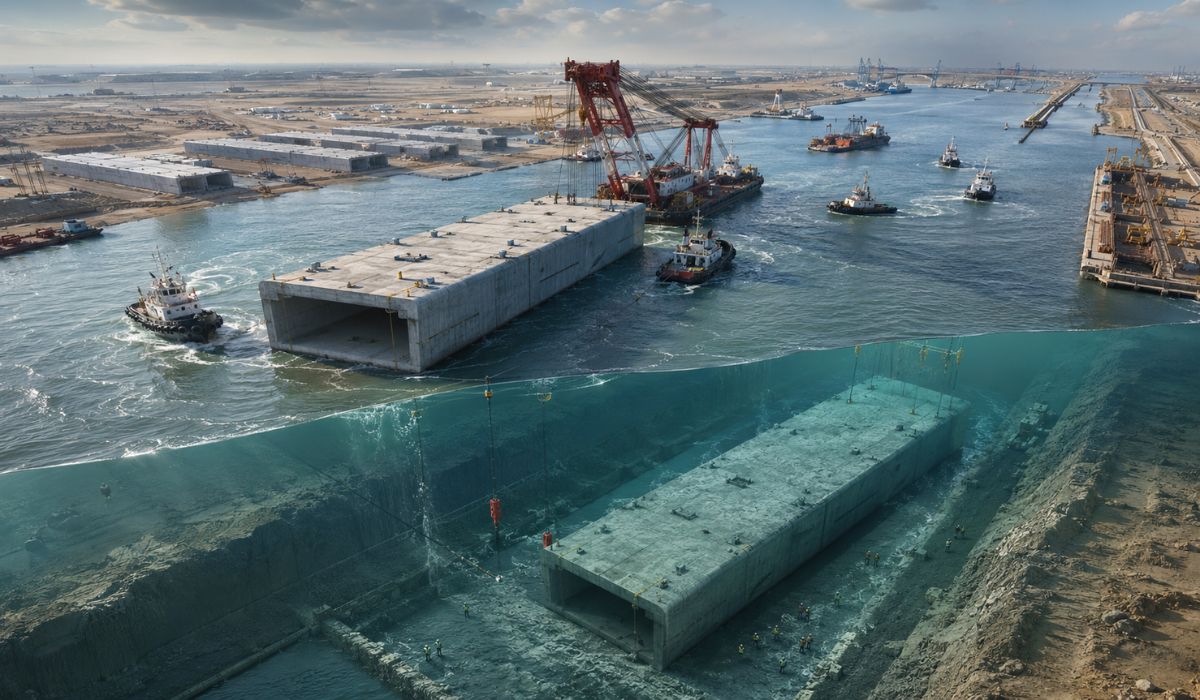
Iraq floats and sinks under an arm of the Euphrates 10 giant concrete boxes of 46,000 tons and 125 meters each to assemble a 2.4 km submerged tunnel and open a new land route between Asia and Europe.




As waves rock the equipment, water is pushed upward and enters an internal pressurized chamber. **This flow passes through turbines and generates electricity directly within the structure itself, without needing solar panels, wind turbines, or cables connected to land.**
The energy produced does not travel back to the continent, as happens with other offshore renewable installations. Instead, the electricity is consumed right there, powering the artificial intelligence chips housed within the metallic hull that makes up each of the spheres.
The ocean water itself fulfills a second essential function. It naturally cools the processors, eliminating one of the highest costs for traditional data centers, which typically consume large volumes of energy and fresh water just to keep servers at a safe temperature.
Why take data centers offshore now
The motivation for this race lies in what is happening on land. Conventional data centers face increasing restrictions when it comes to securing electrical power, skilled labor, and environmental permits to set up near cities.
The pressure is so great that Ars Technica highlighted an impressive figure for the year. **Leading tech companies are expected to invest approximately US$765 billion in AI data centers by 2026**, amidst a wave of public resistance and infrastructure bottlenecks.
In this scenario, taking computing to sea no longer sounds crazy and begins to seem strategic. The ocean offers virtually unlimited space, abundant water for cooling, and a constant energy source from waves, which do not stop day or night.
The market’s take on the concept is straightforward. Computer architect Benjamin Lee, from the University of Pennsylvania, summarized the bet by saying that Panthalassa transforms an energy transmission problem into a data transmission problem, shifting complexity to the side that digital engineering already knows how to handle better.
The Ocean-3 node, the size of a skyscraper

The company’s next chapter is called Ocean-3. This is Panthalassa’s most advanced prototype and is expected to begin testing in the North Pacific later this year, according to information released by Ars Technica.
The scale of the structure is impressive. The sphere is about 85 meters tall, a length similar to that of Big Ben in London, or the Flatiron Building in New York.
Before this model, the company had already run smaller experiments. A previous prototype completed a three-week sea trial off the coast of Washington state in 2024, validating parts of the technology in real open-sea conditions.
The stated goal is for each node to operate for over a decade in the most aggressive ocean conditions. CEO and co-founder Garth Sheldon-Coulson told CBS he dreams of deploying thousands of these spheres across the world’s oceans in the coming years.
The obstacles that could sink the project
Despite the robust budget and big names on the investor list, Panthalassa faces technical problems that do not yet have ready solutions. The first of these is communication between the spheres and the rest of the network.
Satellite connections remain slower and less stable than the fiber optic cables used by land-based data centers. For AI systems that rely on constant information exchange between servers, this speed difference can become a difficult bottleneck to overcome.
Another sensitive point is maintenance. Imagining thousands of autonomous machines spread across the open sea, operating for over ten years without any human intervention, raises questions about failures, leaks, corrosion attacks, and even risks of digital or physical piracy.
The concept also received doses of irony on social media. Jeff Bercovici, deputy editor for technology and media at the Wall Street Journal, joked on X that if the vessels can truly move without engines, Panthalassa might have accidentally solved a much bigger problem than data centers: global maritime transport.
The idea is not entirely new, but it is the most ambitious

Taking servers underwater or above water has been attempted before. Microsoft conducted submerged data center experiments in 2015 and 2018 as part of Project Natick, before shelving the initiative for operational reasons.
Chinese companies have also advanced in this area in recent years. There are records of submarine data centers installed near Hainan Island and off the coast of Shanghai, in addition to the work of Singapore-based company Keppel on floating data center projects.
What differentiates Panthalassa, according to Ars Technica, is the rare combination of self-generated energy, heavy local processing, and direct satellite connection. This integrated package, on an ocean scale, had not yet been attempted by any of the previous initiatives.
The bet also aligns with a specific market moment. With artificial intelligence pressuring the global electricity supply, any experiment that reduces demand on land ends up gaining increased attention from investors and governments concerned about grid overload.
What’s at stake in the floating AI race
Panthalassa’s success or failure could set a new standard for the industry. If the spheres work as promised, other companies are likely to follow suit and open up an entire front of innovation in the ocean.
Geopolitics also comes into play. Countries with extensive coastlines gain an unexpected strategic asset to host cutting-edge digital infrastructure, balancing a race that currently favors economies with cheap energy, flat land, and little social resistance.
For the end consumer, the change may seem invisible, as each AI call will continue to travel across the internet in the same way. Behind this transparency, however, lies a profound reorganization of where computing happens and who controls the physical infrastructure that supports the next generation of applications.
For now, everything depends on what happens with Ocean-3 in the North Pacific tests. The experiment will tell whether the idea of giant spheres can truly scale, or if it will join the list of bold technological promises that sank before becoming routine.
And you, do you believe that ocean AI data centers will succeed or would you bet that this billion-dollar project might end up sinking like Microsoft’s Project Natick? Would you be willing to run your artificial intelligence calls on servers swaying in the middle of the sea?
Tell us in the comments if you trust satellite connections for heavy tasks, if you think these floating nodes can really last a decade without maintenance, and how you imagine the environmental impact of spreading thousands of giant spheres across the planet’s oceans. The discussion promises to be long-lasting.