Portuguese
  Spanish


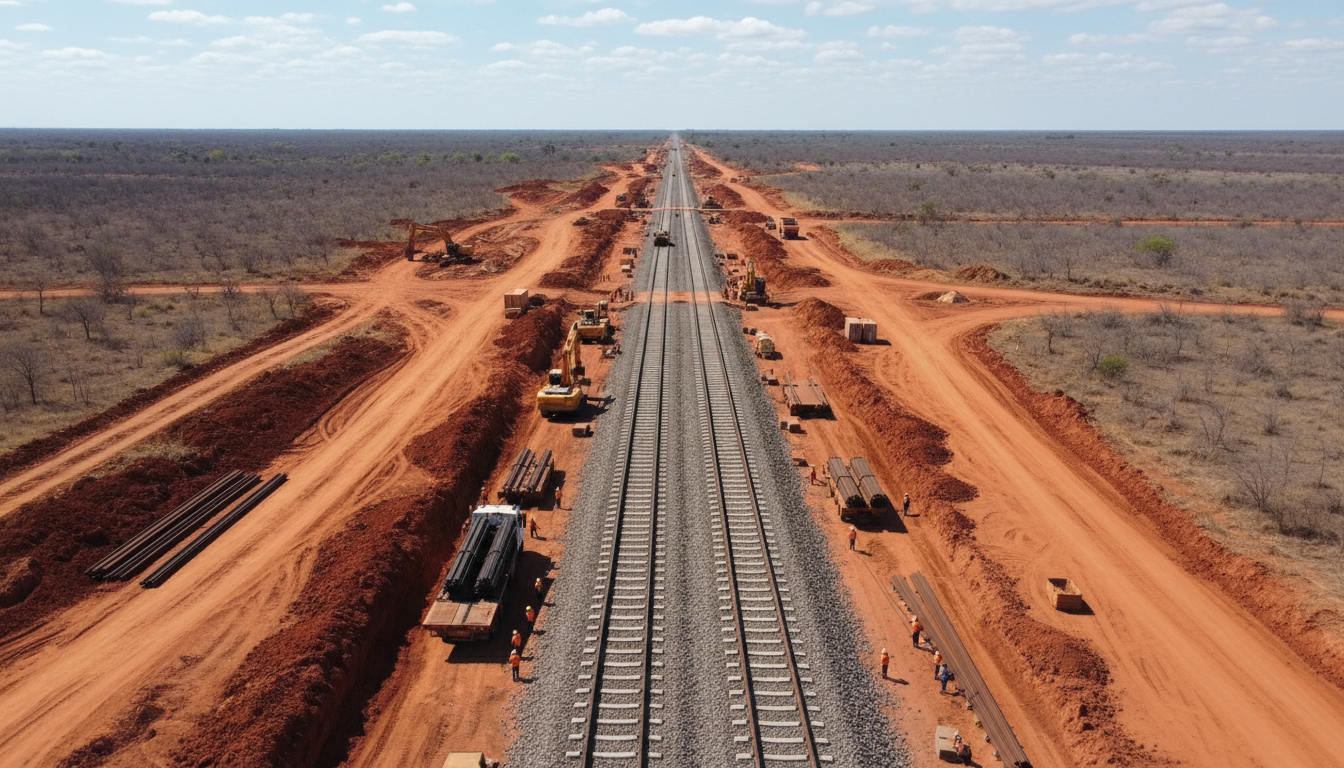

The idea was born in the 1950s, construction began in 2006, the tracks already cover 727 kilometers, and the railway is 81% complete — but the Transnordestina has not yet transported a single grain from the hinterland to the sea, and its 53 municipalities continue to wait for the train that will change the logistics of the Northeast
According to a report from Diário do Nordeste published in April 2026, the Transnordestina Railway will officially complete 20 years of construction in June 2026.
However, the history of this railway is much older than two decades.
The first attempt to build a railway connecting the interior of the Northeast to the coast took place in 1959 — 67 years ago. Since then, the project has been announced, shelved, resumed, and halted more times than any Northeasterner would like to remember.
-
Brazil to Convert 80 Public Properties into 11,000 Affordable Homes Across 44 Cities to Address Housing Shortage

-
Brazilian Company Develops Wall Panels from Recycled Refrigerator Foam with Comparable Thermal and Acoustic Performance

-
Brazil’s São Paulo Region Unveils Latin America’s Largest Timber Shopping Mall, Built in 7 Months, Capturing Carbon and Preventing 900 Tons of Emissions
-
Danish Island Uses Seaweed for Durable, Centuries-Old Roofing Solution


This time, however, the numbers suggest that the train is closer to becoming a reality than at any previous moment.
1,206 kilometers crossing the Northeast
According to Terra, the Transnordestina has a total length of 1,206 kilometers.
Furthermore, the railway crosses three states: Piauí, Pernambuco, and Ceará.
There are 53 municipalities along the route — 28 in Ceará, 18 in Piauí, and 7 in Pernambuco.
The starting point is Eliseu Martins, in the interior of Piauí. The final destination is the Industrial and Port Complex of Pecém, on the coast of Ceará.
Therefore, when the railway is operational, grains, fertilizers, cement, fuels, and minerals produced in the hinterland will be able to reach the sea by rail instead of by road — reducing freight costs and emissions of pollutants.
The total investment is R$ 14.9 billion. Of this amount, R$ 7.4 billion comes from the Northeast Development Fund (FDNE), managed by Sudene.
- 1,206 km of total length
- 53 municipalities crossed in 3 states (CE, PI, PE)
- R$ 14.9 billion of total investment
- 727 km already completed
- 326 km under simultaneous construction
- 81% of phase 1 completed
- 19 construction lots
- 33.9 thousand tons of rails received in Ceará

What is happening now with the construction
As reported by the federal government in March 2026, the construction received a new boost with the release of R$ 152.4 million from the FDNE.
In Ceará, four of the 11 lots have already been delivered. Additionally, all remaining lots are 100% mobilized.
Similarly, in Piauí, the section between Eliseu Martins and São Miguel do Fidalgo is in full implementation.
According to data from the Ministry of Transport, phase 1 of the railway — which runs from Paes Landim (PI) to Pecém (CE) — is 81% physically completed.
Consequently, Transnordestina Logística S.A. (TLSA), the concessionaire responsible for the project, states that phase 1 will be completed in 2027, within the contractual schedule.
In this regard, TLSA declared: “Phase 1 includes the stretch from Paes Landim to the Port of Pecém and will be completed in 2027.”
By July 2026, it is expected that 253 kilometers will be completed just in Ceará — half of the total 527 kilometers of the railway in that state.
67 years of promises: why it took so long
However, the history of the Transnordestina is marked by more frustrations than achievements.
The original idea emerged in the 1950s when the federal government conceived a railway corridor that would connect the northeastern interior to the coast.
However, the first construction attempt in 1959 was abandoned due to lack of economic viability.
The project was shelved for almost half a century.
Only in 2006 did actual construction begin — this time under the responsibility of TLSA.
Despite this, over the following 20 years, the railway faced contract cancellations, halts of entire lots, audits, and changes of contractors.
Originally, the project envisioned 1,753 kilometers, reaching the Port of Suape in Pernambuco.
However, the scope was reduced to the priority axis of 1,206 kilometers, connecting only to Pecém.
Thus, the stretch to Suape — phase 3, with 547 kilometers — remains pending, with no start date in sight.

What changes for 53 cities when the train arrives
On the other hand, when the railway finally operates, the impact on the logistics of the Northeast will be immense.
Currently, agricultural and mineral production from the interior of Piauí, the Ceará hinterland, and western Pernambuco travels on poor roads to the ports.
According to Gazeta do Povo, the cost of road freight in these regions is up to three times higher than that of rail freight.
Therefore, for grain producers in the Piauí cerrado — one of Brazil’s last agricultural frontiers — the Transnordestina represents the difference between economic viability and loss.
Additionally, the railway will create a direct corridor between the productive interior and Pecém, which is the closest port to Europe and the east coast of the United States among all Brazilian ports.
Similarly, the shift from road to rail will reduce pollutant gas emissions — a truck emits up to five times more CO₂ per ton-kilometer than a train.
In this sense, the Transnordestina is not just an infrastructure project. It is a transformation in the economic model of 53 municipalities that depend on roads to survive.

While in Brazil the railway waits 67 years, China builds in 3
The comparison with international projects is inevitable — and painful.
The China-Kyrgyzstan-Uzbekistan railway, spanning 523 kilometers, was agreed upon in 2022 and already has 5,000 workers drilling tunnels in the mountains of Central Asia.
Similarly, the Mato Grosso Railway (FTM), with 743 kilometers, advances 1 kilometer per day and is already 73% complete in just four years of construction.
Still, the Transnordestina needs context. The terrain of the Northeast presents distinct geological challenges, and the problems are not just technical — they are contractual, political, and financial.
The recent progress, with the release of funds and simultaneous mobilization of all lots, is the most concrete sign that this time may be different.
The risk that 67 years have taught
However, any optimism must be tempered with caution.
Completion forecasts have already changed several times: 2026 for some sections, 2027 for phase 1, 2028 for full operation.
Phase 3, which would take the railway to Suape, does not even have a start date.
Moreover, the dependence on public funding — especially through the FDNE — leaves the schedule vulnerable to budget cuts and changes in government.
In light of this, four generations of Northeasterners have grown up hearing that the train was coming. The difference now is that 727 kilometers of tracks are already laid — and that is something no political promise can undo.
The question that remains is not whether the Transnordestina will be completed. It is whether it will be completed in time to still make a difference for the cities that have been waiting for it since before their oldest residents were born.