Portuguese
  Spanish


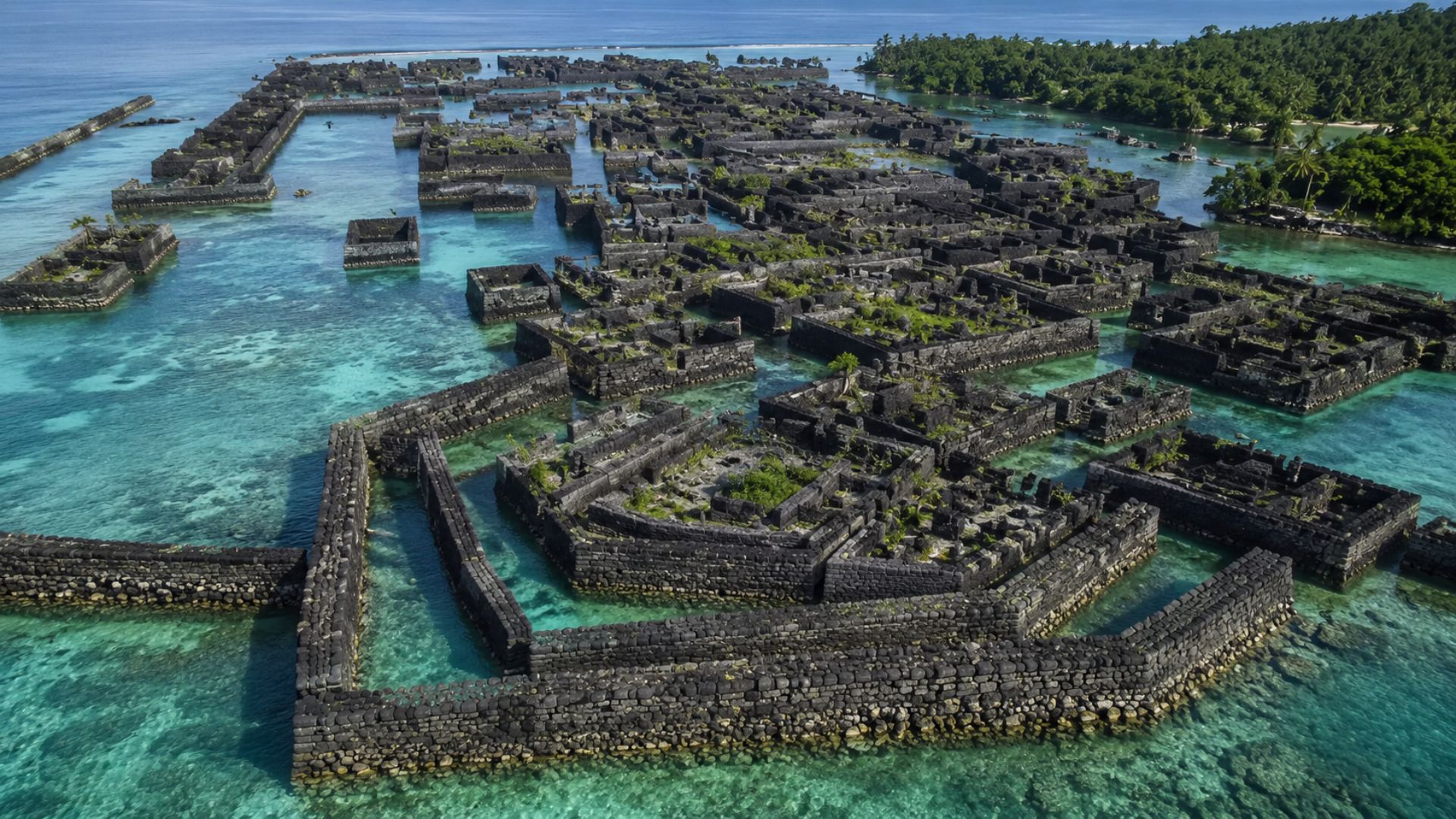


Nan Madol, the city built on 92 artificial islands off the coast of Pohnpei, in Micronesia, challenges archaeologists with the engineering that moved about 750 thousand tons of volcanic basalt over coral reefs without any type of mortar. According to NSC, recognized as a World Heritage Site by UNESCO in 2016, the city simultaneously entered the list of endangered heritage sites.
An entire city built on the sea, without drinking water, without metal, without wheels, and without writing. It sounds like fiction, but Nan Madol has existed for over 800 years on the southeast coast of the island of Pohnpei, in the Federated States of Micronesia. The city is made up of more than 92 artificial islands interconnected by tidal channels, all built with columns of volcanic basalt positioned directly on living coral reefs. The total weight of the basalt transported over four centuries amounts to approximately 750 thousand metric tons, an average of 1,850 tons per year, all without mortar, without cement, and without any machinery.
What makes this city even more intriguing is that no one has been able to replicate with certainty the method used to transport blocks of up to 50 tons over more than 40 kilometers, from the opposite side of the island to the reefs. The Saudeleur dynasty, which ruled Pohnpei between approximately 1100 and 1600 AD, coordinated this monumental construction over about four centuries, transforming Nan Madol into the political, religious, and administrative center of the entire region. UNESCO recognized the site as a World Heritage Site in 2016, but simultaneously inscribed it on the list of endangered heritage sites.
How a city was built on living corals without mortar
The first enigma of Nan Madol lies in the very foundation on which the city was built. The artificial islands were raised directly on coral reefs, requiring precise knowledge of maritime stability, tidal behavior, and weight distribution. The builders stacked basalt columns in a horizontal formation, taking advantage of the natural geometry of volcanic rock — the so-called columnar basalt to create stable walls without any type of binder.
-
Nigerian Housing Crisis Addressed with Innovative Solution: Architect Builds Solar-Powered Modular Homes from Recycled Waste in Just 4 Hours for Low-Income Families

-
Mushrooms, orange peels, and agricultural waste are being turned into insulation panels for construction, replacing conventional materials with grown rather than manufactured walls.

-
House Built with 1.5 Tons of Recycled Plastic Completed in 10 Days in India, Transforming a Waste Picker’s Life and Tackling Urban Waste

-
Brightline to Connect Los Angeles and Las Vegas in Two Hours with the First U.S. Electric High-Speed Train, a $12 Billion Project Aiming to Reduce Road Traffic




This technique allowed the structures to withstand eight centuries of tides, tropical storms, and coastal erosion. The massive pillars function as a kind of three-dimensional grid: each column supports its neighbor by its own weight and the friction between surfaces, dispensing with mortar. Archaeologists consider that the city of Nan Madol represents one of the greatest feats of oceanic engineering of antiquity, comparable in scale and complexity to the Egyptian pyramids and Stonehenge.
The transport of 750 thousand tons of basalt over 40 kilometers

The basalt used in the city was extracted from a volcanic plug located on the opposite side of Pohnpei, more than 40 kilometers away from the site. The most accepted hypothesis among researchers is that the blocks were transported by means of rafts and large traditional canoes, taking advantage of coastal channels and tidal currents to facilitate movement.
The collective effort required to move stones up to 50 tons in an isolated region of the Pacific defies any simple explanation. The city was built by a civilization that had no metal, wheel, or draft animals. Local residents attribute the feat to magic — Pohnpei legends tell that the blocks flew to the reef by enchantment of two mythical brothers. Scientists, however, point out that the transport demanded sophisticated systems of flotation, dragging, and human coordination maintained over generations.
The Venice of the Pacific and its network of canals

The comparison with Venice is no exaggeration. The city of Nan Madol has a complex network of canals that functioned simultaneously as a transport route, sanitation system, and defense mechanism. The constant circulation of the tides prevented the accumulation of sediments and the stagnation of water between the islands, maintaining minimum hygiene conditions for a population concentrated on artificial platforms in the middle of the ocean.
The name Nan Madol means “in the intervals,” a direct reference to the tidal channels that cut through the complex like aquatic streets. The maritime passages ensured quick access to temples, ceremonial spaces, and the residential sectors of the Saudeleur elite. The urban planning of the city reveals a level of sophistication that surprises for an insular civilization without written record, demonstrating mastery of hydraulic engineering centuries before similar concepts were formalized in the West.
Power, religion, and social separation on the artificial islands
Nan Madol was not just a work of engineering — it was the instrument of power for the Saudeleur dynasty. The city functioned as an administrative and religious center, concentrating political leaders and priests responsible for the spiritual rituals of Pohnpei. The arrangement of the islands reflected a rigid social hierarchy: specific areas were reserved exclusively for funeral ceremonies, while others housed activities such as the construction of ocean-going vessels.
The isolation of the elite on the central islands of the city reinforced the centralized power of the dynasty and made any kind of insurrection difficult. Access to the most important areas was controlled by the canals, creating natural barriers between the rulers and the common population. The Saudeleur maintained this dominance for approximately 500 years until it was overthrown around 1600 by the warrior Isokelekel, who definitively ended the centralized government and left the city intact as a monumental ruin. The artificial islands of Nan Madol remain standing, silent witnesses to five centuries of Saudeleur dominance.
UNESCO and the Threat from the Sea
In July 2016, UNESCO inscribed Nan Madol on the World Heritage List, the first site in Micronesia to receive this designation. However, at the same time, the city was included on the List of World Heritage in Danger. The threats are concrete: silting of the canals, uncontrolled growth of mangroves whose roots displace stones and topple walls, coastal erosion, and the rising sea levels caused by climate change.
In 2018, the U.S. Ambassador’s Fund for Cultural Preservation allocated $375,000 for studies on invasive vegetation, canal hydrology, and structure-by-structure documentation. The site is protected by the federal government of Micronesia and the state of Pohnpei, under the traditional custody of the Nahnmwarki of Madolenihmw, the local hereditary chief. Despite efforts, Nan Madol receives about a thousand visitors a year, a tiny fraction compared to other world heritage sites.
A City That Even Inspired Horror Fiction


The enigmatic atmosphere of Nan Madol has transcended the boundaries of archaeology and reached literature. Writer H.P. Lovecraft used the city as inspiration to create R’lyeh, the submerged metropolis where the monster Cthulhu sleeps in his cosmic horror mythology. The coincidence between the remote location, the megalithic structures, and the air of mystery surrounding the ruins has fueled decades of popular speculation about supernatural origins.
The reality, however, is equally impressive. A civilization without writing, metal, or the wheel built a stone city over the ocean that has endured for eight centuries. Nan Madol is one of the most isolated and least visited archaeological sites on the planet, yet it remains one of the greatest testaments to human engineering and social organization — a World Heritage Site that the sea created, sustained, and now threatens to engulf.
Did you know about the existence of Nan Madol? What impresses you the most: the transport of 750,000 tons of basalt without wheels, the construction over live corals, or the risk of the sea swallowing everything? Share in the comments.