Portuguese
  Spanish


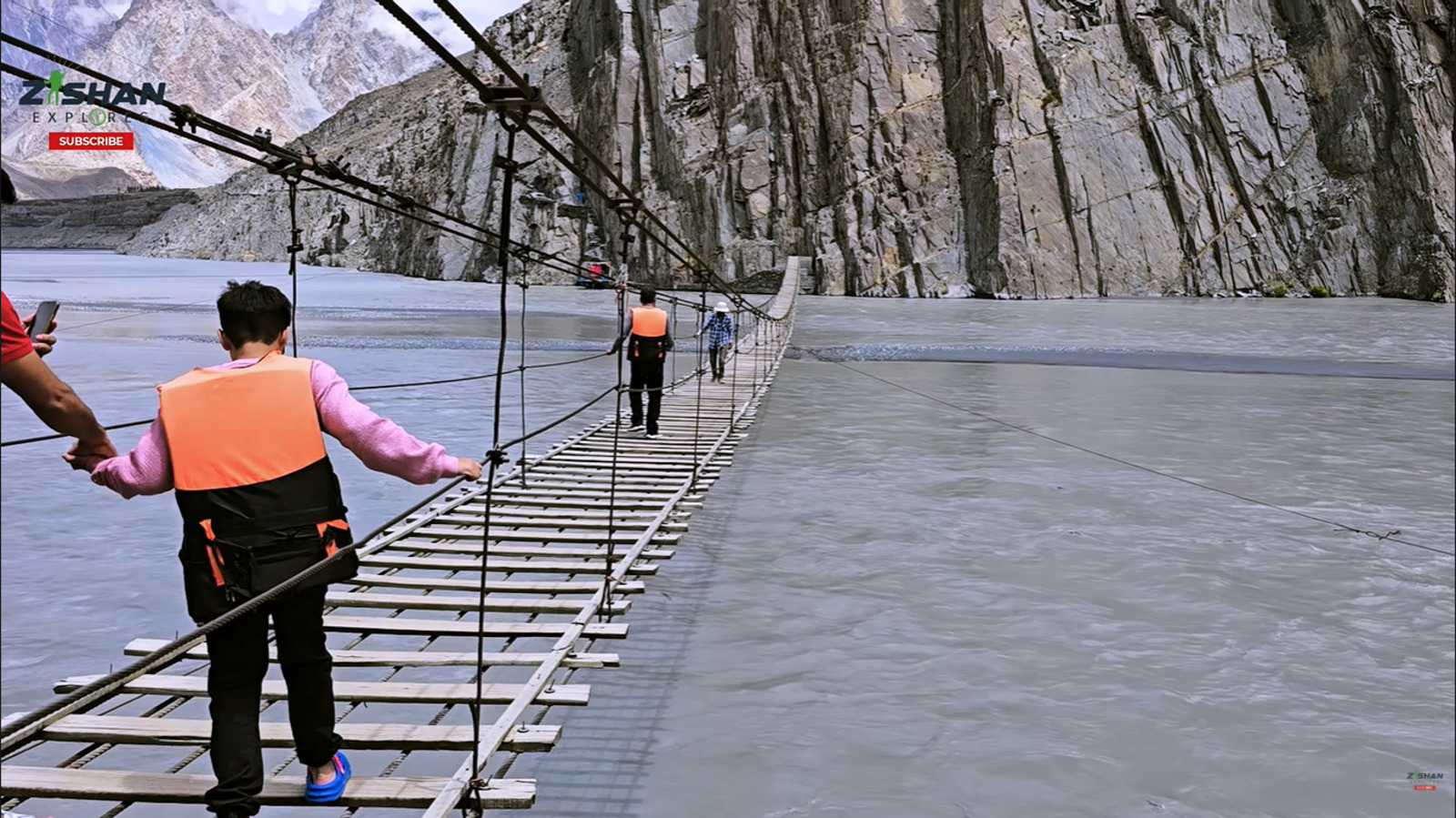

With missing planks, strong winds, and a crossing over Borit Lake, the Hussaini Suspension Bridge became a tourist attraction in northern Pakistan after being rebuilt with steel cables
The Hussaini Suspension Bridge, in northern Pakistan, gained fame as the world’s most dangerous bridge for crossing Borit Lake with ropes, planks, and strong winds, in a mountainous region where travel still requires courage.
World’s most dangerous bridge: Extreme crossing in Upper Hunza
Located in Gilgit-Baltistan, the Hussaini Suspension Bridge crosses Borit Lake in Upper Hunza, amidst a landscape marked by rivers, streams, and mountain passes. It is one of several precarious rope bridges in the region.
The structure draws attention due to its visually risky state. The bridge is long, many planks are missing, and strong winds shake the crossing during passage, requiring constant attention.
-
Former Atacadão Employee Turns Online Cake-Baking Lessons into a Confectionery Brand with Factory, Store, Delivery, and Nearly $400,000 in Revenue

-
Brazilian Startup Sells Nearly 9 Million Surprise Bags of Near-Expiry Food, Prevents Thousands of Tons of Waste, Aiming for $42 Million Revenue by 2026
-
How to Prevent Brown Recluse Spider Bites: Common Hiding Spots and Free Tips to Reduce Risks

-
Natto: The Unusual Japanese Superfood Gaining Popularity on Social Media and Driving Record Exports




There is only one suspension bridge connecting Hussaini village to Zarabad. This connection reinforces the practical importance of the crossing for those traveling between local areas.

Isolation marked the region until 1978
The fame of the Hussaini Suspension Bridge is also explained by its geographical context. Gilgit-Baltistan remained isolated from the rest of Pakistan until 1978 due to the absence of roads.
Before that, there was the option of traveling in small planes, but this resource was only accessible to wealthier citizens. For most, the only option was to cross the mountain passes on foot to Rawalpindi.
The completion of the Karakoram Highway in 1978 connected the region to the country. Still, traveling between areas of northern Pakistan remains difficult, in conditions comparable to those faced 100 years ago.
Dangerous bridge became a tourist attraction
Even with its dangerous appearance, the Hussaini Suspension Bridge is considered relatively safe and has transformed into one of the region’s most sought-after tourist attractions.
Hikers visit the site to test their nerves, carefully crossing the bridge. The experience combines height, movement, spaced planks, and the visual impact of a difficult-to-access mountainous landscape.
Reconstruction brought steel cables
The bridge was destroyed by the 2011 monsoons and then completely rebuilt. The new structure is now supported by steel cables and solid wooden planks, maintaining its function as a crossing.
Nearby facilities have boosted tourism in the area. Today, in addition to crossing the bridge, the area offers zip-lining and suspended cycling for visitors seeking adventure in Upper Hunza.
The Hussaini Suspension Bridge remains linked to the image of risk and isolation. In a region where mountains and rivers shape movement, it continues to serve as a local passage.
With information from Atlas Obscura.