






 Portuguese
  Spanish
  5 min of reading
  0 comments


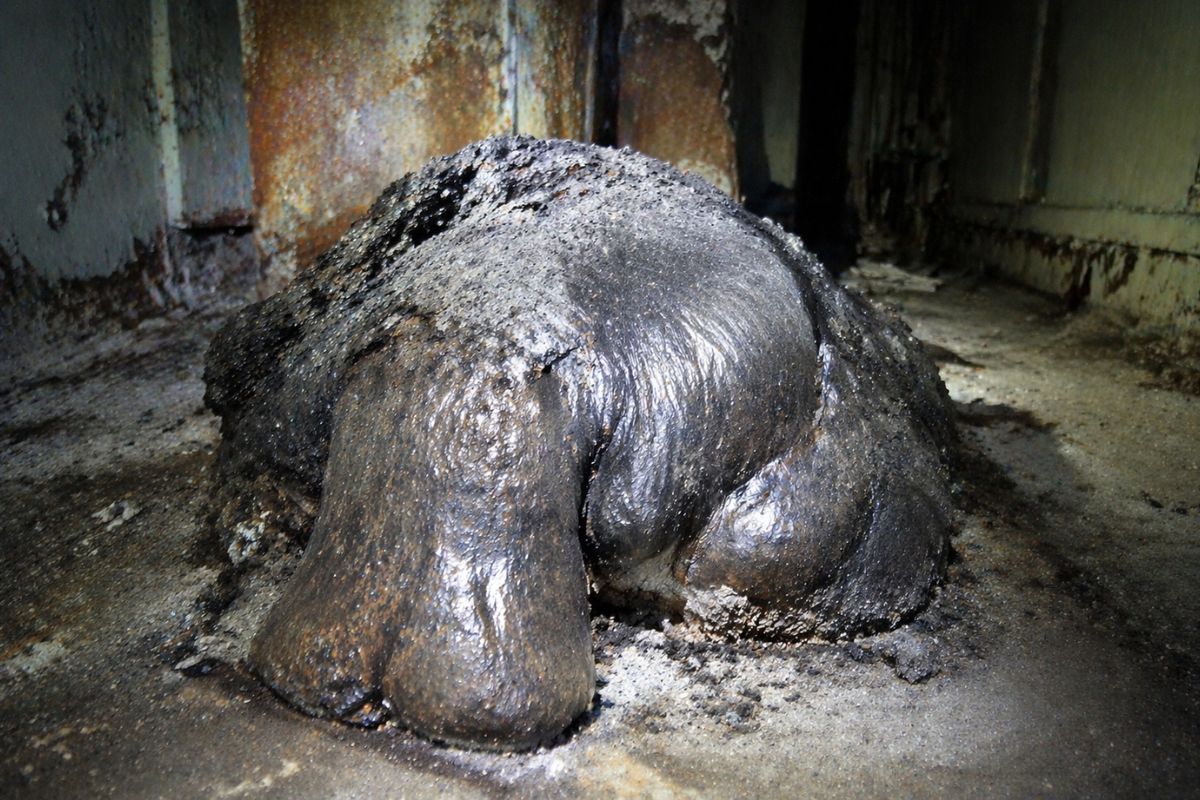
The Elephant’s Foot is a corium object formed when reactor 4 of Chernobyl exploded in 1986, melting nuclear fuel with concrete and metal into a mass that emitted 10,000 roentgens of radiation per hour and that, almost 40 years later, still kills in five minutes.
Almost four decades have passed since the explosion of reactor 4 at the Chernobyl nuclear power plant, which occurred on the night of April 25 to 26, 1986, near Pripyat, in what was then Soviet Ukraine, produced the most dangerous object on record. Named the Elephant’s Foot because of its irregular shape, it is a mass of corium that settled on the lower floor of the reactor building after the simultaneous meltdown of nuclear fuel, concrete, and the metallic elements of the structure. The radioactive material dispersed by the accident reached a surface area calculated at 155,000 km² in territories now divided among three Eastern European countries. The region around the plant remains uninhabitable, with radiation levels preventing permanent human presence.
The corium that constitutes the Elephant’s Foot is classified as one of the most harmful substances ever generated by human activity. In the immediate aftermath of the disaster, the object was emitting radiation at a rate of 10,000 roentgens per hour, a dose twenty times above the threshold that already causes death within a few hours. Just 30 seconds of direct proximity was enough to receive a fatal dose. With the natural decay of isotopes over the decades, the intensity has decreased, but continuous exposure of approximately five minutes is still lethal to any living organism.
How the object emerged in the underground of Chernobyl

The origin of the Elephant’s Foot lies in the phenomenon known as nuclear meltdown. When the temperature inside the reactor exceeded all limits, the atomic fuel, the reinforced concrete walls, and the metallic parts of the structure melted simultaneously, forming a kind of artificial lava that flowed down to the lower floors. As it lost heat, this substance hardened in a corridor below the reactor and acquired the silhouette that earned it its nickname.
-
Federal Police involved in the case to identify the person responsible for hacking the Civil Defense system, which sent ten false alerts, frightened residents of different capitals, and turned messages about real risks into notifications with “misanthropy” and even alien attacks.

-
Extreme drought causes ghost village to reappear at the bottom of the reservoir that supplies Athens, revealing houses, a school, and ruins swallowed since the 1980s as the lake shrinks and exposes the water crisis threatening the capital of Greece.

-
An entire village lay asleep at the bottom of a lake for 3,000 years: divers suction sediments in Italy and reveal more than 600 wooden stakes, bronze tools, and traces of a Bronze Age settlement hidden underwater.
-
They call it the “Shopee house” and even cardboard, but the R$ 20,000 house is a certified Wood Frame from Alea, financed by Minha Casa Minha Vida: understand if it’s worth more than masonry.



At first glance, the object looks like a block of dark rock. But behind this harmless appearance, the mass of corium concentrates radioactive isotopes that have been active and emitting radiation continuously since 1986. The area where the Elephant’s Foot rests remains isolated and classified as an extreme risk zone, accessible only with highly specialized protective equipment and under strict time stay protocols.
10 thousand roentgens per hour: the impact of the object’s radiation on the human body

To understand the lethality of the Elephant’s Foot, the reference number is simple: an accumulated dose of 500 roentgens is enough to kill a person within hours. The object was emitting twenty times that amount every sixty minutes in the first years after the accident, causing vomiting, uncontrolled fever, and cognitive failure within moments of proximity. No one could stay in the same room without receiving a biological death sentence.
Decades of decay have reduced the potency, but have not made the object safe. The current estimate is that about 300 seconds of continuous exposure is sufficient to cause death, which keeps the Elephant’s Foot as one of the most dangerous points in the Chernobyl complex and on the entire planet nearly four decades after it was formed. The isotopes present in the corium will take centuries to reach levels considered harmless.
The photographer who recorded the object and survived
The most widely circulated photograph of the Elephant’s Foot was taken in 1996 by nuclear specialist Artur Korneyev, who was part of the teams responsible for tracking contaminated fuel and measuring radiation within the ruins of the plant. Korneyev described his experience as that of someone who was always on the front lines, and remarked with characteristic irony that the radiation produced in that country was unsurpassed. The statement mixed sarcasm with the weight of having worked in conditions that very few human beings have faced.
The photographic record bears visible marks of the environment in which it was produced. The excessive graininess in the image likely results from the interference of radiation on the film, not from equipment malfunction. Even a decade after the disaster, being in the same room as the object still posed a severe health risk to anyone. Korneyev’s photo documents both the appearance of the Elephant’s Foot and the hostility of the environment that houses it.
How researchers collected samples from an object that nobody could touch
Studying the Elephant’s Foot posed challenges that went beyond radiation. In the early years, the corium was so compact that no conventional tool could extract fragments for analysis, and the improvised solution was to fire a Kalashnikov rifle at the mass to highlight small enough pieces to be taken to the laboratory. The method reveals the precarious conditions faced by those who needed to investigate the object without adequate technology for that level of risk.
As time passed, the consistency of the material changed. Researcher Maxim Saveliev stated in 2021 to Science magazine that the corium already had a texture similar to sand, a sign that the substance is becoming more brittle. This transformation worries scientists because a friable material can release radioactive particles more easily, increasing the danger of contamination if the containment structure around the object were to fail.
The concrete sarcophagus and the future of the most dangerous object in the world
After the accident, the destroyed reactor was encased in a concrete shell that the international community began to call a sarcophagus. The Elephant’s Foot remains within this containment, continuously irradiating as its isotopes undergo the slow decay process over centuries. There was concern that internal reactions could cause the corium to advance through the soil to contaminate underground water reserves, but this scenario has not been confirmed to this day.
The Elephant’s Foot brings together, in a single object, the physical, chemical, and environmental dimensions of the worst nuclear accident ever recorded. Even after almost 40 years, no one can approach it without putting their own life at risk, and this silent permanence underground in Chernobyl serves as a concrete warning that certain consequences of human intervention survive for much longer than any generation that caused them. The object does not forgive, does not forget, and does not stop emitting.
And you, did you already know the story of the Elephant’s Foot? Do you think an object capable of killing in five minutes even after almost four decades should change the way we view nuclear energy? Leave your opinion in the comments.





-

1 person reacted to this.