






 Portuguese
  Spanish
  5 min of reading
  0 comments


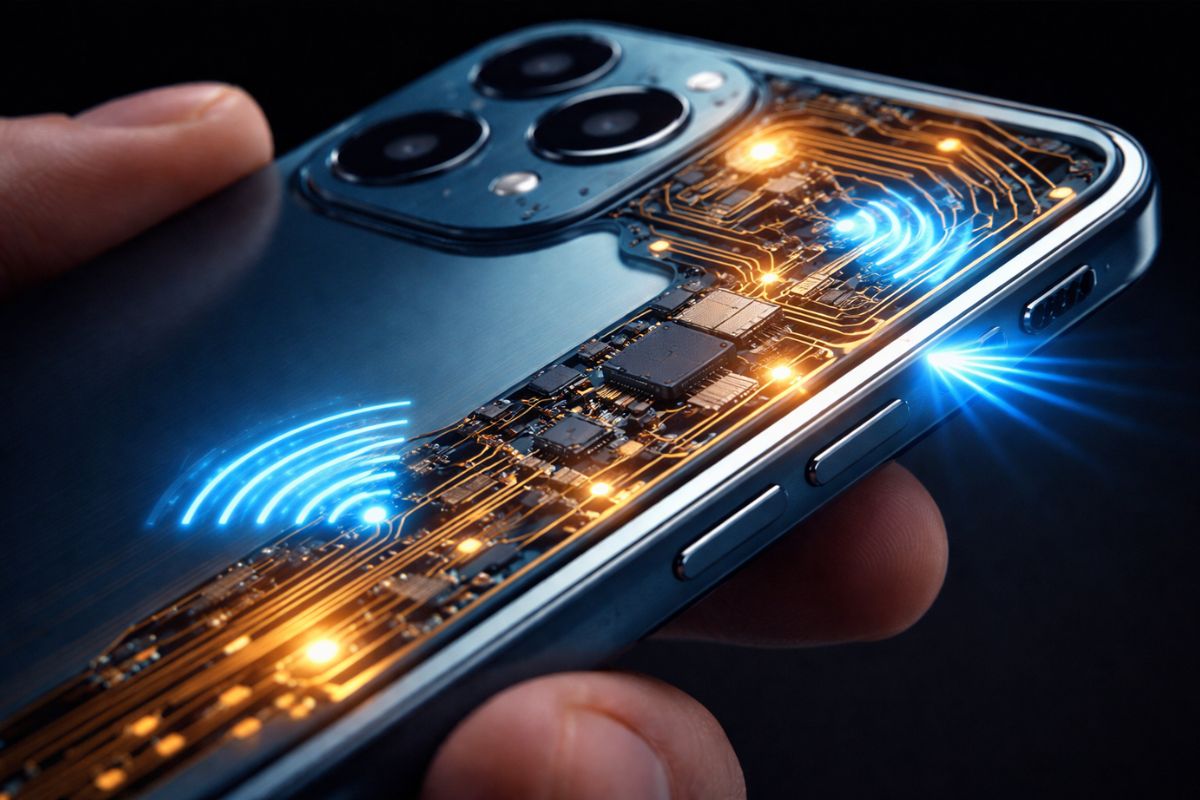
The cell phone you use in your daily life has dozens of antennas for 4G, 5G, Wi-Fi, Bluetooth, and GPS, all invisible because engineering embedded them in the metal frame and in the internal boards using fractal geometry and insulating cuts that capture signal without you noticing.
The modern cell phone seems to have no antennas, but this impression is just appearance. In fact, the components responsible for signal reception, including 5G frequencies, have been incorporated into the physical structure of the device over decades of advancements in miniaturization and radio frequency engineering. In many smartphones sold today, the metal frame that surrounds the sides of the body acts as the main antenna. Small plastic cuts inserted into this frame isolate sections of metal, preventing the piece from behaving like a single conductor and impairing reception. It is a solution that transforms the cell phone chassis into connectivity infrastructure without the user noticing.
The change did not happen overnight. The world’s first commercial cell phone, the Motorola 8000X from 1984, needed a huge external antenna to compensate for the poor network of the time and to prevent the user’s own head from blocking the signal during calls. Since then, the combination of denser networks, higher frequencies, and more sophisticated manufacturing techniques has allowed antennas to shrink to the point of disappearing completely from the eyes of the cell phone user.
How the antennas ended up inside the cell phone

The transition began between the 1990s and 2000s when engineers discovered that it was possible to compress the component into a spiral shape, creating the so-called helical type antenna. This technique proved that the element did not need to be a straight rod and could take on complex shapes occupying minimal space within the cell phone chassis. It was the first step to eliminate the external antennas that marked the generation of devices known as “bricks”.
-
Brazilian student creates a cheap formula that makes plants grow up to 90% faster and wins an award in a global scientific competition.

-
Europe unveils armored tank with remote turret, 1,500 horsepower, and 120-millimeter cannon

-
Old hard drives may hide neodymium, dysprosium, praseodymium, and terbium, and a United States company is expanding its network with a new 93,000-square-foot facility to recover rare earths used in electric cars, artificial intelligence, defense, and renewable energy.

-
Giant crane lifts up to 3,000 tons, requires special logistics to reach the site, and can transform 18-hour operations into just 3 hours, speeding up the hoisting of oil platforms, refineries, and plants in giant industrial projects.




Another leap came with the application of fractal geometry in the design of antennas. Fractals are patterns that repeat at smaller and smaller scales, and when applied to the shape of an antenna, they allow it to maintain an effective length for capturing signals while occupying a reduced physical area within the cell phone. Currently, the industry goes further: it prints these components directly onto the internal parts using lasers and metallic coating, optimizing every millimeter of available space.
The physics that allowed smaller antennas in cell phones

There is a physical reason why antennas have shrunk so much. The dimension necessary for an antenna to work well is about 25% of the wavelength of the frequency it needs to capture. As modern networks operate at much higher frequencies than the old analog signal, the wavelengths have decreased proportionally, and with them, the size required for antennas.
In practice, this means that a cell phone operating on a 5 GHz network needs an antenna of only 1.5 centimeters, since the wavelength at this frequency measures about 6 centimeters. This drastic reduction is what made it feasible to hide multiple antennas inside a device that fits in the palm of your hand. The higher the frequency used by the network, the smaller the antenna needed, and the 5G bands push this logic even further, requiring increasingly compact components in the cell phone.
The infrastructure of towers also helped cell phones lose external antennas
It wasn’t just internal engineering that changed. In the early decades of mobile telephony, transmission towers were few and far between, which forced devices to carry large and powerful antennas to reach the signal. With the multiplication of base stations in cities, the distance between the cell phone and the nearest tower has drastically decreased, reducing the need for range and allowing internal components to become smaller and less powerful.
In addition to proximity, technologies such as beamforming began to optimize transmission between the tower and the cell phone. Instead of spreading the signal in all directions, the system concentrates energy in the specific direction of the device that is communicating, compensating for the reduced size of internal antennas and maintaining connection quality even in environments with many physical obstacles.
When hiding the antenna went wrong: the case of the iPhone 4
The story of antenna miniaturization in cell phones is not just about successes. In 2010, Apple launched the iPhone 4 using the external frame as an antenna, but the design caused signal failures when the user’s hand touched the junction between the metal sections, causing a short circuit that degraded reception. The episode became known as “antennagate” and forced the company to distribute protective cases to fix the problem.
The case illustrates the delicate balance that engineers need to maintain when transforming the structure of the cell phone into an antenna. The plastic cuts that isolate sections of the metal frame exist precisely to prevent this type of interference, and any error in the positioning of these cuts in the frame can compromise connectivity. Since then, manufacturers have refined the design of these divisions so that contact with the hand does not affect signal performance.
Dozens of invisible antennas: what works inside your cell phone today
A modern smartphone does not rely on a single antenna. The device carries dozens of components dedicated to specific functions: separate antennas for 4G and 5G network frequencies, modules for Wi-Fi, Bluetooth, GPS, and NFC, the technology used in contactless payments. All these elements operate in harmony within a space that, from the outside, appears to be just a box of glass and metal. With the arrival of 5G networks and their even higher frequency bands, the number of antennas per cell phone tends to grow, making miniaturization engineering increasingly decisive.
The hidden complexity inside each modern cell phone is the result of four decades of evolution that led from visible external rod antennas to microscopic fractals printed with lasers on internal boards. The next time you pick up your cell phone, remember that dozens of antennas are capturing different signals at the same time, compressed into a space smaller than your thumb nail, and that all of this works because engineers have learned to bend the laws of physics down to pocket size.
And you, did you remember that old cell phones had that huge antenna sticking out? Have you ever had signal problems that could be related to the device’s design? Share in the comments.


Be the first to react!