Portuguese
  Spanish


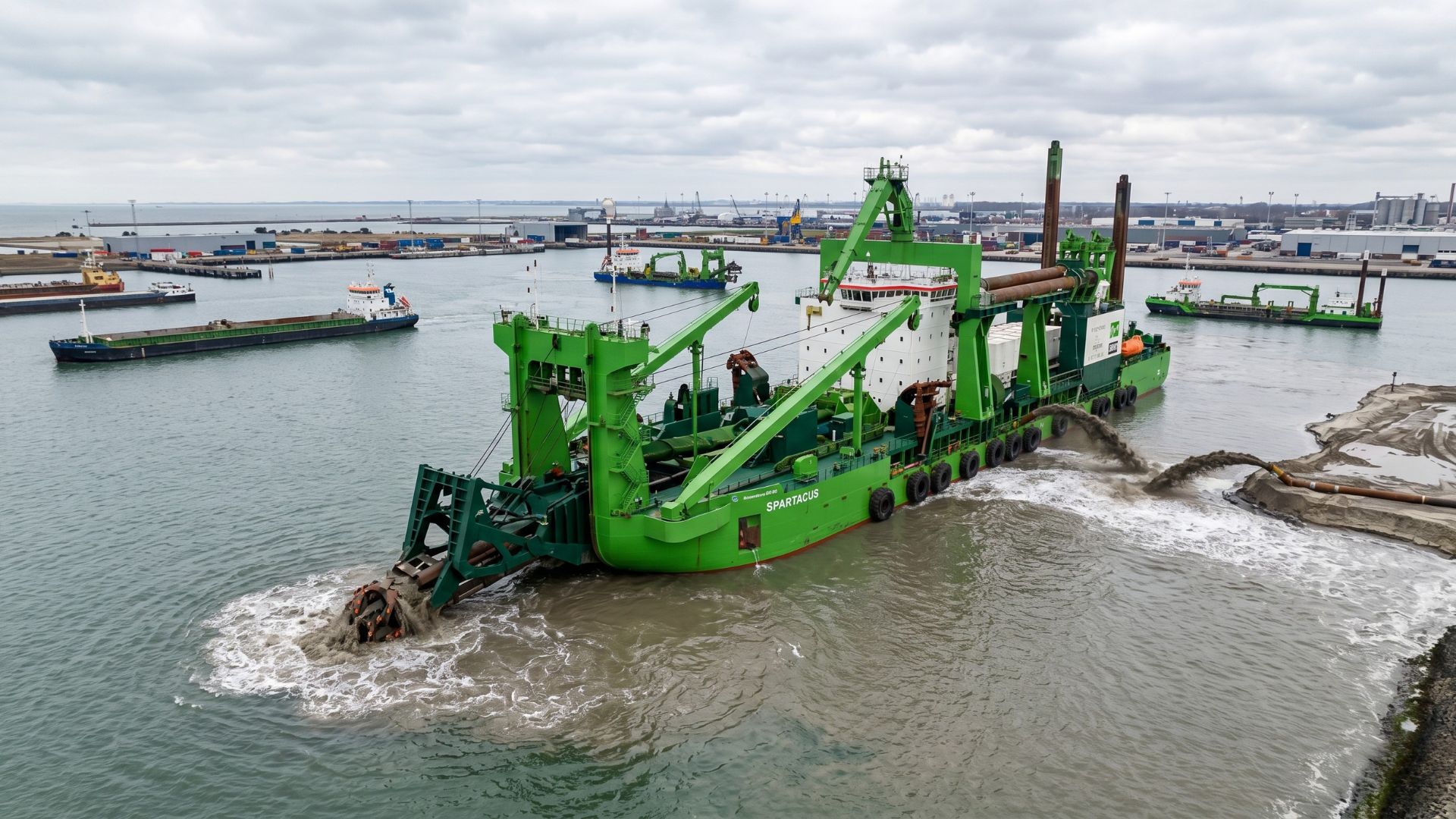

Spartacus is the largest and most powerful suction and cutter dredger in the world, with 164 meters, 44,180 kW of power, and the capacity to operate at 45 meters depth.
When most people think of large vessels, they usually imagine container ships, oil tankers, or cruise ships. But there is a category of ship capable of literally reshaping the geography of the planet. These are dredgers, vessels responsible for deepening channels, building ports, creating artificial islands, and removing millions of tons of sediment from the seabed. Among all of them, one vessel stands out impressively. Named Spartacus, the dredger built by the Dutch company Royal IHC for the Belgian company DEME is considered the largest and most powerful suction and cutter dredger ever built.
With 164 meters in length, installed power of 44,180 kW, and the capacity to excavate extremely hard soils up to 45 meters deep, it has set a new standard for global maritime engineering.
Spartacus was created to perform tasks that previously required explosives and multiple vessels
The main goal of Spartacus was to drastically expand the capacity of traditional dredgers. According to Royal IHC, the vessel was designed to cut through much more resistant soils than those typically encountered by conventional dredgers.
-
Orphaned Youth Turns Dismissed Idea into Global Prestige with Innovative Wristwatch

-
English Skills Boost Career Opportunities in the Oil and Gas Industry

-
Brazil Secures Second Place at WorldSkills 2024 in Lyon, with 64 Young Professionals and 8 Medals, Including Gold from a Rio de Janeiro Hairdresser

-
3,000 Military Personnel from 10 Countries, Including US and Chinese Marines, Train Together in Brazil’s Savanna: Operation Formosa Becomes Largest Naval Ground Exercise Before First Cancellation Since 1988



The extraordinary power allows work in geological formations that previously required more complex techniques, including drilling and controlled detonation in certain maritime infrastructure projects.
This capability is particularly important in port expansion works, deepening of navigation channels, and installation of offshore structures, sectors that increasingly require excavations in challenging environments.
The result is a vessel capable of taking on projects that previously had to be divided among various specialized machines.
164 meters in length and 44,180 kW have transformed the vessel into a global reference
The numbers help to understand why Spartacus draws so much attention. The vessel is 164 meters long, approximately equivalent to a building of more than 50 floors lying on the water. Its installed power reaches 44,180 kW, making it officially the most powerful cutter suction dredger ever built.
For comparison, the total power exceeds that of many large commercial ships and is enough to power a medium-sized city.
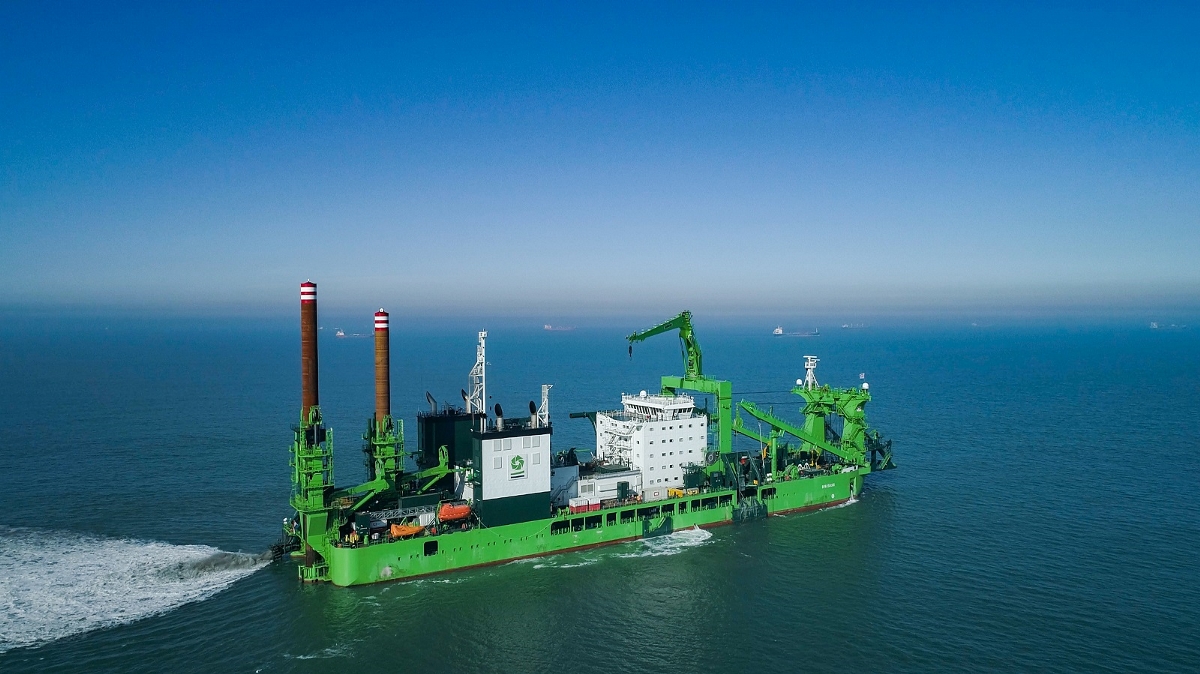
This energy is used to move dredging systems, suction pumps, hydraulic systems, propulsion, and the gigantic cutter head installed at the end of the main structure.
Royal IHC describes the vessel as a true “smart mega cutter”, a term used to highlight the combination of brute force, automation, and operational efficiency.
The cutter head works like a giant excavator working on the seabed
The most impressive component of Spartacus is its cutting system. At the end of the so-called cutter ladder, there is a huge rotating head equipped to fragment compacted sediments, hardened clay, and other resistant materials found on the seabed.
After cutting, the material is immediately sucked through pipes and transported for disposal or reuse.

The vessel has the heaviest cutter ladder ever built for a dredger of this type, allowing it to work at depths that were previously beyond the reach of most equipment available on the market.
According to the technical data released by Royal IHC, the maximum operational depth reaches 45 meters, about 10 meters beyond the limit normally found in dredgers of this category.
First cutter suction dredger in the world powered by liquefied natural gas
Besides its power, the Spartacus also made history for another reason. It was designed as the world’s first cutter suction dredger capable of operating using LNG (liquefied natural gas).
The four main engines can run on LNG, marine diesel oil, or heavy fuel oil, while the auxiliary engines use dual fuel technology.
The adoption of LNG was a strategic decision by DEME to reduce emissions and increase the environmental efficiency of the fleet. According to Royal IHC, the combination of cleaner fuel and energy recovery systems allows for a reduction in CO2 emissions by approximately 30% compared to conventional solutions.
The ship also uses heat recovery from exhaust gases and reuses the thermal energy associated with the cryogenic storage of LNG.
Ports, channels, and offshore projects depend on machines like the Spartacus
The work carried out by vessels of this type rarely makes headlines, but it is essential for the functioning of global trade.
Many of the world’s largest ports depend on constant dredging to allow the entry of increasingly larger ships.
Navigation channels need to be deepened, coastal areas need to be reclaimed, and offshore energy projects often require seabed preparation before the installation of structures.
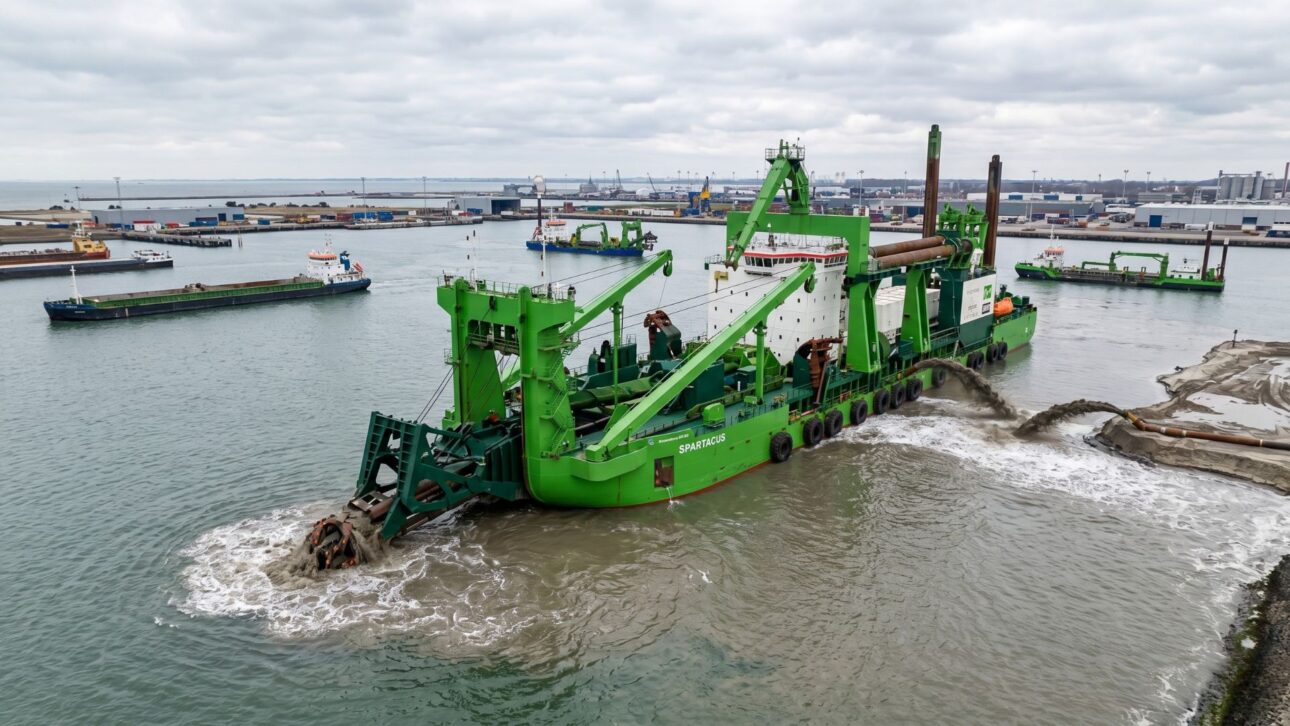
Machines like the Spartacus are used precisely in these scenarios, where gigantic volumes of material need to be removed or repositioned quickly and accurately.
Therefore, even though it operates away from the spotlight, the vessel indirectly participates in the expansion of ports, logistical corridors, energy terminals, and coastal works in different regions of the planet.
An oceanic excavator capable of reshaping continents
Few vessels represent the human capacity to alter landscapes as well as the Spartacus.
With a length of 164 meters, an installed power of 44,180 kW, an operational depth of 45 meters, and LNG-powered technology, it has become the largest and most powerful cutter suction dredger ever built.
While cargo ships transport goods and passenger ships transport people, Spartacus does something even more unusual: it modifies the very terrain on which maritime infrastructure will be built.
And it is precisely for this reason that many engineers see it not just as a vessel, but as one of the most impressive ocean engineering machines ever put into operation.