Portuguese
  Spanish


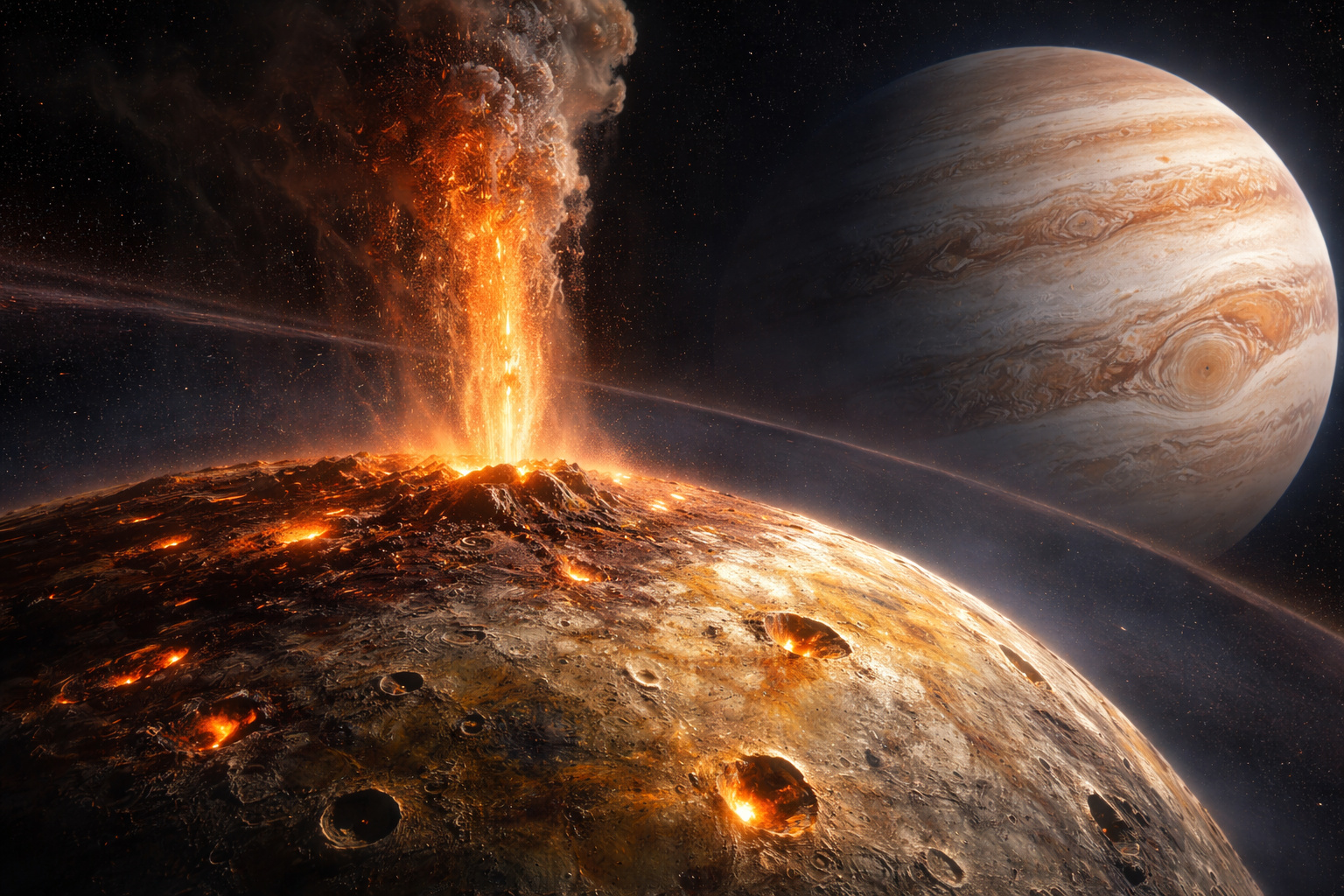


Io, moon of Jupiter, has more than 400 active volcanoes, jets of up to 400 km, and creates a plasma ring that alters the entire environment of the giant planet.
In 2024 and 2025, new observations from NASA and analyses based on data from the Juno and Galileo missions reinforced an impressive scientific consensus: Io, one of Jupiter’s moons, is the most volcanic body in the entire Solar System. Located about 421 thousand kilometers from the giant planet, this relatively small moon — with a diameter of approximately 3,643 km — exhibits geological activity so extreme that it surpasses any known volcanic phenomenon on Earth.
With more than 400 confirmed active volcanoes, constant eruptions, and jets of material that can exceed 400 kilometers in height, Io not only transforms its own surface but also directly influences the spatial environment around Jupiter. The material ejected by its volcanoes feeds a gigantic plasma ring that envelops the planet and can reach temperatures close to 100,000°C, according to data released by NASA.
Io, moon of Jupiter, extreme volcanic activity and numbers that challenge Earth
Io is often described as a world in permanent eruption. Unlike Earth, where volcanism is associated with tectonic plates, the activity on Io is driven by a completely different mechanism: tidal heating.
-
Brazilian Students Convert Seized Illegal TV Boxes into Linux-Powered Mini Computers for Schools and Social Projects Across São Paulo

-
Brazilian Engineer Develops Affordable Custom 3D-Printed Prosthetics for Children and Teens, Operated by Elbow or Wrist Movement Without Batteries

-
China Left 51 Rocket Bodies in Low Earth Orbit Between 2021 and 2025, Doubling Previous Period, Report Warns of Space Debris Threatening Satellites for Decades
-
Brazilian Researcher Uses Low-Cost Sensors to Measure Cyclists’ Pollution Exposure in São Paulo







The intense gravity of Jupiter, combined with the orbital influence of other moons like Europa and Ganymede, creates tidal forces that continuously compress and expand Io’s interior. This process generates enough heat to melt rocks and fuel a global volcanic system.
The result is an unprecedented level of geological activity, with hundreds of active volcanoes simultaneously, many of them releasing lava at temperatures exceeding 1,200°C.
This extreme heat makes Io one of the most energetically active bodies in the Solar System, surpassing in intensity any volcanic activity on Earth.
Lava jets exceed 400 km and constantly reshape the surface
One of the most impressive phenomena observed on Io are the so-called “plumes.” These eruptions launch material to altitudes that can exceed 400 kilometers, far above most known eruptions on Earth.
These plumes are primarily composed of sulfur dioxide and lava particles, which spread across the surface upon returning. This process creates colorful deposits that range from shades of yellow, red, black, and white, giving Io a unique appearance.

The surface of the moon is constantly renewed. Impact craters, common on other celestial bodies, are rare on Io because volcanic activity quickly covers any marks left by collisions.
This makes Io’s surface one of the youngest in the Solar System in geological terms, despite the moon’s age being similar to that of other satellites.
Io’s plasma ring envelops Jupiter and reaches extreme temperatures
Io’s influence is not limited to its surface. The material ejected by the volcanoes is captured by Jupiter’s magnetic field, forming what is called Io’s plasma torus.
This ring is composed of ionized particles that orbit the planet at high speeds, creating an extremely energetic environment. According to data from NASA, this plasma can reach temperatures close to 100,000°C, making it one of the hottest regions in the Solar System in terms of energetic particles.

Io effectively acts as a continuous source of material that feeds this system, directly influencing Jupiter’s magnetosphere.
This process is also related to the formation of the planet’s auroras, which are some of the most intense ever observed in the Solar System.
Jupiter’s gravity acts as an internal engine for volcanic activity
The engine behind all this activity is known as tidal heating. As Io orbits Jupiter, its slightly elliptical orbit causes the moon to be constantly deformed by the planet’s gravity.
This deformation generates internal friction, producing enough heat to maintain large volumes of magma within the moon.
This mechanism transforms Io into an extreme example of how gravitational forces can generate intense geological activity, even in relatively small bodies.
The gravitational interaction with Europa and Ganymede keeps this dynamic active, preventing Io’s orbit from becoming circular and interrupting the process.
Chemical composition and sulfur-dominated atmosphere
Intense volcanic activity also defines the composition of Io’s atmosphere, which is extremely thin and composed mainly of sulfur dioxide.
The eruptions release large amounts of this gas, which can condense and freeze on the surface or escape into space, contributing to the plasma torus.
Moreover, sulfur compounds are responsible for the vibrant colors of the moon, which range from bright yellow to dark shades.
Io redefines the limits of geology beyond Earth
The study of Io has important implications for understanding geological processes on other celestial bodies. The moon demonstrates that internal activity does not solely depend on residual heat from planetary formation or radioactive decay.
Gravitational forces may be sufficient to keep a body geologically active for billions of years, broadening the range of possibilities for other worlds.
This understanding directly influences the search for geological activity on moons and planets outside the Solar System, where similar conditions may exist.
Recent observations expand knowledge of the Jupiter system
Mission such as Juno continue to provide detailed data about Jupiter and its moons, including Io. This data helps map volcanic activity, measure magnetic fields, and understand the interaction between the different components of the Jovian system.
The observations also allow for the identification of new eruptions and tracking changes on the surface over time, offering a dynamic view of a world in constant transformation.
A world in permanent eruption in the Solar System
Io represents an extreme within the Solar System: a body where volcanic activity is not episodic but constant. Its surface, atmosphere, and interaction with Jupiter form an interconnected system that challenges traditional models of planetary geology.
The combination of over 400 active volcanoes, gigantic jets, and a continuously fed plasma ring places Io in a unique category among known celestial bodies. The existence of Io raises questions about how many other extreme worlds may exist in the universe and to what extent similar processes may occur in distant planetary systems.