Portuguese
  Spanish


The banyan tree of Munger, in Bihar, was dated to about 700 years by Indian researchers using radiocarbon, debunking the hypothesis that it was planted alongside the Burra Bunglow and indicating that the tree probably existed before the region’s historic building.
The banyan tree of Munger, in the state of Bihar, India, surprised researchers by revealing an estimated age of about 700 years. The study showed that the tree was probably not planted alongside the Burra Bunglow, as was believed, but existed before the historic building.
The information was released by the Ministry of Science and Technology of India on July 3, 2026, through PIB Delhi. The research was conducted by specialists from the Birbal Sahni Institute of Palaeosciences, in Lucknow, and published in the scientific journal Quaternary Research.
Scientific dating changed the reading of the tree

The discovery drew attention because the age of the banyan tree was estimated based on scientific evidence, not oral tradition, uncertain historical record, or local interpretation. The team used radiocarbon dating to arrive at a robust estimate.
-
The eyes seem to follow every movement of the observer, but the true story of the Ain Ghazal Statues reveals an artistic knowledge far ahead of what was imagined for the time.

-
A civil engineer returned to her parents’ property in Espírito Santo, found 400 cacao trees, made mistakes with the first chocolates, spent two years adjusting harvest, pruning, fermentation, and drying, and transformed the small family farm into an artisanal chocolate brand with agritourism.

-
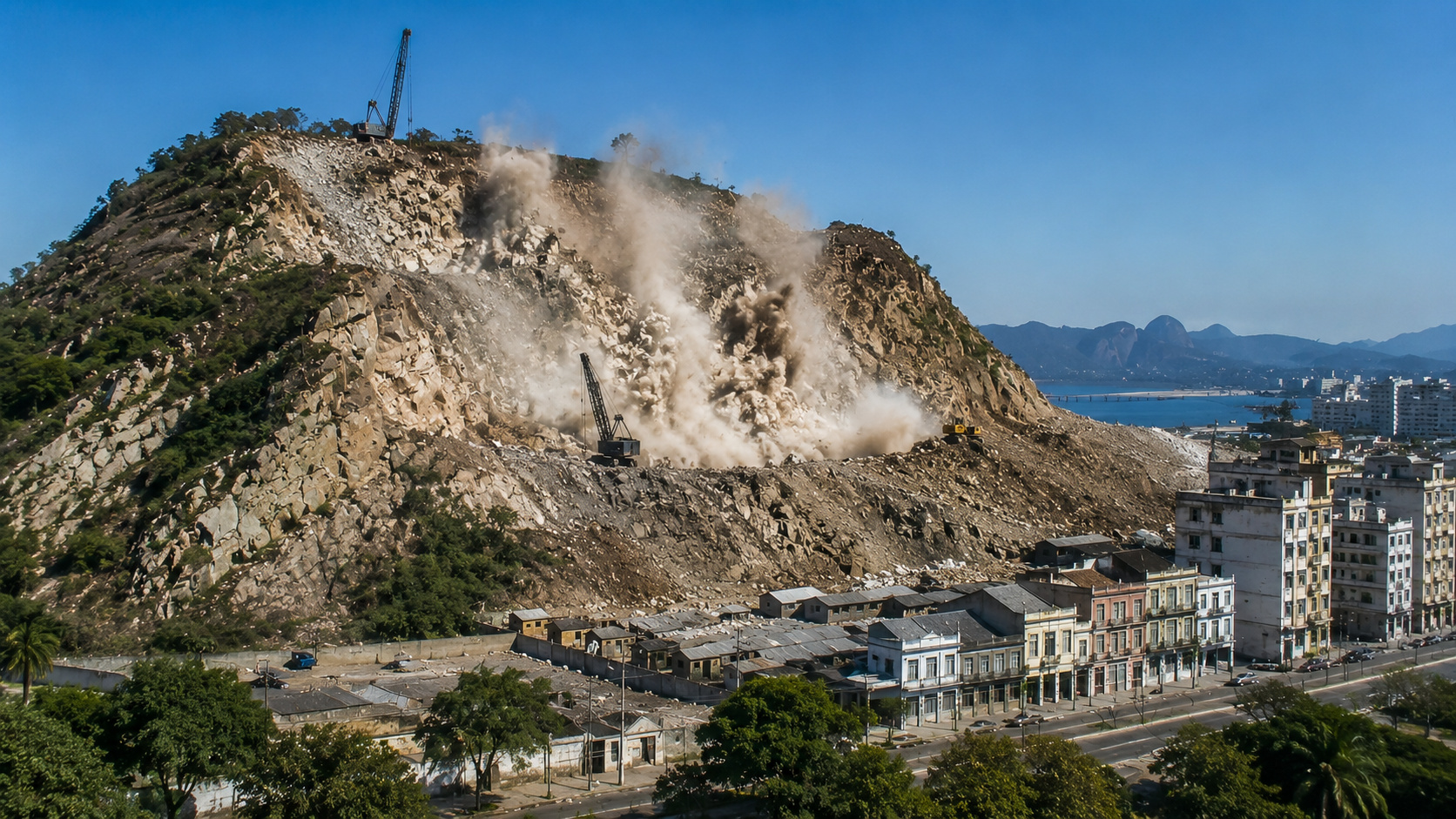
A Brazilian city removed material from a hill, dumped tons of earth over Guanabara Bay, and created 1.2 million m² where there was once water; decades later, the new territory turned into gardens, expressways, sports areas, museums, and a meeting point for thousands of residents.
-
Man knocks down wall during renovation of century-old house and finds letter sent from Ireland, hidden for almost 100 years, with thanks for a gift and news of a family.



This point is important because many ancient trees in India have social and cultural value, but do not always have proven age. In the case of Munger, science began to reorganize the very historical narrative of the landscape.
Tree may be about 700 years old
According to the statement, the tree in Munger was identified as the oldest precisely dated banyan tree ever found. The estimate of about 700 years was obtained by a high-precision laboratory method.
The result placed the tree in a timeline prior to the Burra Bunglow, a historic building associated with the end of the Mughal period and the beginning of the British period. This means that the tree likely witnessed the construction of the building, not the other way around.
Hypothesis about the Burra Bunglow was revised
Before the research, there was an assumption that the banyan tree of Munger had been planted in front of the Burra Bunglow. The site was associated with meetings between rulers and citizens, village assemblies, religious ceremonies, and cultural exchanges.
The new analysis, however, refuted this reading. If the tree is approximately 700 years old and the building is estimated to be about 300 to 350 years old, the order of events changes. The tree ceases to be a complement to the building and becomes a prior presence in the landscape.
Remnant of a natural forest
The research indicates that the banyan tree is likely a remnant of a natural forest that once existed in the Munger region. This interpretation broadens the significance of the tree, which ceases to be just an ornamental landmark in front of a historic building.
In this new context, it comes to represent an older landscape, possibly predating the urban and architectural transformations of the surroundings. The tree becomes a living clue about how the region was before the occupation recorded at the Burra Bunglow.
Researchers faced a technical challenge
The investigation began when Dr. Trina Bose, from the Birbal Sahni Institute of Palaeosciences, was invited by the Bihar Forest Department to determine the age of the tree. She recognized that conventional dating methods had limitations for tropical species.
The problem is that many broadleaf tropical trees do not have distinct annual growth rings, which complicates the application of traditional dendrochronology. Therefore, the team needed to develop an alternative approach to estimate the age of the banyan tree with greater accuracy.
Radiocarbon helped solve the age

The team, led by Dr. Bose and composed of Dr. Mayank Shekhar and Dr. Akhilesh K. Yadava, collected wood samples close to the pith of a secondary trunk and an old primary branch. The pith is relevant because it holds material associated with the initial phases of growth.
Then, the researchers extracted alpha-cellulose, a stable component of plant cell walls. The samples underwent high-precision radiocarbon dating using Accelerator Mass Spectrometry. This technical set allowed for a more reliable age estimate.
Method used modern calibration
In addition to radiocarbon dating, the team applied calibration with the IntCal20 curve and the OxCal software. These resources help transform laboratory results into more consistent chronological estimates.
The combination of collection, cellulose extraction, AMS analysis, and calibration strengthened the study’s conclusion. Instead of relying on stories passed down over time, the age of the banyan tree is now supported by scientific protocol.
Ancient trees have cultural value in India
Banyan trees play a significant role in the social and cultural life of India. Their extensive branches and root networks create shaded areas, meeting points, and habitats for birds, insects, and other forms of life.
Over the centuries, this type of tree has also become a symbol of permanence and community. In the case of Munger, the new dating reinforces that ancient specimens are not just natural elements: they also hold cultural, ecological, and historical memory.
Discovery helps governments and conservation
The research published in Quaternary Research provides a method that can help governments, forest departments, and conservation agencies identify historical trees with greater accuracy. This is especially important when preservation decisions depend on age, rarity, and cultural value.
With a more reliable methodology, ancient trees can cease to be evaluated solely by appearance, tradition, or local accounts. Conservation gains strength when natural heritage is protected based on scientific evidence.
Technique can reach other tropical trees
The study is not limited to the banyan tree of Munger. According to the statement, the methodology can be applied to other ancient tropical trees in different regions of the world, especially where the absence of clear rings makes traditional dating difficult.
This paves the way for new discoveries about biodiversity, historical landscapes, and environmental changes. In tropical regions, many ancient trees may still have underestimated ages due to a lack of appropriate methods. The research creates a tool to reveal hidden stories in living trunks.
Natural heritage gains a new historical layer
The identification of the age of the banyan tree redefines the relationship between tree, building, and territory. What was once seen as a tree planted to accompany the Burra Bungalow now appears as something older, linked to the natural forest that existed in the area.
This change alters the symbolic weight of the location. The tree is not just a backdrop to a historical building; it may be a survivor of a previous landscape, spanning centuries of transformation in Bihar. The natural heritage now directly dialogues with the constructed history.
Living tree changes the order of events
The banyan tree of Munger gained prominence because science showed that a tree can hold a history older than human constructions around it. The discovery indicates that the Burra Bungalow emerged in a landscape where the tree was likely already established.
This case also raises an important question: how many ancient trees are still treated as mere parts of the landscape, without their real age being known? Do you think governments should map and protect more historical trees with scientific methods? Share your opinion.