






 Portuguese
  Spanish
  3 min of reading
  0 comments


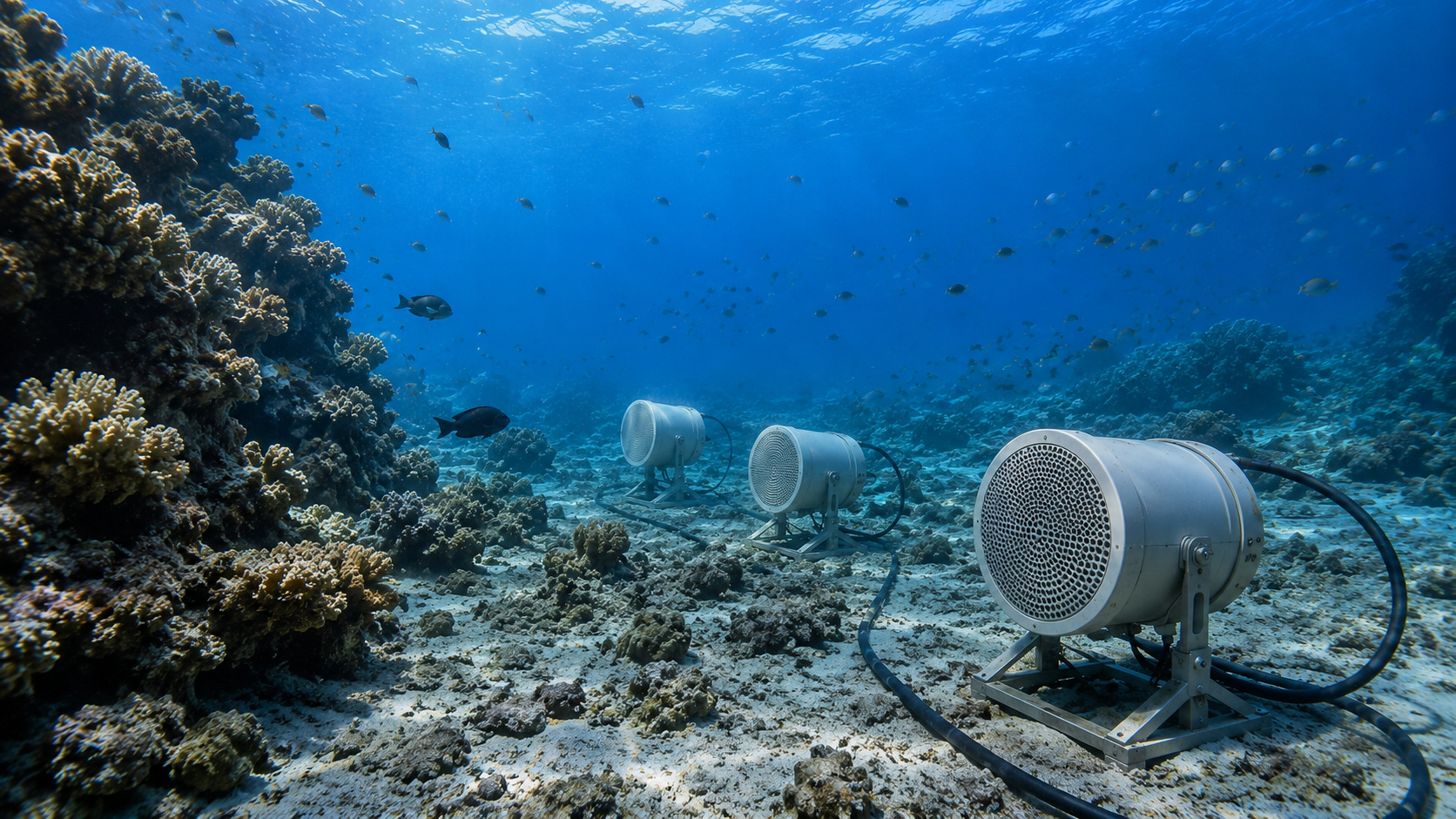
Technique developed by researchers uses underwater loudspeakers installed on the ocean floor to reproduce the natural sounds of healthy reefs, attract young fish, stimulate the recolonization of marine species, and try to accelerate the recovery of degraded areas that have lost biodiversity over recent years
A curious strategy has begun to gain traction in marine science: researchers have started installing underwater loudspeakers on the ocean floor to help degraded coral reefs.
The technique uses recordings of healthy reefs, full of natural sounds, to make damaged areas more attractive to young fish and other marine organisms.
According to a study published in 2019 in the journal Nature Communications, the sound of the ocean acts as a natural guide for various species.
-
They wanted artificial intelligence, but they drained the water from a village in Mexico: the water consumption of data centers caused a hepatitis outbreak, and big tech companies Amazon, Microsoft, and Google were forced to halt billion-dollar projects.

-
System created to save lives in disasters turned ‘against’ Brazilians overnight: a hacker attack sent out a false alert from Civil Defense with the word “misantropia” that went off on the phones of half the country, even in silent mode, and took down the Cell Broadcast.
-
In the cold desert of Ladakh, where it hardly rains, engineer Sonam Wangchuk created the ice stupa, a tower that freezes winter water and stores it for irrigating crops in the spring, a simple engineering feat that mimics nature.
-
For the first time in history, solar and wind energy generated more electricity than natural gas worldwide in a single month, April 2026, a milestone in the energy transition that shows renewable sources taking the lead in the global electric system.




Thus, when a reef loses life, it also loses part of its soundscape. As a result, the area becomes less attractive to animals seeking shelter, food, and safety.
Technology uses natural sounds to simulate healthy reefs
Underwater loudspeakers for coral reefs are equipment installed on the seabed to reproduce sounds from preserved environments.
In this way, they imitate the acoustic movement of a healthy reef, typically marked by the noises of fish, crustaceans, and other organisms.
As researchers observed, these sounds help marine animals identify suitable habitats for development.
Therefore, the technology does not reconstruct the coral on its own. However, it creates better conditions for the return of marine life to degraded areas.
How sound attracts young fish to degraded areas
In healthy reefs, the soundscape is usually rich, constant, and full of biological signals.
Therefore, young fish use these sounds as a reference when searching for safe locations.
When loudspeakers reproduce this acoustic environment, the degraded area begins to appear more alive.
In addition to the attraction effect, sound can stimulate the recolonization of marine species and increase biological activity in reefs.
Among the observed effects are:
- Attraction of young fish to affected regions
- Stimulation of the return of marine species
- Improvement of natural communication in ecosystems
- Increase in biological activity in reefs
Acoustic enrichment emerges as support for restoration
This technique is known as acoustic enrichment.
It uses natural sounds to reinforce recovery processes in ecosystems that have lost biodiversity over time.
According to research published in Nature Communications, the strategy proved promising when applied as a complement to other conservation actions.
Thus, the method can help accelerate the return of fish and strengthen the oceanic food chain.
Among the main benefits are:
- Increase in marine species diversity
- Faster recovery of degraded habitats
- Strengthening of the oceanic food chain
- Stimulation of marine organism reproduction

Can Speakers Save Coral Reefs?
Despite positive results, **underwater speakers** do not represent a single solution to save coral reefs.
The technique works best when combined with measures against pollution, environmental degradation, and climate change.
Still, tests show that sound can accelerate the return of marine life to affected areas.
In this way, the combination of technology and nature opens up a new possibility for researchers seeking to restore threatened ecosystems.
What this discovery shows about the future of the oceans
The experiment reveals that coral reefs do not depend solely on color, temperature, and physical structure.
They also depend on sound, movement, and interaction between species.
Therefore, the installation of loudspeakers on the ocean floor stands out for combining technological simplicity and ecological knowledge.
As reefs face increasing pressures, acoustic enrichment emerges as a supporting tool to bring life back to silent environments.
If the sound of a healthy reef can attract fish back, how far can this technology help in the recovery of the oceans?


-

1 person reacted to this.